


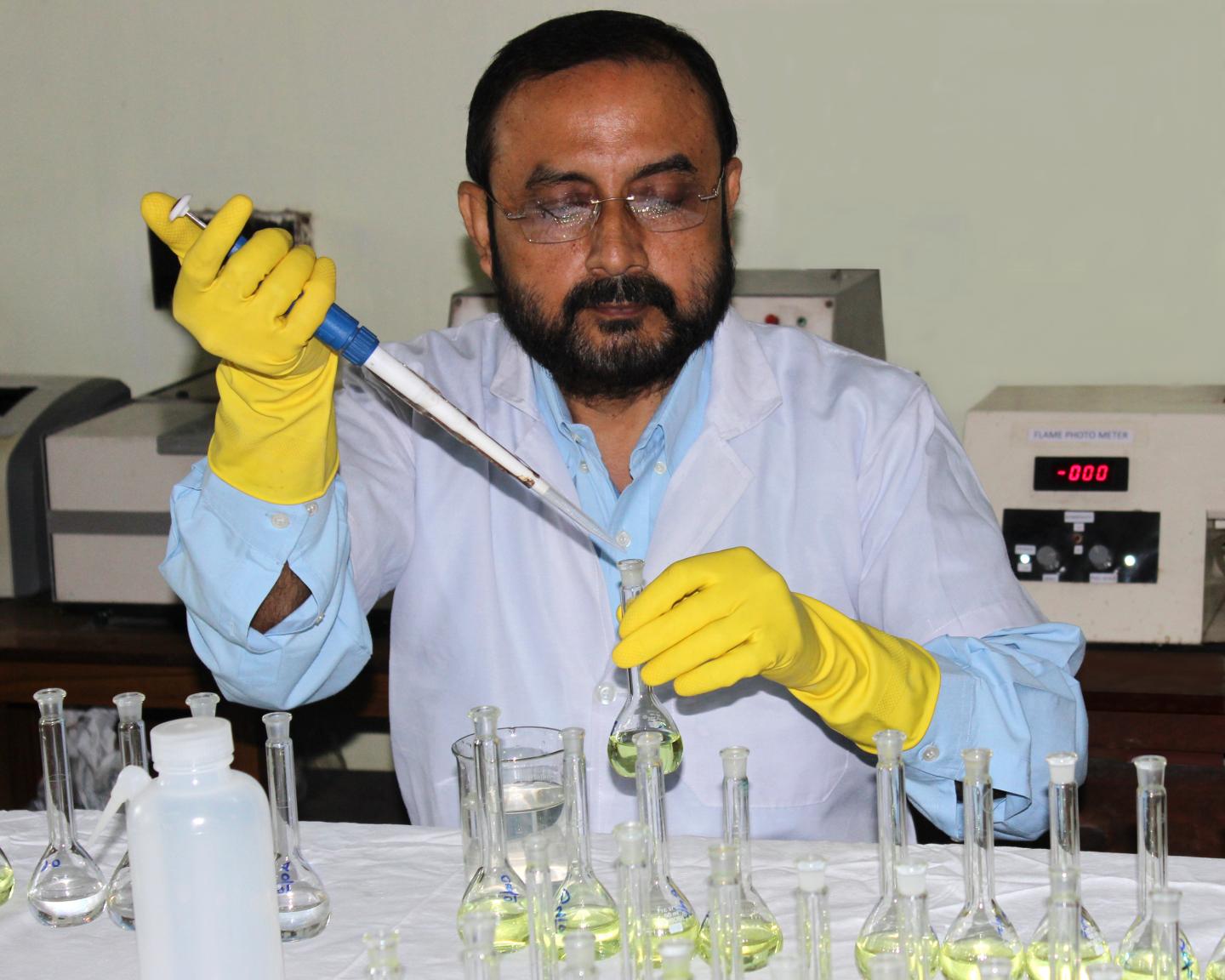
Credit: Abantika Debnath.
The Food and Agriculture Organization of the United Nations estimates that around 45 million tons of phosphorus fertilizers will be used around the world in 2018.
Much will be applied to soils that also received phosphorus fertilizers in past years.
According to a new study, much of that could be unnecessary.
"Previous application of phosphorus fertilizers increases the effectiveness of subsequent applications," says Jim Barrow, lead author of the study. Barrow is a scientist at the University of Western Australia.
He says better understanding soil phosphorus dynamics can have many benefits. It could lead to more judicious use of phosphorus fertilizers. "At a world level, phosphorus is a limited resource. We need to use it wisely."
At a local level, excessive use of phosphorus fertilizers can pollute water. And at the farm level, purchasing phosphorus fertilizers is a major expense for farmers. "If farmers use only as much as is required, it will help the environment," Barrow states. "It will also save them money."
When phosphorus fertilizers are applied to soils, only a fraction is taken up by plants. That's because most of the phosphorus is stuck on soil grains; only a small proportion is in solution. "When the portion in solution is high, plants can get phosphorus quickly from the soil," says Barrow. "Low fertilizer application rates are sufficient."
Phosphate, the compound used in fertilizers, can react with and penetrate soil particles. Barrow points out that when this happens, it's "scarcely available to plants. This is a major reason why farmers have to reapply phosphorus fertilizers."
But this has its upside. "When phosphate penetrates soil particles, it makes the soil particles more negatively charged," Barrow explains. Since similar charges repel each other, negatively charged soil particles repel the negatively charged phosphate. That means there is more in solution. Plants get it faster, and therefore need less fertilizer.
Barrow and colleagues explored whether phosphate would continue to penetrate soil particles at the same rate over time. They reasoned that the rate would decrease as the negative charge built up.
They showed that when a lot of phosphorus has been applied over time the penetration of phosphate slows down and ultimately stops. "When this happens, you only need to replace phosphate used (and removed in produce) in the previous year," says Barrow.
It's similar to repairing a gravel road. The potholes and other gaps need to be filled first before a smooth, functional top layer is applied.
Barrow worked with colleagues at Bidhan Chandra Agricultural University in West Bengal, India. They used soil from a site about 65 miles west of the city of Kolkata, India. To mimic phosphorus application over time, the researchers applied phosphorus and then kept the soil at 140°F (60°C) for more than a month.
"It is quite slow at ordinary temperatures," says Barrow. "This way we don't have to wait around for years before we can do an experiment."
The findings can help farmers use phosphorus fertilizers more efficiently. Farmers could also save money. "But these findings need to be conveyed to farmers," says Barrow. "The effectiveness of the soluble phosphate fertilizers has been grossly underestimated."
###
Read more in Soil Science Society of America Journal. Barrow worked with colleagues Abhijit Debnath, Arup Sen, and students at Bidhan Chandra Agricultural University in West Bengal, India.
Media Contact
Susan Fisk
[email protected]
608-273-8091
@ASA_CSSA_SSSA
http://www.agronomy.org
Related Journal Article
http://dx.doi.org/10.2136/sssaj2018.03.0115

