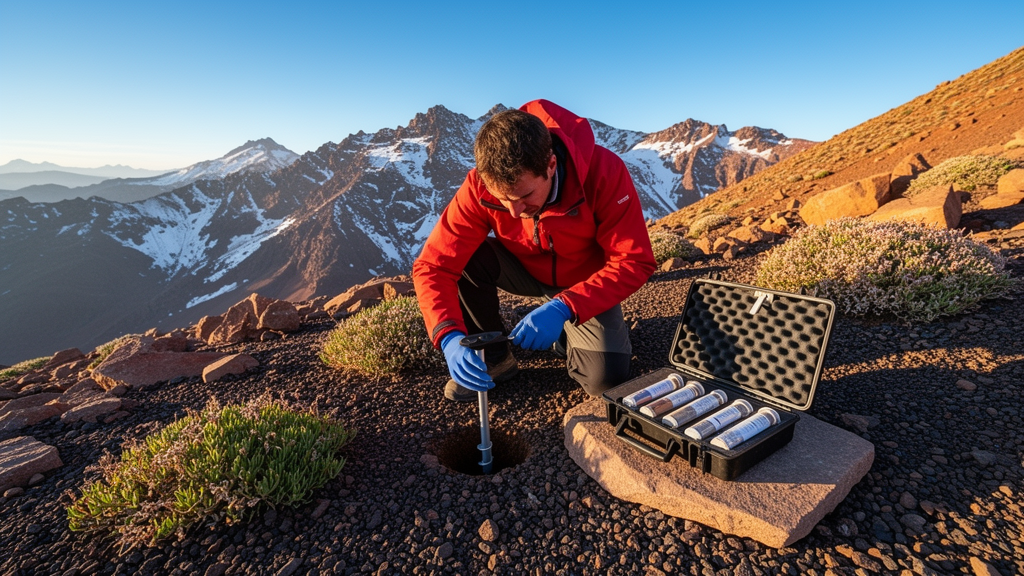
Researchers have reported the first comprehensive survey of soil bacterial and fungal communities on Mount Toubkal, North Africa’s highest peak, covering an elevational gradient from 500 to 4,165 meters in Morocco. The study, published open access in the journal Microbial Ecology on 27 October 2026 as a peer-reviewed accepted manuscript, combined next-generation sequencing of 16S rRNA and ITS1 markers with measurements of soil physicochemical properties and enzyme activity across nine sampled elevation-sites.
The central finding is a divergence in how the two groups of microbes vary with altitude. Bacterial alpha diversity remained comparatively stable along the transect, whereas fungal richness decreased toward higher elevations. A site-level analysis confirmed a negative association between fungal richness and elevation, with a Spearman correlation of rho = -0.70 (P = 0.036, n = 9). Fungal richness and Shannon diversity were both positively associated with soil organic matter at the site level (rho = 0.83, P = 0.005, and rho = 0.77, P = 0.016, respectively), while bacterial richness was associated with available phosphorus, pH, and phosphatase activity.
Community composition also differed among the sampled elevation-sites. Actinobacteriota was the dominant bacterial phylum throughout the transect, while Ascomycota dominated fungal communities at most sites. One notable exception occurred at 3,500 meters, where Chytridiomycota became the dominant fungal group. The authors note that the observed compositional differences among sites reflected both community-centroid and dispersion differences, a methodological caveat that matters when interpreting beta-diversity patterns.
Compositional turnover along the transect was further indicated by increasing community dissimilarity with absolute elevation difference between sites. Overall, microbial diversity and composition were associated with variation in soil organic matter, available phosphorus, and pH along the sampled gradient. These soil variables, rather than elevation alone, appear to track the observed microbial patterns, although the study’s site-level correlations are based on a small number of sampling locations and describe associations rather than causal effects.
High-mountain ecosystems are widely described as sentinels of global environmental change, and the authors position this dataset as the first soil-microbiome baseline for Mount Toubkal. Because the soil microbial communities of North Africa’s highest peak had not previously been explored, the work expands current knowledge of microbial biogeography in North African mountain ecosystems and provides a reference point for future monitoring. The published version is subject to further editorial edits before the final Version of Record replaces the accepted manuscript.
Subject of Research: Soil bacterial and fungal communities along an elevational gradient on Mount Toubkal, Morocco
Article Title: Elevation-Associated Patterns of Soil Bacterial and Fungal Communities Along Mount Toubkal, North Africa’s Highest Mountain
Article References: Idbella, M., Abelouah, M. R., Benmrid, B., Ibnyasser, A., Idbella, A., Nouj, N., Haddine, M., Hazzoumi, Z., Bargaz, A., & Bonanomi, G. (2026). Elevation-Associated Patterns of Soil Bacterial and Fungal Communities Along Mount Toubkal, North Africa’s Highest Mountain. Microbial Ecology. https://doi.org/10.1007/s00248-026-02921-0
Image Credits: AI Generated
DOI: 10.1007/s00248-026-02921-0
Keywords: Mount Toubkal, soil microbiome, elevation gradient, bacterial diversity, fungal diversity, 16S rRNA, ITS1, soil organic matter, Morocco, microbial biogeography, Actinobacteriota, Ascomycota
News Source: Morgan Morrow. (October 27, 2026). Soil Microbes Mapped Along Morocco’s Mount Toubkal for the First Time. Scienmag.