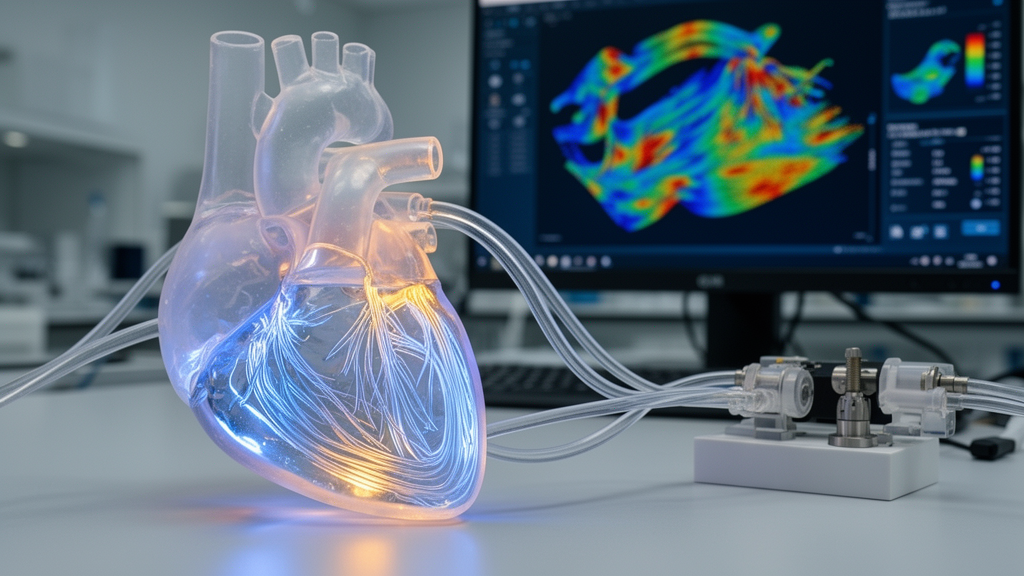
Researchers have developed a multimodal framework combining a soft robotic benchtop simulator and a lumped parameter computational model to replicate left atrial function in sinus rhythm and atrial fibrillation. The platform addresses major clinical challenges in managing atrial fibrillation, where the intricate geometry of the left atrial appendage complicates planning personalized interventions designed for stroke prevention.
Current research and procedural planning have relied heavily on animal subjects and cadavers, which raises reproducibility concerns and highlights the need for physiologically relevant, high-fidelity tools. To address these limitations, the benchtop simulator incorporates patient-specific geometries alongside soft robotic actuators, allowing the physical system to reproduce realistic wall motion and hemodynamics.
Operating alongside the physical simulator, a complementary lumped parameter computational model delivers mechanistic insights into cardiac performance. This computational framework quantifies systemic hemodynamic shifts that occur throughout the progression of arrhythmia disorders and during therapeutic interventions.
Validation against human imaging data and porcine models demonstrated that the models effectively replicate clinical markers of atrial dysfunction and arrhythmia disorders. The authors report that this scalable, versatile experimental and computational framework advances cardiovascular biomechanics, enabling device development, clinical research, procedural training, and personalized treatment to improve patient outcomes.
By combining patient-specific geometries with soft robotic actuation, the benchtop simulator establishes a high-fidelity, physiologically relevant experimental platform designed to overcome the reproducibility concerns associated with conventional cadaveric and animal models. The physical simulator reproduces realistic left atrial wall motion and hemodynamics under conditions of both normal sinus rhythm and atrial fibrillation. This mechanical replication directly addresses the challenges presented by the intricate geometry of the left atrial appendage, an anatomical region where complex structural variations have complicated the planning and execution of personalized stroke prevention interventions. Integrating soft robotic actuators with patient geometries allows the system to closely emulate dynamic wall behavior and realistic cardiac flow.
Working in tandem with the physical simulator, the complementary lumped parameter computational model provides mechanistic insights into cardiovascular function by quantifying systemic hemodynamic changes. While the soft robotic system physically replicates patient-specific wall movement and local hemodynamic conditions, the lumped parameter computational architecture models the broader circulatory alterations that take place during the progression of arrhythmia disorders and throughout targeted therapeutic interventions. This combined multimodal approach enables investigators to quantify hemodynamic shifts and evaluate clinical markers of atrial dysfunction across changing cardiac states within a unified, reproducible framework.
The performance and accuracy of the multimodal framework were demonstrated through validation against porcine experimental models and human clinical imaging data, confirming that the paired tools accurately capture clinical markers of atrial dysfunction and arrhythmia disorders. Reported in Nature Communications, the authors emphasize that this versatile and scalable experimental and computational framework advances cardiovascular biomechanics. By providing an integrated platform that replicates left atrial hemodynamics and wall motion, the system supports medical device development, clinical research, and procedural training, while offering tools for personalized atrial fibrillation treatment to help improve patient outcomes.
Subject of Research: Soft robotic and computational modeling of left atrial hemodynamics
Article Title: Soft robotic and computational models of left atrial hemodynamics in sinus rhythm and atrial fibrillation
Article References: Singh, M., Mendez, K., Ayers, B., Wang, S. X., Takahashi, A., Teodorescu, D. L., Mill, J., Albors, C., Escher, A., Fan, Y., Ozturk, C., Sheridan, E., Rutherford, E., Camara, O., Chakravarty, T., & Roche, E. T. (2026). Soft robotic and computational models of left atrial hemodynamics in sinus rhythm and atrial fibrillation. Nature Communications. https://doi.org/10.1038/s41467-026-79045-z
Image Credits: AI Generated
DOI: 10.1038/s41467-026-79045-z
Keywords: atrial fibrillation, left atrial appendage, soft robotics, computational modeling, cardiovascular biomechanics, hemodynamics, benchtop simulator, stroke prevention, Soft, robotic, computational, models
News Source: Ophelia Keating. (November 9, 2026). Soft Robotic and Computational Models Replicate Left Atrial Hemodynamics. Scienmag.