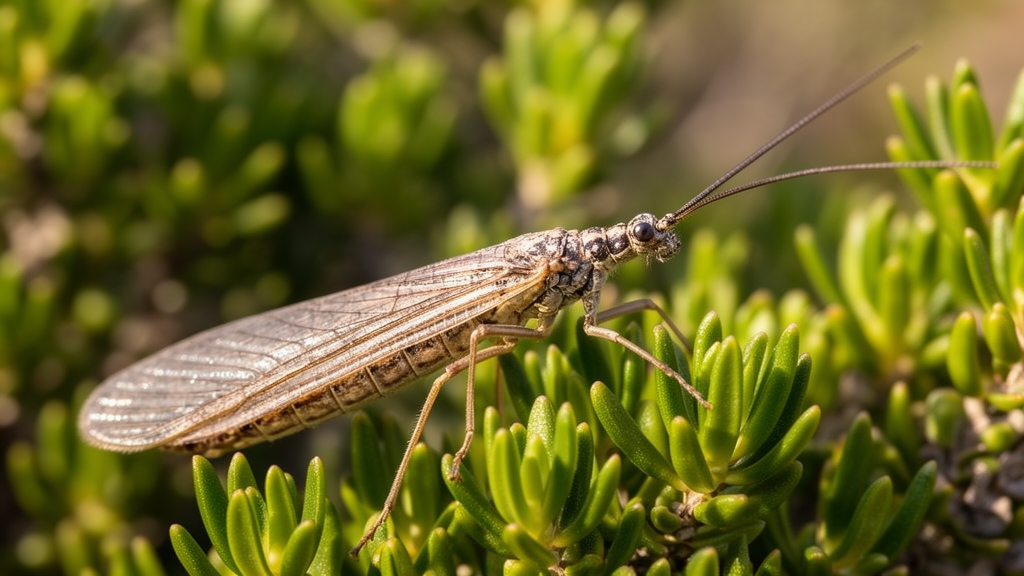
The Mediterranean islands harbor 33 species of snakeflies, an ancient and little-known order of insects whose living members are often described as relics of the age of dinosaurs, according to a comprehensive review published in Deutsche Entomologische Zeitschrift.
Snakeflies, the order Raphidioptera, are the smallest order of holometabolous insects, meaning those whose larvae undergo complete metamorphosis. Around 252 valid species are currently described worldwide, split between two families: Raphidiidae with about 206 species and Inocelliidae with 46. Although further species likely remain to be discovered, the authors consider it very unlikely that the global total exceeds 300. All snakeflies share an elongated prothorax that gives them a snakelike appearance, translucent wings with sparse venation and a pterostigma, and in females a conspicuous ovipositor. Most species require two years to develop, with at least one hibernation of the mature larva, and the larvae of most species live under tree bark or in soil and rock crevices, preying on soft-bodied arthropods.
Today the order is confined to arboreal parts of the Northern Hemisphere, because a drop in temperature during winter is a precondition for normal development. This restriction is itself the product of a dramatic history. In the Mesozoic, particularly the Cretaceous, snakeflies had their golden age, probably with thousands of species occurring even in tropical zones and the Southern Hemisphere. Then, about 66 million years ago, the asteroid impact at the end of the Cretaceous caused worldwide darkness and years of cooling, which probably drove the order close to extinction. At least two lines survived in the Northern Hemisphere, and their general appearance still largely resembles that of their Mesozoic forebears, which is why the extant Raphidioptera may justifiably be called living fossils.
The Mediterranean region is one of the hotspots of snakefly diversity. The sea itself contains more than 4,300 islands, most of them small and uninhabited, but several are large and mountainous, including Sicily with elevations above 3,300 meters, Sardinia above 1,800 meters, Corsica above 2,700 meters, Crete above 2,450 meters, and Cyprus above 1,950 meters. These high mountains carry large forests and thus offer excellent ecological conditions for snakeflies, which generally need forested habitats, preferably at higher altitudes.
The palaeogeographical history of the islands is remarkably varied, and this diversity is impressively reflected in their snakefly faunas. Sardinia and Corsica broke off from the Iberian landmass in the Oligocene, between 35 and 28 million years ago, and have never been connected to the mainland since, although they were repeatedly joined to each other during Pleistocene glacial periods. Crete emerged as an island when the Aegean Sea formed about 10 million years ago; parts of it were repeatedly flooded, but some land always remained above water, allowing the original fauna to persist. Rhodes was once part of Anatolia and separated possibly in the Pliocene. Cyprus derived from the Levantine mainland by a submarine break-off in the Miocene and drifted westward. By contrast, most islands near the mainland, such as those in the Adriatic, the Ionian Sea, and the northern Aegean, were connected to the continent during Pleistocene glacial periods, when sea level was up to 230 meters lower than today, permitting faunal exchange.
This history explains the distribution patterns the review documents. The Adriatic and Ionian islands of Krk, Hvar, Korfu, Levkas, and Kefalonia harbor only species that also occur on the adjacent Balkan mainland, such as Dichrostigma flavipes and Parvoraphidia microstigma. The same holds for the northern Aegean islands of Thasos and Samothraki and for the Sporades. The large island of Euboea, repeatedly connected to continental Greece during the Pleistocene, hosts at least six snakefly species, most of which also occur on the adjacent mainland. In the eastern Aegean, Lesbos, Chios, Samos, and Ikaria were regularly connected with the Anatolian mainland, and their faunas are correspondingly Anatolian in character, with each island inhabited by a different species of the subgenus Raphidia s.str.
Long isolation, by contrast, is the key precondition for the evolution of endemic species. Eleven snakefly species are endemic to one, or rarely a few, Mediterranean islands: Phaeostigma (Phaeostigma) euboica on Euboea; Phaeostigma (Aegeoraphidia) prophetica on Rhodes and Ph. (Ae.) karpathana on Karpathos; three species on Crete, Ph. (Ae.) biroi, Ph. (Superboraphidia) minois, and Raphidia (R.) ariadne; Subilla principiae on Sardinia; Subilla colossea on Rhodes; Raphidia (R.) peterressli on Chios; and the Inocelliids Fibla (F.) maclachlani on Corsica, Sardinia, and Sicily and Fibla (Reisserella) pasiphae on Crete. The endemic species of Rhodes, whose sister taxa occur in Anatolia, are clearly of Anatolian origin, while Fibla maclachlani is of Iberian origin and is regarded as a very old faunal element of the former Corsardinian landmass, whose ancestors were presumably carried into insular isolation when the land broke away from Iberia in the Oligocene.
Some cases remain genuine puzzles. The presence of the Inocelliid Fibla (Reisserella) pasiphae on Crete, whose closest relatives, the subgenus Fibla s.str., occur only in the Iberian Peninsula, Corsardinia, Sicily, and North Africa, is described by the authors as a total conundrum: palaeogeological evidence rules out a land bridge to North Africa, and transport of larvae by drifting wood from the western Mediterranean is considered extremely unlikely, so the question must for now remain open. Cyprus presents another instructive case. It is inhabited by only two snakefly species, Phaeostigma (Crassoraphidia) cyprica and Ulrike syriaca, both of which occur in the Levant and cannot be morphologically differentiated from Levantine individuals. Notably, none of the many snakefly species of southern Anatolia has been found on Cyprus, a strong argument that the island was never connected to Anatolia; the two species may have arrived in the Pleistocene or even the Holocene, possibly by human activity.
The review also confirms a biogeographical boundary in the Aegean. The botanist Karl Heinz Rechinger showed in his phytogeographical studies that a borderline separates the flora of the Cyclades from that of the East Aegean islands, dividing European from Asian elements; this boundary was later named Rechinger’s Line. The distribution of the snakeflies of the Aegean islands, the authors report, convincingly confirms this line. Another species with a remarkable history is Raphidia (R.) mediterranea, a Balkanopontomediterranean faunal element recorded on several Aegean islands and in Italy and even Central Europe, whose spread has been attributed mainly to anthropogenic dispersal, perhaps already in antiquity, a conclusion supported by comparative molecular studies of continental populations.
What remains to be discovered? The authors judge it rather unlikely that further island-endemic snakeflies are still to be found, with one notable exception: the Balearic Islands. No Raphidioptera have ever been recorded there, yet Mallorca, with mountains almost 1,500 meters high and large forests, separated from Iberia in the Oligocene like the Tyrrhenian islands, could plausibly harbor remnants of the old snakefly fauna, possibly undescribed species of the genera Ohmella and Fibla. The authors also flag potential conservation concerns: a few species confined to very small areas, including Ph. euboica and Ph. (Graecoraphidia) divina retsinata on Euboea, Ph. (S.) minois on Crete, and particularly Subilla principiae on Sardinia, known so far only from a small light forest of Quercus pubescens, could be eradicated if their habitats were destroyed. The authors hope the paper will serve as a basis for future phylogeographic studies of natural and anthropogenic dispersal of snakeflies between islands and mainlands.
Subject of Research: Biogeographical review of snakefly (Raphidioptera) diversity and endemism on Mediterranean islands
Article Title: The snakeflies of the Mediterranean islands: review and biogeographical analysis ( Neuropterida , Raphidioptera )
Article References: Aspöck, H., & Aspöck, U. (2023). The snakeflies of the Mediterranean islands: review and biogeographical analysis (Neuropterida, Raphidioptera). Deutsche Entomologische Zeitschrift, 70(1), 175-218. https://doi.org/10.3897/dez.70.101559
Image Credits: AI Generated
Keywords: snakeflies, Raphidioptera, Mediterranean islands, endemic species, biogeography, island colonization, Crete, Sardinia, Rechinger line, living fossils, Inocelliidae, Raphidiidae
News Source: Gavin Prescott. (October 27, 2026). Snakeflies: Living Fossils Reveal 33 Species Across Mediterranean Islands. Scienmag.