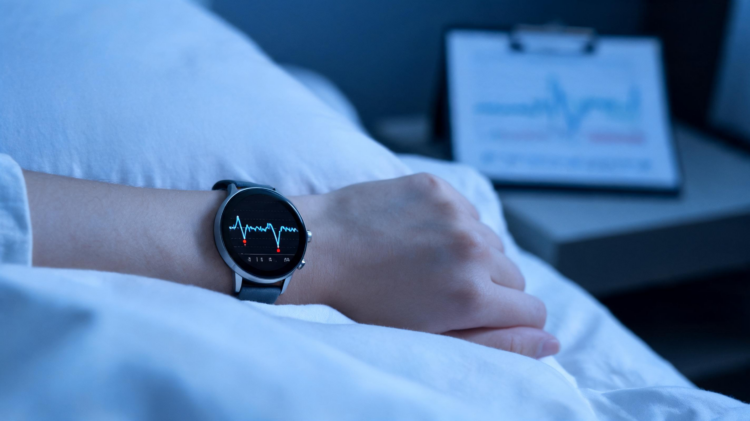
A consumer smartwatch has shown strong performance in identifying moderate-to-severe obstructive sleep apnea and distinguishing patients with a high physiological burden of nighttime oxygen loss, according to a prospective study published in the Journal of Clinical Sleep Medicine. Researchers evaluated the Samsung Galaxy Watch against overnight laboratory polysomnography, the clinical reference test for sleep-disordered breathing. The findings suggest that a device already worn by millions of people could help expand initial screening for a condition that often remains undetected. The watch was not evaluated as a replacement for formal diagnosis, but as a potentially scalable way to identify people who may need definitive testing and treatment.
Obstructive sleep apnea occurs when the upper airway repeatedly narrows or closes during sleep, interrupting airflow while respiratory effort continues. These episodes can reduce blood oxygen, fragment sleep and produce repeated physiological stress. The disorder is commonly assessed using the apnea-hypopnea index, or AHI, which represents the average number of apneas and hypopneas per hour of sleep. In the study, moderate-to-severe disease was defined as an AHI of at least 15 events per hour. Although AHI is widely used, it does not fully describe how deeply or how long oxygen levels fall during individual events. For that reason, the investigators also examined hypoxic burden, a measure intended to capture the cumulative impact of oxygen desaturations.
Hypoxic burden integrates the depth, duration and frequency of oxygen drops associated with sleep apnea. This approach can distinguish between two people with similar event counts but different physiological consequences: one may experience brief, shallow desaturations, while another undergoes longer or deeper declines in oxygenation. Previous research cited by the investigators has linked higher hypoxic burden more closely with cardiometabolic risk and disease severity than AHI alone. By testing the smartwatch against both measures, the study addressed a central challenge in wearable sleep technology: whether a consumer device can identify not only frequent breathing disturbances but also people whose disturbances place greater stress on the body.
The research enrolled 152 adults aged 22 years or older who either had a previous diagnosis of moderate-to-severe sleep apnea or had a high pre-test likelihood of the disorder, defined by a STOP-Bang questionnaire score of at least three. Participants wore the Galaxy Watch during two nights of in-laboratory polysomnography. The first laboratory night was followed by at least three nights of watch-only monitoring at home, and then a second laboratory night. In total, 147 participants completed both laboratory assessments, contributing 1,850 hours of in-lab sleep data. This design allowed the researchers to compare watch estimates with PSG measurements under controlled conditions while also examining performance during ordinary nights at home.
Polysomnography records multiple physiological signals, including brain activity, eye movements, muscle activity, heart rhythm, airflow, respiratory effort and blood oxygenation. It can therefore determine sleep stages and identify the timing and consequences of respiratory events in detail, but it requires specialized equipment, trained personnel and access to a sleep laboratory. Those requirements can make testing expensive, difficult to schedule or unavailable to people living far from specialist services. A smartwatch, by contrast, can collect signals during routine sleep with little disruption. The Galaxy Watch used in this study generated an estimated AHI, or eAHI, from wearable measurements, allowing researchers to compare a device-derived screening signal with PSG-derived disease categories.
For detecting moderate-to-severe sleep apnea, the Galaxy Watch achieved an area under the receiver operating characteristic curve of 0.94, with a 95 percent confidence interval from 0.889 to 0.980. The area under this curve summarizes how well a test separates people with and without a target condition across possible thresholds; a value of 1 represents perfect discrimination, whereas 0.5 represents performance no better than chance. At the device’s default eAHI threshold of 15, sensitivity was 94.1 percent, with a 95 percent confidence interval of 84.1 to 98 percent. Specificity was 66.7 percent, with a confidence interval from 51 to 79.4 percent. In practical terms, this threshold identified most participants meeting the PSG definition, while also producing some false-positive classifications.
The researchers also tested a threshold optimized for their study cohort. At an eAHI of 25.95, sensitivity was 82.4 percent, with a 95 percent confidence interval of 69.7 to 90.4 percent, while specificity rose to 94.9 percent, with a confidence interval from 83.1 to 98.6 percent. This shift illustrates the trade-off built into screening thresholds. A lower threshold can capture more people with disease but may refer more people who ultimately do not meet the diagnostic definition. A higher threshold can reduce false alarms but may miss some affected individuals. The best threshold depends on the intended use, the population being screened and how a positive result is followed up. The study’s results therefore demonstrate strong discrimination rather than establishing a universal threshold for clinical use.
The most striking result emerged when the investigators classified participants according to PSG-derived hypoxic burden. Within the group defined as having high-risk obstructive sleep apnea, the Galaxy Watch achieved 100 percent sensitivity and 100 percent specificity using the default eAHI threshold. In this analysis, the device separated the high- and low-risk hypoxic-burden categories without misclassification in the study cohort. Because the result came from a selected group undergoing evaluation for suspected or known disease, it should not be interpreted as proof that the watch will perform identically in the general population. Confidence intervals, population differences and variations in sleep patterns can affect diagnostic accuracy. Nevertheless, the finding supports further investigation of wearable screening based on physiologically meaningful risk measures rather than event counts alone.
The researchers describe the study as evidence that consumer-grade wearables could help triage people for definitive sleep testing, particularly where access to laboratory PSG is limited. A watch-based signal could encourage earlier referral, support large-scale population screening or help clinicians prioritize patients who appear to have more consequential oxygen disturbances. It could also enable repeated measurements across several nights, potentially capturing variability that a single night may miss. At the same time, the device cannot independently establish the full clinical diagnosis, determine every type of sleep disorder or prescribe treatment. The study’s data were not publicly released because of privacy, commercial and ethical restrictions, and the underlying code was not made available for proprietary reasons. Samsung Electronics provided financial support and study materials. The trial was registered at ClinicalTrials.gov as NCT06603441, and the results point toward a future in which familiar wearable technology helps connect people with specialist care without removing the need for clinical evaluation.
The study’s prospective structure is important because wearable algorithms can appear accurate when tested retrospectively on data used during development. Here, the watch was assessed while participants underwent repeated laboratory evaluations, creating comparisons with PSG measurements collected during the same period rather than relying solely on historical records. The intervening watch-only nights also placed the device in a less controlled setting. That combination provides a more informative test of whether performance can persist beyond a single supervised examination, although it still does not reproduce the diversity of a population-wide screening program.
Interpretation of the findings should account for the composition of the enrolled group. Participants were adults already known to have moderate-to-severe OSA or considered likely to have it on the basis of STOP-Bang screening. Such an enriched sample is useful for evaluating whether a device can distinguish clinically important categories, but it may not reflect people with mild disease, no symptoms, different patterns of comorbidity or a low baseline probability of OSA. Diagnostic measures such as predictive value also change with prevalence, so results observed in this cohort cannot be transferred directly to every primary-care or consumer setting.
The threshold results have implications for how a wearable might be incorporated into care. A screening system designed to minimize missed moderate-to-severe cases could favor a more sensitive threshold and accept additional referrals for confirmatory assessment. A service facing limited diagnostic capacity might instead use a more specific threshold to prioritize patients most likely to meet laboratory criteria. Neither strategy makes the watch result definitive: a positive signal would require clinical review and diagnostic testing, while a negative result might not safely exclude disease in someone with substantial symptoms or other clinical concerns. Thresholds would also need evaluation in the intended healthcare workflow.
Hypoxic burden adds a potentially useful dimension because respiratory-event frequency alone can obscure differences in the oxygen consequences of apnea. Two individuals with comparable AHI values may not experience equivalent exposure to desaturation, and cumulative oxygen stress is relevant to understanding risk. The study therefore tests a practical screening concept: a wearable need not reproduce every PSG signal to help identify a subgroup warranting attention, provided its output is associated with a clinically meaningful physiological classification. That concept remains dependent on how hypoxic-burden categories are defined and validated across different populations and devices.
Several questions remain before routine deployment can be assumed. Independent studies would need to examine performance in broader age ranges, less-selected groups and settings outside the participating laboratory, while also assessing night-to-night stability and the consequences of algorithm errors. Evaluation against formal diagnostic pathways would clarify how often watch alerts lead to confirmed disease and appropriate treatment rather than unnecessary testing. Privacy and proprietary-code restrictions may also make independent replication more difficult. Even with those uncertainties, the results support a measured role for smartwatches as an entry point to care: they may help reveal risk at scale, while PSG or another clinically accepted diagnostic assessment remains responsible for confirmation and management decisions.
Subject of Research: Smartwatch detection of moderate-to-severe obstructive sleep apnea and high hypoxic burden
Article Title: Smartwatch-based detection of moderate-to-severe and high-risk obstructive sleep apnea
Article References: Alavi, A., Costa, E., Matsumoto, M. M. S., Odenwald, N., Elkarra, N., Ma, Y., Taweesedt, P. T., Kawai, M., Kushida, C., & Capasso, R. (2026). Smartwatch-based detection of moderate-to-severe and high-risk obstructive sleep apnea. Journal of Clinical Sleep Medicine, 22(1), Article 150. https://doi.org/10.1007/s44470-026-00159-8
Image Credits: AI Generated
DOI: 10.1007/s44470-026-00159-8
Keywords: obstructive sleep apnea, smartwatches, wearable technology, polysomnography, hypoxic burden, sleep medicine, digital health, sleep screening, Smartwatch-based, detection, moderate-to-severe, high-risk
Cite Scienmag News
APA MLA Chicago
Scienmag. (August 28, 2026). Smartwatch Detects Serious Sleep Apnea in Prospective Clinical Study. https://scienmag.com/smartwatch-detects-serious-sleep-apnea-in-prospective-clinical-study/
Scienmag. “Smartwatch Detects Serious Sleep Apnea in Prospective Clinical Study.” Scienmag, 28 August 2026, https://scienmag.com/smartwatch-detects-serious-sleep-apnea-in-prospective-clinical-study/. Accessed 28 August 2026.
Scienmag. “Smartwatch Detects Serious Sleep Apnea in Prospective Clinical Study.” Scienmag. August 28, 2026. https://scienmag.com/smartwatch-detects-serious-sleep-apnea-in-prospective-clinical-study/
Copy citation Download RIS
Tags: AHI-based sleep disorder assessmentconsumer smartwatch for sleep disorder screeningdetectiondigital healthearly detection of sleep-disordered breathinghigh-riskhypoxic burdenmoderate-to-severenighttime oxygen desaturation monitoringobstructive sleep apneaobstructive sleep apnea diagnosisphysiological burden of sleep apneapolysomnographypolysomnography comparisonSamsung Galaxy Watch sleep studyscalable sleep disorder screening toolssleep apnea detectionsleep medicinesleep screeningSmartwatch-basedsmartwatcheswearable device for sleep healthwearable technologywearable technology in sleep medicine