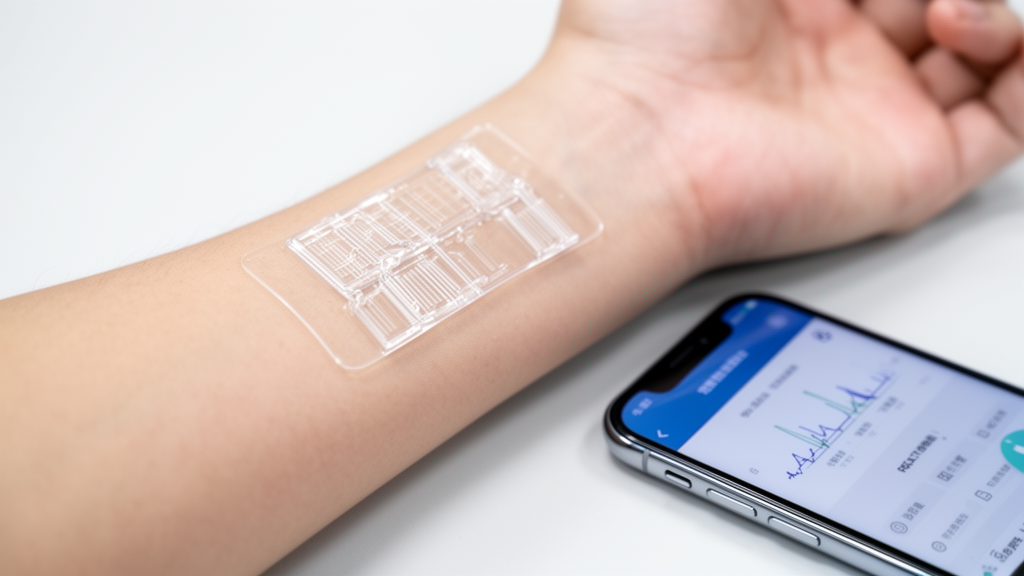
Researchers at the Norwegian University of Science and Technology have developed an electronic-free wearable smart patch capable of assessing cardiovascular indicators using an ordinary smartphone camera. The transparent device, described in an experimental study published in the journal Advanced Materials, measures both heart pulse and blood vessel stiffness directly from mechanical skin movements. Unlike conventional digital wearables that rely on embedded microchips, batteries, or wiring, the device operates entirely through passive material deformation.
Fabricated entirely from flexible silicone rubber, the patch presents a distinct visual appearance reminiscent of the iridescent surface of a compact disc or a miniature rainbow. Its functional architecture features two specialized functional sides. On the reverse side facing the body, the researchers engineered a three-dimensional adhesive microstructure inspired by the suction cups of an octopus, ensuring that the patch adheres firmly and securely to the human skin. On the external side, the material incorporates a nanoscale pattern designed to shift color when mechanically stretched. Because the entire assembly consists of structured rubber, it requires no internal circuits, external power cables, or specialized power sources to function.
The core operating mechanism relies on the physical transmission of pressure waves generated by the cardiovascular system. As blood vessels expand and contract with each heartbeat, the resulting pulse waves cause subtle mechanical deflections on the surface of the skin. Because the patch is tightly bonded to the skin via its biomimetic suction structures, these localized skin movements stretch the flexible silicone film. This physical stretching induces tiny but measurable changes in the color reflected by the nanostructured surface. According to the research team, these optical shifts are distinct enough to be observed directly by the human eye, enabling real-time visual tracking of cardiovascular activity.
To translate these structural color shifts into quantitative physiological data, the system requires only an ordinary mobile phone camera. The color changes can be detected directly without the need for a spectrometer, laser, or other specialized equipment.
This mechanical sensing technique addresses significant limitations inherent in existing consumer wearables, such as smartwatches. Commercial wrist-worn devices typically rely on optical photoplethysmography, projecting green light-emitting diode (LED) illumination into the tissue to monitor fluctuations in blood volume over time. A recognized drawback of this optical monitoring method is that light absorption is heavily influenced by melanin concentration in the dermal layers. Consequently, smartwatch sensors frequently demonstrate degraded accuracy on darker skin types, presenting a barrier to equitable healthcare technologies.
Beyond standard pulse tracking, the mechanical patch simultaneously records blood vessel stiffness, an essential biomarker for cardiovascular health that optical smartwatch sensors struggle to capture. In healthy individuals, vascular elasticity varies with lifestyle factors; sustained physical exercise supports youthful arterial compliance, whereas heavy smoking and natural biological aging lead to progressive arterial stiffening. Stiff blood vessels contribute substantially to various forms of cardiovascular disease. Conventional non-invasive clinical evaluation of vascular stiffness requires cumbersome diagnostic platforms, involving multiple electrodes strapped across a patient’s chest, arms, and legs linked by cables to an electrocardiogram machine alongside fingertip pulse oximeter clips.
While comprehensive diagnostic machinery remains accessible within well-funded hospitals, emergency rooms, general practice clinics, and ambulances in high-resource regions like Norway, such setups are impractical in remote or resource-limited healthcare environments. In rural global regions where specialized medical personnel and bulky clinical machines are unavailable, diagnostic access remains constrained. The nanophotonic patch simplifies this infrastructure by relying entirely on smartphones, which are already widely distributed across global populations. By transferring the processing complexity from dedicated clinical hardware to widespread consumer mobile devices, the researchers aim to expand reliable vascular screening to underserved settings.
The device was designed, manufactured, and evaluated entirely at the Norwegian University of Science and Technology. Although currently validated within an experimental framework, the investigators believe this non-electronic platform could establish a foundation for a broader class of wearable health monitors. The combination of low production costs, passive mechanical operation, freedom from battery charging, and independence from complex electronic hardware positions the nanophotonic film as an accessible alternative to conventional bio-interfaced electronics, offering expanded diagnostic capability through ubiquitous mobile technology.
Subject of Research: Non-electronic nanophotonic skin patch for smartphone-based cardiovascular monitoring
Article Title: A smart patch that can measure your pulse without electronics
Article References: A smart patch that can measure your pulse without electronics. Original publication (Bibliographic details unavailable.)
Image Credits: AI Generated
DOI: Not provided
Keywords: Cardiovascular monitoring, Smart patch, Nanophotonics, Pulse measurement, Blood vessel stiffness, Arterial stiffness, Silicone rubber, Smartphone diagnostics, Wearable health technology, Optical monitoring, Skin pigmentation equity, Mechanical sensing, Biomimetic adhesives, NTNU research, Advanced Materials, Non-electronic sensors, Healthcare accessibility
News Source: Denise Maddox. (November 16, 2026). Smartphone-Readable Patch Measures Pulse and Arterial Stiffness Without Embedded Electronics. Scienmag.