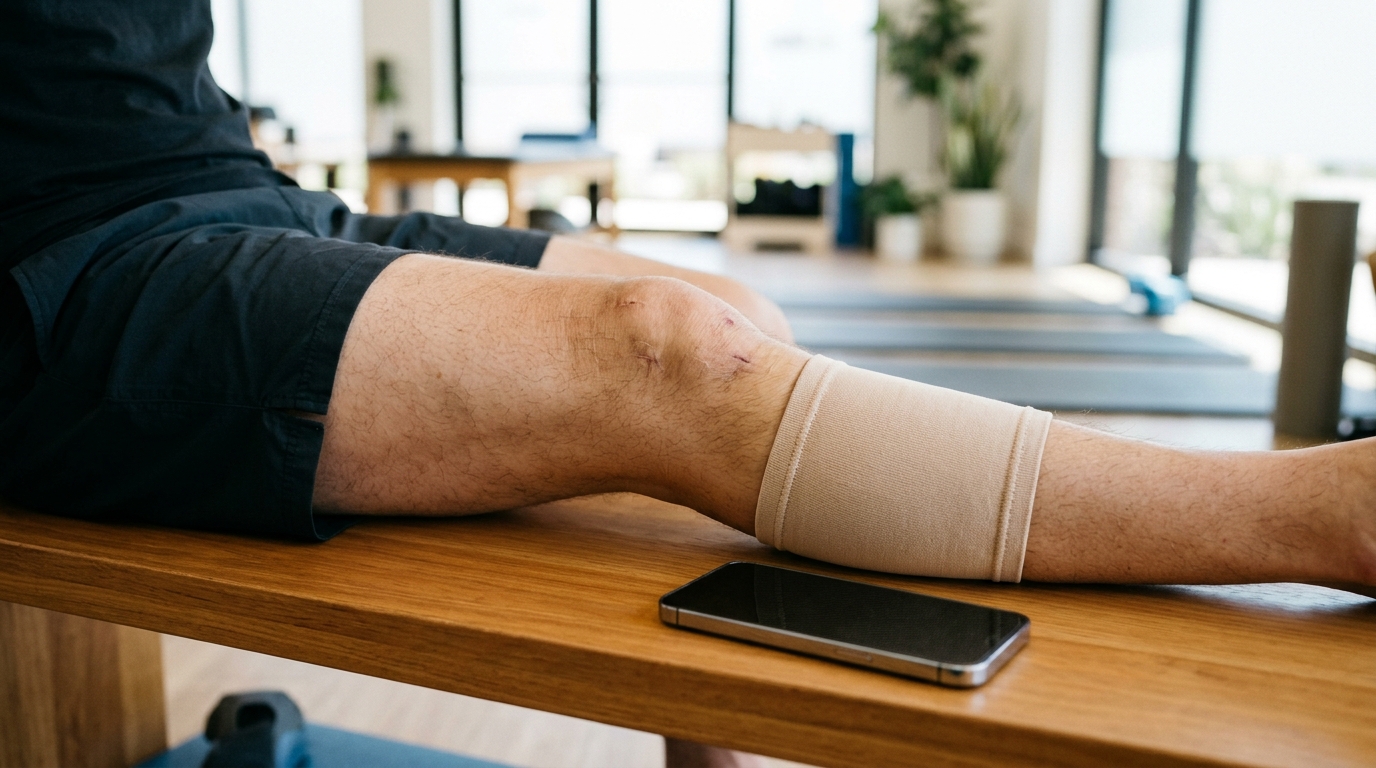
Researchers have identified three distinct recovery phenotypes in patients following anterior cruciate ligament (ACL) reconstruction by analyzing passively collected smartphone mobility metrics. This cross-sectional study, which involved 120 adults assessed between three and twelve months post-primary surgery, demonstrated that objective digital tracking of daily activity patterns correlates significantly with patient-reported functional outcomes, pain intensity, and psychological health. By using unsupervised k-means clustering, the investigators observed that mobility-based phenotypes mapped onto meaningful differences in both physical and psychosocial recovery indicators, suggesting that smartphone-based monitoring could serve as a scalable, objective tool for personalizing rehabilitation strategies.
The study, conducted at a specialized orthopedic and sports rehabilitation clinic, focused on the subacute-to-late rehabilitation phase, a period characterized by notable inter-individual variability in functional progress. Participants included 120 individuals who had undergone standardized arthroscopic single-bundle ACL reconstruction using either bone-patellar tendon-bone (BTB) or hamstring tendon autografts. To be eligible, participants were required to possess a compatible smartphone and provide a minimum of 14 consecutive days of valid mobility data within the 30 days preceding their clinical follow-up visit. The study recorded mobility variables including daily step count, step-count variability, average walking bout duration, total ambulatory distance, active minutes, and the duration of the longest sedentary bout per day, as captured by native smartphone health platforms.
Patient-reported outcomes were evaluated using established, validated instruments. Functional status was measured using the Knee Injury and Osteoarthritis Outcome Score (KOOS) subscales for pain, activities of daily living (ADL), and sports and recreation. Knee-specific quality of life was assessed via the ACL Quality of Life (ACL-QoL) questionnaire. Psychological burden was examined through the Pain Catastrophizing Scale (PCS), the Patient Health Questionnaire-9 (PHQ-9) for depression, and the Generalized Anxiety Disorder-7 (GAD-7) for anxiety. Additionally, researchers tracked kinesiophobia using the Tampa Scale for Kinesiophobia-11 (TSK-11) and collected data on rehabilitation utilization and perceived needs, including a single-item numeric rating scale for concern about returning to physical activity.
The findings indicated that higher daily mobility levels were consistently associated with superior recovery outcomes. Average daily step count emerged as a particularly robust predictor of function, pain, and quality of life. Statistical analysis showed that each additional 1,000 steps per day was associated with improved KOOS-ADL and ACL-QoL scores, as well as lower pain intensity. The multivariable regression models, which accounted for clinical covariates such as age, sex, body mass index, graft type, and time since surgery, explained between 42% and 49% of the variance in patient-reported recovery metrics. Conversely, prolonged sedentary bouts and higher activity variability were associated with poorer functional outcomes and increased pain intensity.
Clustering the data revealed three clear recovery phenotypes: a high-activity/low-pain group, a moderate-activity/moderate-pain group, and a low-activity/high-pain group. The high-activity phenotype was characterized by superior function, minimal psychological distress, and high levels of daily physical activity. In contrast, the low-activity/high-pain phenotype showed reduced mobility, significant functional impairment, greater pain, and higher levels of pain catastrophizing.
A notable finding was the marked variation in rehabilitation needs across the identified phenotypes. Participants classified in the low-activity/high-pain group were substantially more likely to report being currently involved in physiotherapy and to express unmet rehabilitation needs compared to those in the high-activity/low-pain cluster. Fear of movement (kinesiophobia) also increased significantly as activity levels decreased across these groups. However, while depressive and anxiety symptoms were descriptively higher in the low-activity/high-pain phenotype, these specific psychological measures did not reach statistical significance between the defined clusters.
The study authors emphasize that these phenotypes reflect behavioral mobility profiles rather than longitudinal recovery trajectories due to the cross-sectional design. Because assessments were performed across a broad 3-to-12-month postoperative window, the results likely incorporate heterogeneity in recovery stage, rehabilitation progression, and symptom status that could not be fully addressed through statistical adjustment. Residual confounding may also stem from surgical factors, such as concomitant meniscal or chondral pathology, and differences in postoperative rehabilitation protocols, which could influence early recovery outcomes independently of physical activity levels.
Data completeness and methodology remain important considerations. The study relied on participants carrying their smartphones during daily activities, and differences in phone carry time were observed across the identified phenotypes. Those in the low-activity group exhibited fewer hours of average daily phone carry time, which may have reduced the capture of mobility events. Consequently, while the findings support the clinical validity of passive smartphone monitoring as an objective, patient-centered tool for assessing functional recovery, the researchers caution that some observed differences in mobility metrics might partially reflect variations in data capture.
Despite these limitations, the results suggest that digital mobility monitoring could enhance the precision of postoperative care. By stratifying patients based on objective mobility phenotypes rather than relying solely on periodic self-report, clinicians may be better positioned to identify individuals at risk of suboptimal recovery early. This digital approach could facilitate the implementation of tailored, needs-based rehabilitation interventions without adding significantly to the patient’s or the provider’s clinical burden.
Future research is warranted to clarify the stability of these recovery phenotypes and their predictive value for long-term outcomes. The study authors recommend that prospective longitudinal investigations utilize standardized follow-up intervals, more uniform treatment pathways, and validated psychological assessments to further validate these findings. Furthermore, studies specifically investigating the influence of phone carriage habits on phenotype classification will be essential to refine the methodology and reduce potential measurement bias in digital health research.
Across the study cohort, participants completed their assessments at an average of 7.2 months following surgery, with a standard deviation of 2.8 months. Surgical records indicated that hamstring tendon autografts were the predominant graft type, utilized in 55.5 percent of participants, while bone-patellar tendon-bone autografts comprised the remainder of the cohort. In addition, nearly half of the cohort, 49.2 percent, presented with no concomitant meniscal damage, whereas meniscal repair represented the most frequent concurrent procedure, occurring in 28.1 percent of patients. During the data extraction window, participant adherence to passive digital tracking remained high, recording an average of 27.5 valid monitoring days out of a possible 30 and an average daily telephone carry duration of 13.5 hours. To ensure measurement integrity across these tracking periods, the investigators systematically reviewed step data sources within native health platforms, removing entries generated by synchronized external smartwatches and third-party fitness trackers whenever identifiable.
The tracked cohort accumulated an overall average of 6,825 daily steps and 103.4 active minutes, though daily activity routines exhibited substantial fluctuation. Overall, 72.5 percent of participants reached or exceeded 6,000 steps per day on most monitored days. The researchers established this 6,000-step benchmark as a pragmatic indicator of ambulatory recovery in the early-to-mid postoperative phase, explicitly noting that it served to classify relative functional recovery rather than dictate a prescriptive or optimal target. Sedentary habits were prominent alongside daily walking; participants recorded an average longest continuous sedentary period of 92.7 minutes each day, and 64.2 percent experienced sustained inactivity intervals exceeding 30 minutes. Mobility patterns also fluctuated between structured work schedules and rest periods, reflected by an average difference of 1,032 steps between weekday and weekend activity levels across the study population.
Postoperative rehabilitation adhered to a structured, four-phase criterion-based physical therapy framework guided by functional milestones rather than elapsed postoperative time. During the initial two weeks, clinical protocols prioritized effusion management, passive knee extension, quadriceps activation, patellar mobilization, and progressive weight-bearing ambulation. Between two and six weeks, therapy advanced toward full joint range of motion, closed-chain strengthening, balance exercises, and neuromuscular control. From six to twelve weeks, physiotherapists intensified resistance exercises while incorporating single-leg balance and low-impact cardiovascular conditioning. Beyond three months, patients progressed to advanced plyometric drills, agility routines, and sport-specific training. Progression between these sequential stages required meeting specific clinical milestones, including adequate muscular strength, satisfactory neuromuscular coordination, and the absence of significant joint effusion, allowing individualized pacing while maintaining standardized programmatic guidelines across the entire surgical cohort.
Comparative analysis of the three clustering phenotypes revealed marked quantitative separations across functional and psychological metrics. For knee pain on the numeric rating scale, mean scores shifted from 1.72 in the high-activity phenotype to 5.01 in the low-activity phenotype. Knee injury outcome scores followed parallel gradients, with KOOS-Pain declining from 88.94 in the high-activity cluster to 62.37 in the low-activity cluster, and KOOS-ADL falling from 92.10 to 71.04. Knee-related quality of life dropped from 85.13 among high-activity patients to 58.92 among low-activity patients. Pain catastrophizing scale scores rose steeply from 8.52 in the high-activity phenotype to 24.91 in the low-activity phenotype. Furthermore, while only 15.8 percent of high-activity patients were undergoing physiotherapy and just 5.3 percent cited unmet rehabilitation needs, 64.9 percent of low-activity patients remained in active physical therapy and 56.8 percent reported unmet recovery needs. The authors observed that although each 1,000-step daily increment was associated with modest improvements in regression models, the step disparity between the lowest and highest phenotypes exceeded 4,000 steps per day, supporting a cumulative dose-response relationship across daily life.
Subject of Research: Digital mobility monitoring for post-surgical orthopedic recovery.
Article Title: Smartphone-derived mobility metrics identify distinct recovery phenotypes following ACL reconstruction: associations with function, pain, and psychological health
Article References: Kandakurti, P. K., Koura, G. M., Reddy, R. S., Kardm, S., Gautam, A. P., Elshiwi, A. M. F., Ali, Z. A., Alali, R. S., & El Melhat, A. M. (2026). Smartphone-derived mobility metrics identify distinct recovery phenotypes following ACL reconstruction: associations with function, pain, and psychological health. Knee Surgery & Related Research, 38(1), Article 52. https://doi.org/10.1186/s43019-026-00353-1
Image Credits: AI Generated
DOI: 10.1186/s43019-026-00353-1
Keywords: ACL reconstruction, smartphone mobility, recovery phenotypes, digital health, orthopedic rehabilitation, physical activity monitoring, sedentary behavior, patient-reported outcomes, kinesiophobia, pain management, KOOS, ACL-QoL, unsupervised clustering, personalized rehabilitation, activity tracking
News Source: Ophelia Keating. (November 17, 2026). Smartphone Data Identifies Distinct Recovery Phenotypes After ACL Reconstruction. Scienmag.