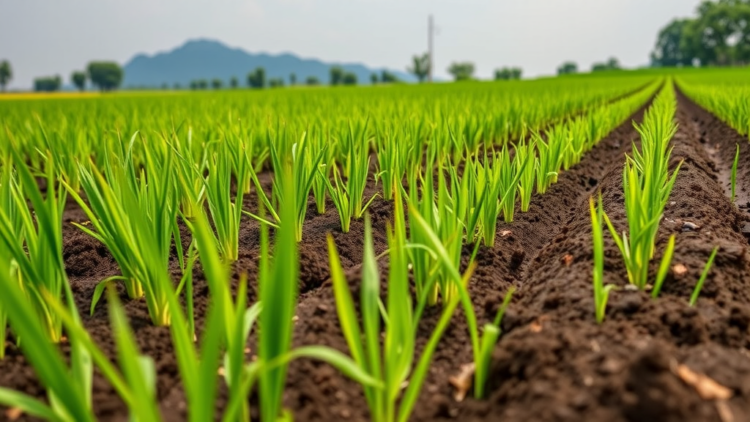
Rice feeds more than 3.5 billion people and covers roughly 165 million hectares of the planet, yet the way it is grown across South and Southeast Asia is quietly undermining the very soils that sustain it. A sweeping new systematic review, synthesizing 109 peer-reviewed studies and institutional reports published between January 2000 and March 2025, concludes that a family of ‘smart’ soil fertility practices can simultaneously raise yields, improve nitrogen use efficiency, restore soil organic carbon, and cut the greenhouse gas emissions that make rice one of agriculture’s largest climate liabilities.
The review, conducted by researchers at the Bangladesh Rice Research Institute and collaborators, followed the PRISMA 2020 reporting standard and the Synthesis Without Meta-analysis guideline, screening 240 records from five databases down to a final evidence base spanning ten rice-producing countries. The authors deliberately avoided a formal statistical meta-analysis because the underlying trials differed too widely in design, agro-ecology, and reporting quality, opting instead for a structured, semi-quantitative synthesis with explicit confidence ratings for each technology.
The headline numbers are striking. Site-specific nutrient management, including the Nutrient Expert decision-support tool developed by IFDC and CIMMYT, improved rice yields by 6 to 18 percent and nitrogen use efficiency by 20 to 117 percent over typical farmer practice across 143 on-farm trials. In Nepal’s Terai region, a four-year multi-site trial recorded yield gains exceeding 2 tonnes per hectare, roughly doubling farm profitability, while applications across India’s Indo-Gangetic Plains cut the global warming potential of rice by about 2.5 percent and of wheat by 12 to 20 percent.
Integrated nutrient management, which blends organic inputs such as farmyard manure, compost, and green manures with balanced inorganic fertilization, emerged as the strongest long-term foundation for soil health. Across trials in Bangladesh, India, China, the Philippines, and Vietnam, it raised grain yields by 8 to 28 percent and soil organic carbon by 14 to 60 percent over periods of five to twenty years. In Bangladesh, where paddy organic matter averages below 1.5 percent against a target of 2.5 percent for optimal harvests, the most effective strategy combined 2 to 3 tonnes per hectare of poultry manure with 50 to 70 percent of the recommended inorganic fertilizer rate.
On the nitrogen side, controlled-release urea, whose polymer coatings synchronize nitrogen release with crop demand, curbed ammonia volatilization losses by 23 to 62 percent and cut runoff nitrogen losses by 8 to 58 percent. In double-rice systems it reduced annual methane emissions by roughly 19.7 percent and nitrous oxide by 35.2 percent, trimming global warming potential by around 21 percent. Nano-enabled formulations promise nitrogen use efficiency gains of 18 to 30 percent, but the authors caution that field-scale safety and ecotoxicology data remain insufficient for policy recommendations.
Water management delivered some of the most compelling climate results. Alternate wetting and drying irrigation, which lets fields dry to 15 centimeters below the surface between floodings using a simple PVC tube costing one to three dollars, reduced global warming potential by 20 to 36 percent, mainly through lower methane emissions, with generally no yield penalty. A landmark three-year multi-site experiment across Vietnam, Indonesia, Thailand, and the Philippines confirmed GWP reductions of 22 to 36 percent, with yields actually rising by 12 percent at the Thai site. National assessments for the Philippines suggest nationwide adoption could avoid roughly 5.6 megatonnes of carbon dioxide equivalent per year.
The review is careful, however, not to oversell AWD. The same intermittent aeration that suppresses methanogenic archaea can stimulate coupled nitrification and denitrification, raising nitrous oxide, a gas with far higher per-molecule warming power. The net climate benefit therefore depends on the severity of drying, soil texture, and especially how nitrogen is applied. Mild ‘safe’ AWD paired with deep-placed or controlled-release nitrogen tends to preserve the methane savings, while aggressive drying under high broadcast nitrogen can erode them.
That insight points to what the authors identify as the most powerful combination in the entire evidence base: urea deep placement plus alternate wetting and drying. Placing large urea briquettes 7 to 10 centimeters into the anaerobic soil zone keeps nitrogen in its plant-available ammonium form, blocking the volatilization and denitrification pathways that can strip away 30 to 50 percent of broadcast fertilizer. In Bangladesh, deep placement alone raised yields by 10 to 21 percent while saving 25 to 33 percent of nitrogen and cutting GWP by 9 to 21 percent. At a Bangladesh Rice Research Institute farm in Satkhira, the combined approach lifted yields by about 28 percent and nitrogen recovery by 167 percent over broadcast urea, without the additional nitrous oxide emissions often feared under aerobic conditions.
Not every technology earns an unqualified endorsement. Biochar, which can reduce methane emissions by 10 to 43 percent, rests on the weakest and most geographically concentrated evidence, dominated by Chinese trials. Controlled-release fertilizers remain too costly for most South Asian smallholders without targeted subsidies. The evidence base itself skews heavily toward Bangladesh, India, and China, leaving countries such as Pakistan, Myanmar, Cambodia, and Malaysia largely unrepresented, and most organic amendment trials run only three to five years, too short to capture full soil carbon trajectories.
The policy implications are nonetheless concrete. For Bangladesh, the authors recommend immediate scale-up of AWD and deep placement, both already validated and certifiable under the Verra VM0006 carbon methodology, alongside continued digital extension through the Nutrient Expert platform. India is advised to adopt national site-specific nutrient management mandates for irrigated rice in the Indo-Gangetic Plains, where groundwater depletion and residue burning create co-benefit opportunities. The central message is that no single technology optimizes all four sustainability outcomes at once; the largest gains come from locally tailored combinations, with each recommendation’s confidence level traveling with it into the field.
Subject of Research: Smart soil fertility management practices for sustainable rice production in South and Southeast Asia
Article Title: Smart soil fertility management for improving rice yield, nitrogen use efficiency, and greenhouse gas mitigation across South and Southeast Asia
Article References: Islam, S. M. M., Islam, M. N., Naher, U. A., Rahman, F., Hossain, A. T. M. S., Milu, M. K. H., Islam, A., Jahan, A., Khan, M. H., Gaihre, Y. K., & Islam, M. R. (2026). Smart soil fertility management for improving rice yield, nitrogen use efficiency, and greenhouse gas mitigation across South and Southeast Asia. Discover Soil, 3(1), Article 164. https://doi.org/10.1007/s44378-026-00316-8
Image Credits: AI Generated
DOI: 10.1007/s44378-026-00316-8
Keywords: rice, soil fertility, nitrogen use efficiency, greenhouse gas emissions, alternate wetting and drying, urea deep placement, site-specific nutrient management, integrated nutrient management, controlled-release fertilizer, soil organic carbon, methane, climate-smart agriculture
Cite Scienmag News
APA
MLA
Chicago
Alan Morgan. (September 22, 2026). Smart Soil Strategies Could Boost Rice Yields and Slash Emissions Across Asia. Scienmag. https://scienmag.com/smart-soil-strategies-could-boost-rice-yields-and-slash-emissions-across-asia/
Alan Morgan. “Smart Soil Strategies Could Boost Rice Yields and Slash Emissions Across Asia.” Scienmag, 22 September 2026, https://scienmag.com/smart-soil-strategies-could-boost-rice-yields-and-slash-emissions-across-asia/. Accessed 22 September 2026.
Alan Morgan. “Smart Soil Strategies Could Boost Rice Yields and Slash Emissions Across Asia.” Scienmag. September 22, 2026. https://scienmag.com/smart-soil-strategies-could-boost-rice-yields-and-slash-emissions-across-asia/
Copy citation
Download RIS
Tags: alternate wetting and dryingclimate-smart agricultureClimate-smart agriculture strategiescontrolled-release fertilizerenhancing nitrogen use efficiency in rice productiongreenhouse gas emissionsimpact of soil health on rice yieldsintegrated nutrient managementmethanenitrogen use efficiencynutrient management tools for rice farmingpeer-reviewed research on rice cultivation practicesreducing greenhouse gas emissions from rice paddiesregional analysis of rice farming sustainabilityricerole of organic carbon in soil restorationsite-specific nutrient managementSmart soil management for rice cultivationsoil fertilitysoil fertility improvement techniques for ricesoil organic carbonsustainable agriculture practices in Asiasystematic review of soil fertility interventionsurea deep placement