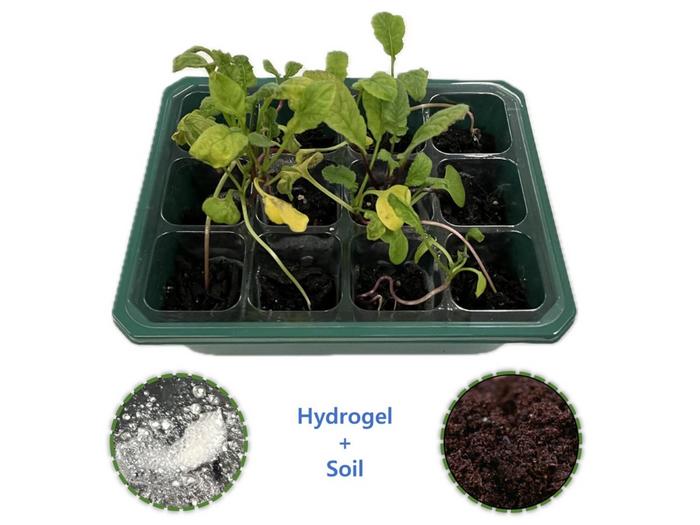
A newly engineered type of soil can capture water out of thin air to keep plants hydrated and manage controlled release of fertilizer for a constant supply of nutrients.
Credit: The University of Texas at Austin
A newly engineered type of soil can capture water out of thin air to keep plants hydrated and manage controlled release of fertilizer for a constant supply of nutrients.
Underpinning this exciting smart soil system is a hydrogel material developed by researchers at The University of Texas at Austin. In experiments, the hydrogel-infused soil led to the growth of larger, healthier plants, compared to regular soil, all while using less water and fertilizer.
“This new gel technology can reduce the burden on farmers by decreasing the need for frequent irrigation and fertilization,” said Jungjoon Park, a graduate student in the Walker Department of Mechanical Engineering and who led the research. “The technology is also versatile enough to be adopted across a wide range of climates, from arid regions to temperate areas.”
The research was published recently in ACS Materials Letters.
Agriculture today accounts for 70% of global freshwater withdrawals and up to 95% in some developing countries as our global population continues to rise. The U.N. Food and Agriculture Organization emphasizes the importance of improving irrigation efficiency, adopting water-saving technologies and promoting crops with lower water footprints to ensure sustainable food production and water resource management.
Meanwhile, traditional farming methods, especially irrigation and fertilizing, face significant challenges, including inefficient water usage and environmental land degradation. As climate change intensifies and water resources become increasingly scarce, the need for more efficient and sustainable irrigation practices has never been more urgent. Additionally, conventional fertilization techniques often result in excessive nutrient exposure, reducing nutrient uptake efficiency and causing environmental pollution, and farmable land degradation.
“The global water scarcity coupled with a growing population has an immediate impact on food security,” said Yu, professor of materials science in the Cockrell School of Engineering’s Walker Department of Mechanical Engineering and Texas Materials Institute. “This new class of hydrogels offers a promising solution to meet the pressing needs of water scarcity and efficient nutrient uptake in modern sustainable agriculture.”
In experiments, plants rooted in the hydrogel soil saw a 138% increase in stem length compared to a control group in regular soil. And the modified soil can achieve approximately 40% water savings, significantly reducing the need for frequent irrigation and ensuring robust crop development.
This research builds on previous discoveries involving hydrogels that can pull water from the atmosphere and make farming more efficient. It is part of Yu’s overall mission that dates back to his childhood: to expand access to clean water to people around the globe.
This work mainly focused on calcium-based fertilizers. The project will continue, and the researchers’ next moves involve integrating different types of fertilizers and longer field tests.
Joining Yu and Park on the project are Weixin Guan and Chuxin Lei, who are also graduate students in the materials science and engineering program and Texas Materials Institute.
Journal
ACS Materials Letters
DOI
10.1021/acsmaterialslett.4c01120
Article Title
Self-Irrigation and Slow-Release Fertilizer Hydrogels for Sustainable Agriculture
Article Publication Date
3-Jul-2024