Credit: University of Houston
Researchers in Houston and elsewhere have shown that robotic systems controlled by the user's own brain activity can help patients recovering from stroke and other disabling injuries. But the demonstrations have taken place in highly controlled settings, and none of the systems have been approved for use in clinics or patient's homes.
An engineer from the University of Houston is leading a team of researchers, health care providers and industry to fast-track the commercialization of a groundbreaking robotic rehabilitation system. Backed by a $750,000 grant from the National Science Foundation's Partnerships for Innovation program (PFI), the goal is to build a system that can be approved by the U.S. Food and Drug Administration and is sturdy, simple and inexpensive enough for stroke patients to use at home.
"We want to break that wall between the lab and home," said Jose Luis Contreras-Vidal, professor of electrical and computer engineering at UH and co-director of the Building Reliable Advances and Innovation in Neurotechnology (BRAIN) Center, a NSF-supported Industry/University Collaborative Research Center based at UH and Arizona State University. "We want to build a system that can be used at home with FDA approval."
The NSF PFI program allows academic innovators to advance prior NSF-funded research by further developing technologies that show promise for commercialization and societal impact. Such technology development efforts benefit from industry-academic collaborations that are needed to accelerate the transition of technology from the academic lab to the marketplace.
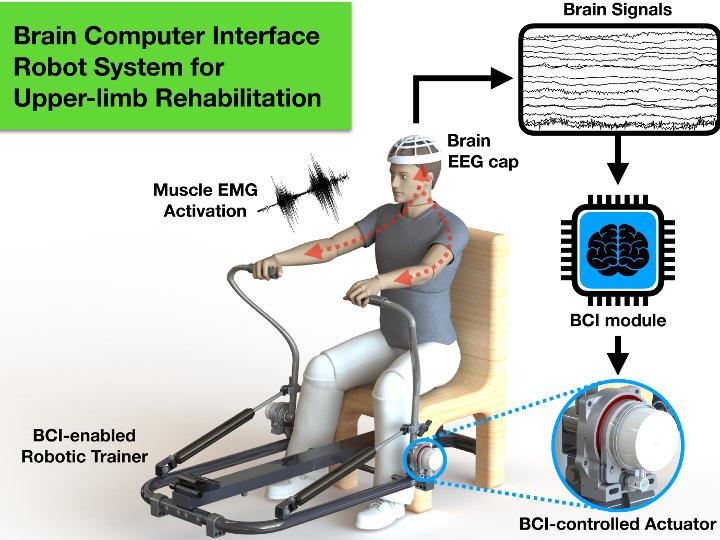
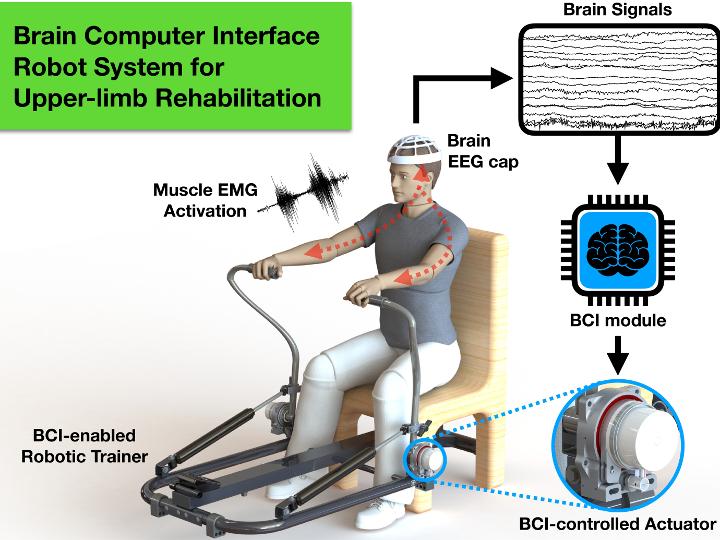
The rehabilitation systems work by capturing electrical activity in the brain, which can be translated into movement through the use of algorithms that decode movement intent from patterned brain activity. Early versions of this brain-computer interface relied upon a skull cap embedded with the sensors, but Contreras-Vidal said any system intended for home use will have to be far simpler for patients to use.
He has worked for years with TIRR Memorial Hermann, a nationally ranked rehabilitation hospital, in a quest to design medical systems that can assist in recovery from strokes and other injuries and illnesses.
Other partners in the project are National Instruments Corp. and Harmonic Bionics, both based in Austin, and TIRR Memorial Hermann. The UH Office of Intellectual Property Management will help with commercialization, and Jeff Feng, associate professor for the UH Gerald D. Hines College of Architecture and Design who has a background in the design of medical devices, will work with Contreras-Vidal on the headset design to optimize usability and form factor.
"It has to be very user friendly," Contreras-Vidal said. The idea is that use of the device – it will be modeled on a simple rowing machine and at least initially will focus on the upper limbs – will promote plasticity in the brain and the restoration of motor function. Contreras-Vidal said the same concept could apply to the lower limbs to restore a patient's ability to walk.
While the work also has applications for virtual reality, gaming and consumer electronics, he said the researchers are focused on using it to help people recover from stroke. It will be tested in the clinic at TIRR before being sent home with patients.
"The research team of the physical medicine and rehabilitation department is fortunate to be a part of this project, which will make a difference and improve the quality of life in stroke survivors," said Dr. Gerard Francisco, chairman and professor of physical medicine & rehabilitation with McGovern Medical School at the University of Texas Health Science Center at Houston and chief medical officer and director of the NeuroRecovery Research Center at TIRR Memorial Hermann.
"Each year, thousands suffer a stroke which can leave them facing a long road of rehabilitation. By developing this device for use at home, it can be an added and convenient component to their rehabilitation journey."
Harmony Bionics will produce the robotic device, while National Instruments will provide a compact, embedded, hardware solution for the brain-computer interface system and provide technical assistance.
"There is a growing need for accelerating the transition to practice of the discoveries and innovations that start at universities," said Igor Alvarado, business development manager for academic research at National Instruments. "This project allows us to help advance new at-home rehab technologies for stroke patients by providing the data acquisition and control platform to be used in prototyping, testing and deploying the new rehab device."
National Instruments also will oversee a national competition, which will release the researchers' datasets and encourage people elsewhere to suggest improvements in the decoding algorithms.
"That's STEM outreach," Contreras-Vidal said. "But it's also citizen-science and advancing the state of the art."
###
Media Contact
Jeannie Kever
[email protected]
713-743-0778
@UH_News
http://www.uh.edu/news-events
Original Source
http://www.uh.edu/news-events/stories/2018/october-2018/10092018contreras-vidal-stroke-rehab.php