Chronic wounds are one of medicine’s quietest burdens. Millions of people worldwide, particularly older adults and patients with diabetes, vascular disease, or other long-term conditions, live with wounds that refuse to close for weeks, months, or even years. Conventional dressings, for all their ubiquity, are essentially passive barriers: they keep bacteria out and moisture in, but they do little to actively drive the complex cascade of cellular events that real tissue repair demands. A new review published in Polymer Bulletin by Anmoy Nandi, Rejaul Karim Ahmed, and Srijita Chakrabarti of Assam down town University takes stock of a field that is trying to change that, surveying the latest generation of bioactive polymeric patches and asking, candidly, why so few of them have made it from the laboratory bench to the patient’s bedside.
The central argument of the review is that modern wound care needs materials that do more than cover. Biomaterial-based polymeric patches are designed to combine three functions in a single platform: structural support for fragile new tissue, controlled delivery of therapeutic agents, and direct regenerative activity. Achieving that combination requires careful attention to a set of design determinants that the authors lay out systematically. Biocompatibility ensures the material does not provoke an immune attack; biodegradability allows the patch to be absorbed as the wound heals rather than requiring painful removal; mechanical integrity keeps the patch intact under the stresses of movement; and the polymer’s origin, whether natural or synthetic, shapes degradation rates, cell interactions, and regulatory pathways. Increasingly, researchers are also incorporating bioactive secondary metabolites, plant-derived compounds and other natural molecules with documented anti-inflammatory, antimicrobial, and pro-regenerative effects, to give the patch genuine pharmacological punch.
Among the most versatile platforms are hydrogels, three-dimensional polymer networks that can hold large quantities of water while remaining soft and tissue-like. Hydrogels maintain the moist environment that wound healing requires, and their crosslinked structure can be tuned to release drugs over hours or days. The review highlights natural polymer hydrogels based on alginate, chitosan, and carboxymethyl cellulose, which have shown anti-inflammatory and healing-accelerating effects in both in vitro and in vivo studies. Photo-crosslinkable gelatin methacryloyl hydrogels allow researchers to pattern the material with light, creating scaffolds that mimic the extracellular matrix. Injectable hydrogel formulations are pushing further, offering targeted control of oxidative stress, one of the key biochemical culprits that keeps diabetic wounds locked in a chronic, non-healing state. Conductive hydrogel patches add yet another dimension, using bioelectric stimulation to encourage cell migration and regeneration while doubling as wearable sensors.
Electrospun nanofiber scaffolds represent a second major architectural family. By drawing polymer solutions through an electric field, manufacturers can produce mats of fibers with diameters in the nanometer range, closely resembling the fibrous architecture of the natural extracellular matrix. This biomimetic topology encourages cells to attach, proliferate, and migrate across the wound bed. The review cites work on polycaprolactone-zinc scaffolds coated with fibroblast-derived extracellular matrix, which enhanced cell proliferation, migration, and fibroblast differentiation, and on radially oriented berberine-loaded PHBV nanofiber dressings designed to accelerate diabetic wound closure. Electrospun dressings loaded with carbon quantum dots and citrate have demonstrated improved antibacterial efficiency, and the technology has begun to appear in real-world clinical evaluation, with commercial systems such as Spincare being assessed for practical wound coverage.
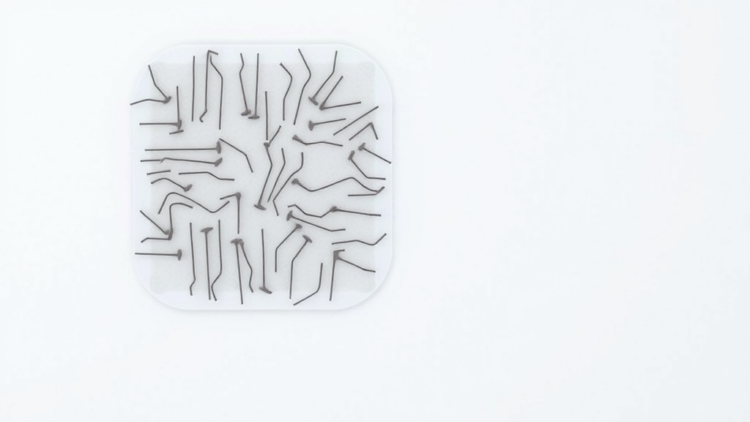
Microneedle arrays are perhaps the most visually striking of the new architectures. These patches studded with microscopic needles, often tens to hundreds of micrometers tall, can painlessly penetrate the tough, dead surface layer of a chronic wound and deposit drugs, growth factors, or biomolecules directly into viable tissue below. The review describes bioinspired wearable polymer microneedle patches developed specifically for diabetic wound therapy, as well as multifunctional designs such as a kangfuxin-chitosan-fucoidan complex patch that enabled full-thickness wound healing in preclinical models, and ROS-scavenging microneedle patches that mop up the reactive oxygen species implicated in chronic inflammation. Because microneedles can be engineered from dissolving or biodegradable polymers, they can leave no sharps waste and release their payload as they dissolve, combining delivery, mechanical debridement of the wound surface, and safety in one device.
Multilayered composite dressings take a different approach to the same problem: rather than one material doing everything, they assign each layer a job. A typical bilayer or trilayer patch might feature a tough, bacteria-blocking outer film, a middle layer that stores and slowly releases therapeutics, and a soft, adhesive inner layer that conforms to the wound. The review points to examples including gelatin-chitosan bilayer patches loaded with medicinal plant extracts, tri-layer dressings combining zinc oxide nanoparticles with insulin-like growth factor 1 for full-thickness skin injuries, and pollen-integrated hydrogel patches with hierarchical structures that release active compounds in a spatio-temporally controlled fashion. This architectural sophistication mirrors the layered structure of skin itself and allows formulators to reconcile requirements, such as moisture retention and mechanical strength, that would otherwise conflict within a single material.
The most futuristic entries in the review are the smart, responsive patches that merge wound care with diagnostics. Hydrogel-based electronic-skin patches have been demonstrated that both accelerate healing and monitor the state of the wound in real time. Conducting polymer arrays with multiplex sensing and drug-delivery capabilities form the basis of next-generation smart bandages, while a negative-pressure smart patch has been reported that can both sense wound conditions and apply therapy on demand. Wearable platforms built on hydrogels are being designed to track biomarkers such as pH, temperature, uric acid, and moisture, parameters that correlate with infection and healing progress, and to trigger therapeutic release only when needed. The authors note that artificial intelligence is beginning to enter this space, with machine-learning approaches proposed for interpreting sensor data and personalizing treatment, turning the humble dressing into a closed-loop therapeutic system.
Underpinning all of these architectures is a growing appreciation of wound biology. The review situates material design within the cellular choreography of repair: the inflammatory phase dominated by macrophages whose plasticity determines whether healing proceeds or stalls, the proliferative phase in which fibroblasts lay down new matrix and new blood vessels form, and the remodeling phase that determines final scar quality. In diabetic and chronic wounds, elevated oxidative stress, persistent infection, and dysregulated inflammation derail this sequence. Bioactive metabolites from plants, marine peptides, and even microbial sources are being explored as natural modulators that can nudge the wound environment back toward regeneration, and polymer chemists are learning to embed these molecules without destroying their activity.
Yet the review’s most sobering contribution is its assessment of translation. Despite an impressive laboratory literature, the number of advanced polymeric patches that have reached routine clinical use remains small. The authors identify a cluster of recurring barriers: manufacturing scalability, since processes like electrospinning and microneedle molding are difficult to reproduce at industrial scale with consistent quality; product standardization, because natural polymers vary batch to batch; regulatory approval pathways that were not designed for combination products blending drug, device, and biological functions; cost-effectiveness in health systems already strained by chronic wound care; and, above all, the scarcity of large-scale clinical validation. Registered clinical trials of advanced patches, including nitric oxide-releasing patches for diabetic foot ulcers and hemostatic patches for surgery, exist but remain limited in number and scope relative to the volume of preclinical publications. The review also flags the poor quality of many animal studies and calls for better standardized reporting, citing newly proposed guidelines for wound-healing research.
The overall picture that emerges is of a field at an inflection point. The material science has arguably outpaced the clinical science: researchers can now build patches that sense, deliver, stimulate, and regenerate, but the pathway from elegant prototype to approved, affordable, widely available product remains bottlenecked by economics, regulation, and evidence. By integrating advances in material design with an honest appraisal of translational and clinical considerations, Nandi and colleagues offer a framework intended to help the next generation of patches cross that gap. For the millions of patients whose wounds will not heal, the promise is real, but so, the review makes clear, is the distance still to travel.
Subject of Research: Bioactive polymeric patches and advanced dressing architectures for chronic wound healing and their translational challenges
Article Title: Next-generation bioactive polymeric patches for chronic wound healing: from advanced architectures to translational challenges
Article References: Nandi, A., Ahmed, R. K., & Chakrabarti, S. (2026). Next-generation bioactive polymeric patches for chronic wound healing: from advanced architectures to translational challenges. Polymer Bulletin, 83(12), Article 643. https://doi.org/10.1007/s00289-026-06697-8
Image Credits: AI Generated
DOI: 10.1007/s00289-026-06697-8
Keywords: chronic wounds, wound healing, biomaterials, hydrogels, electrospun nanofibers, microneedles, smart dressings, drug delivery, tissue regeneration, polymers, diabetic ulcers, clinical translation
Cite Scienmag News
APA MLA Chicago
Neil Sanderson. (September 24, 2026). Smart Polymer Patches Promise a New Era for Chronic Wound Healing. Scienmag. https://scienmag.com/smart-polymer-patches-promise-a-new-era-for-chronic-wound-healing/
Neil Sanderson. “Smart Polymer Patches Promise a New Era for Chronic Wound Healing.” Scienmag, 24 September 2026, https://scienmag.com/smart-polymer-patches-promise-a-new-era-for-chronic-wound-healing/. Accessed 24 September 2026.
Neil Sanderson. “Smart Polymer Patches Promise a New Era for Chronic Wound Healing.” Scienmag. September 24, 2026. https://scienmag.com/smart-polymer-patches-promise-a-new-era-for-chronic-wound-healing/
Copy citation Download RIS
Tags: advanced biomaterials for tissue repairbioactive polymeric patchesbioactive wound dressingsbiocompatible polymer patchesbiomaterialschallenges in translating bioactive patcheschronic wound healingchronic woundsclinical translationcontrolled drug delivery systemsdiabetic ulcersDrug deliveryelectrospun nanofibershydrogelslong-term wound managementmicroneedlespolymer-based wound healing devicespolymersregenerative wound dressingssmart dressingstissue regenerationtissue regeneration scaffoldswound care innovationwound healing