Researchers have developed a proof-of-concept N95 smart mask sensing prototype alongside a machine-learning framework designed to evaluate asthma risk. Asthma is a chronic respiratory disease marked by airway inflammation and hypersensitivity to environmental stimuli that affects more than 350 million individuals across the globe. The proposed system pairs environmental monitoring hardware with physiological tracking tools to assess potential risks for wearers.
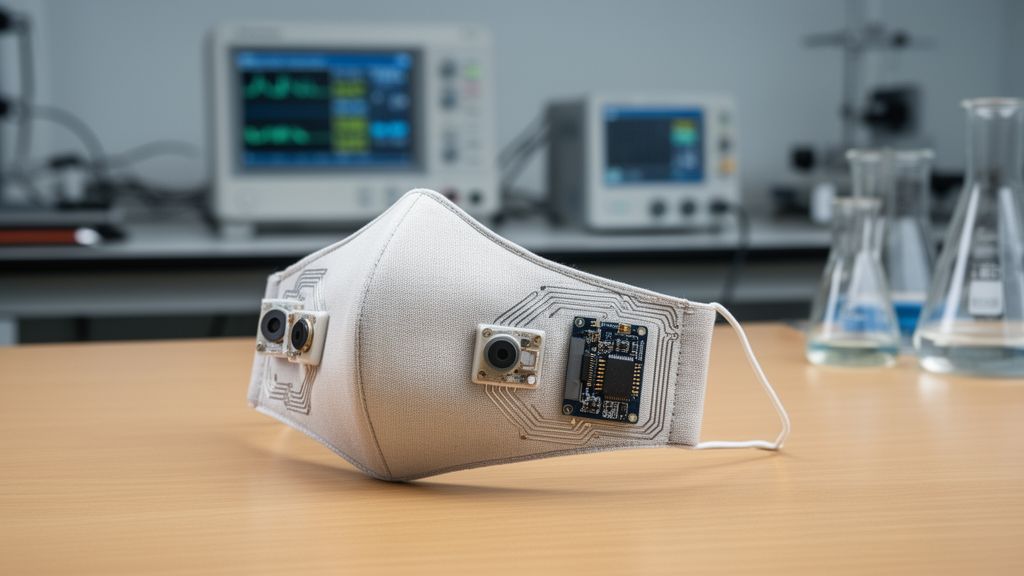
The physical sensing setup incorporates two distinct monitoring layers mounted onto an N95 platform. An environmental sensing layer gathers external ambient data using a PM2.5 particulate sensor, an MQ-135 gas sensor, and a DHT11 temperature and humidity sensor. Simultaneously, a biological sensing layer tracks physiological signals through a MAX30102 sensor measuring heart rate and blood oxygen saturation, a dedicated pulse-rate sensor, and a MAX9814 acoustic breath-sound sensor.
To classify asthma risk, the analytical framework relies on twelve demographic, behavioural, environmental, and physiological attributes derived from a dataset to perform binary classification between Asthma and No Asthma states. The wearable N95 prototype demonstrated the physical acquisition of a subset of these relevant parameters, though the authors noted it was not utilized to generate the full twelve-feature dataset used for model training and validation.
Model training and evaluation incorporated rigorous data preparation steps to prevent information leakage. Data preprocessing and Synthetic Minority Over-sampling Technique procedures were strictly confined to the training subsets within a five-fold stratified cross-validation framework. The investigators comparatively evaluated five distinct algorithms: Logistic Regression, Support Vector Machine, Multilayer Perceptron, Random Forest, and a hybrid CNN–BiLSTM model.
Random Forest delivered the highest overall cross-validation performance among the tested architectures. It achieved an accuracy of 92.93 ± 1.06 percent with a 95 percent confidence interval spanning 91.61 to 94.26 percent. In additional performance metrics, Random Forest registered a precision of 92.77 ± 2.25 percent, a recall of 88.95 ± 1.33 percent, an F1-score of 90.81 ± 1.32 percent, and an area under the receiver operating characteristic curve of 94.47 ± 1.58 percent.
Despite the superior statistical marks achieved by Random Forest, the investigators selected the CNN–BiLSTM architecture as the TinyML model deployed for on-device edge processing on a Seeed Studio XIAO ESP32C3 microcontroller. Once calculated, the predicted asthma probability is mapped to three distinct risk categories designated as Normal, Warning, and Danger based on predefined probability thresholds for visual presentation.
A dedicated software interface displays the outputs generated by the predictive models. The development team emphasized that the current physical sensing prototype functions primarily as an edge-processing proof of concept, laying the operational groundwork for prospective end-to-end integration incorporating the complete twelve-feature input set into wearable multimodal hardware.
Subject of Research: IoT-enabled smart mask and TinyML framework for asthma risk assessment
Article Title: An IoT-enabled smart mask for real-time asthma monitoring, TinyML-based classification, and intelligent alerts
Article References: M, M., Bharathi, G. D., & Manisha, K. M. (2026). An IoT-enabled smart mask for real-time asthma monitoring, TinyML-based classification, and intelligent alerts. Biomedical Engineering Letters. https://doi.org/10.1007/s13534-026-00635-3
Image Credits: AI Generated
DOI: 10.1007/s13534-026-00635-3
Keywords: Asthma, Wearable Technology, Smart Mask, TinyML, Edge Computing, Machine Learning, Random Forest, CNN-BiLSTM, Environmental Sensing, Biomedical Engineering, IoT, ESP32, Particulate Matter, Pulse Oximetry, Acoustic Sensing, Health Monitoring
News Source: Denise Maddox. (November 20, 2026). Smart Mask Prototype Combines Environmental Sensors With TinyML Asthma Risk Classification. Scienmag.