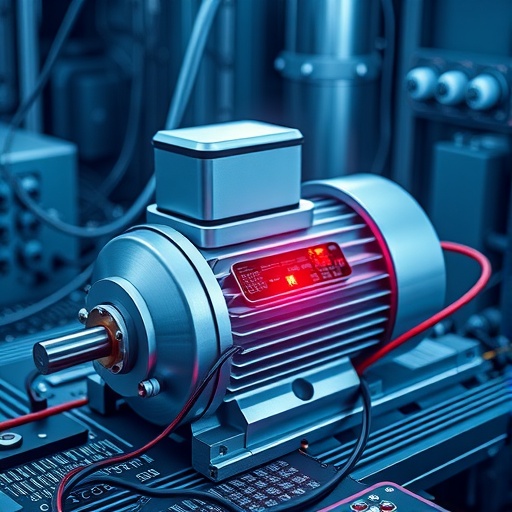
In the evolving landscape of industrial automation, fault detection for single-phase motors has emerged as a critical focus area. These motors, integral to numerous applications—from household appliances to commercial machinery—can experience failures that lead to significant operational disruptions. Traditional manual inspection methods, while reliable, are limited by their time-consuming nature and dependence on skilled personnel. This is where the innovation proposed by Shukla et al. steps in, revolutionizing how we approach real-time monitoring and fault detection through the enhanced capabilities of machine learning.
The intelligent automated fault detection framework introduced by the research team combines advanced machine learning techniques with real-time monitoring for single-phase motors. This new methodology not only seeks to identify faults rapidly but also aims to predict potential failures before they occur. The integration of machine learning algorithms allows for the processing and analysis of vast datasets collected from motor operations, thereby enabling the system to learn from past incidents and improve its accuracy over time. The continuous feedback loop generated by real-time data feeds allows the model to refine its predictive capabilities, an advantage traditional methods simply cannot match.
One of the standout features of this framework is its ability to adapt to different operational environments and conditions. Unlike static algorithms, which may deliver diminishing returns when faced with varying parameters, the intelligent system learns dynamically. By utilizing supervised and unsupervised learning methods, it can discern patterns and anomalies in motor behavior, leading to a more nuanced understanding of fault conditions. This adaptability ensures that industries can maintain high levels of efficiency even when faced with environmental variability.
Moreover, the real-time monitoring aspect is pivotal to this innovation. By employing IoT sensors to collect data on motor performance—such as temperature, vibration, and load conditions—the system maintains an ongoing assessment of overall health. This proactive approach to monitoring empowers maintenance teams to intervene at optimal moments, effectively reducing downtime and associated costs. In addition to increasing reliability, this algorithm-driven method offers opportunities for enhanced energy efficiency, as motors can be operated under optimal conditions more consistently.
The research team’s framework also plays a crucial role in tackling the skills gap prevalent in many industries today. By providing a robust automated solution, organizations can lessen their reliance on specialized manual inspections, allowing technicians to focus on strategic decision-making and more complex problem-solving activities. This shift toward automation not only boosts operational effectiveness but also fortifies workforce competencies in handling advanced technologies.
Implementation of such a system could have far-reaching impacts across various sectors including manufacturing, logistics, and service industries. The implications for maintenance strategies are profound, as downtime can be substantially minimized. Companies are encouraged to consider the economic benefits of integrating intelligent fault detection systems into their operations. As industries become more competitive, the ability to forecast and prevent failure will become increasingly important, emphasizing the importance of innovations such as those proposed by Shukla et al.
However, as with any technology, challenges exist. The integration of machine learning in fault detection requires a cultural shift within organizations, necessitating worker training and a willingness to embrace change. Additionally, the initial investment in technology and training can be substantial. It is important for leaders to understand that the return on investment can be significant over time. The potential for reduced maintenance costs, enhanced operational efficiency, and extended equipment life presents compelling arguments in favor of adopting such technologies.
Moreover, data privacy and security remain significant concerns. As the framework relies heavily on data, organizations must take proactive steps to protect sensitive information related to operations and maintenance logs. Building robust cybersecurity measures into the deployment strategy will be essential to instill confidence across all stakeholders involved in the transition to automated systems.
As industries herald in these advancements, ongoing research and collaboration between academia and industry will be vital. Enhancing the framework’s capabilities through continued learning and improvement will ensure that the fault detection systems for single-phase motors remain relevant despite evolving technology and techniques. Coupled with ongoing surveillance of motor performance, the interpretation and application of data analytics will carve new avenues for innovation in automation.
In summary, an intelligent automated fault detection framework for single-phase motors offers numerous benefits including forecasting abilities, proactive maintenance strategies, and improved operational efficiencies. The findings from Shukla et al. set a precedent for the future of industrial automation, and as organizations embrace this paradigm shift, the implications for productivity and efficiency could redefine manufacturing practices in global industries.
As we look to the future, it is clear that the synergy of machine learning with real-time monitoring will drive advancements in motor fault detection and maintenance practices, paving the way for smarter, more resilient industrial systems.
Through the integration of such technologies, the pathway toward fully autonomous operational systems seems ever more attainable. In the grander scheme, this exploration highlights how a commitment to research and innovation can profoundly enhance not only individual businesses but the industrial landscape as a whole.
With ongoing research and development, the framework introduced by Shukla and his colleagues represents a significant leap forward in fault detection technology, setting the stage for a future where machinery operates with unprecedented reliability and efficiency.
Subject of Research: Intelligent automated fault detection framework for single-phase motors.
Article Title: Intelligent automated fault detection framework for single phase motors using real time monitoring and machine learning.
Article References:
Shukla, A., Shukla, S.P., Chacko, S. et al. Intelligent automated fault detection framework for single phase motors using real time monitoring and machine learning. Discov Artif Intell 5, 368 (2025). https://doi.org/10.1007/s44163-025-00509-0
Image Credits: AI Generated
DOI: https://doi.org/10.1007/s44163-025-00509-0
Keywords: fault detection, machine learning, real-time monitoring, single-phase motors, industrial automation, predictive maintenance, IoT, automation technologies.
Tags: adaptive fault detection systemsadvanced machine learning techniquesAI in industrial automationautomated motor diagnosticsindustrial automation innovationsmachine learning applications in manufacturingmachine learning for fault predictionoperational efficiency in machineryPredictive maintenance strategiesreal-time monitoring of motorssingle-phase motorssmart fault detection