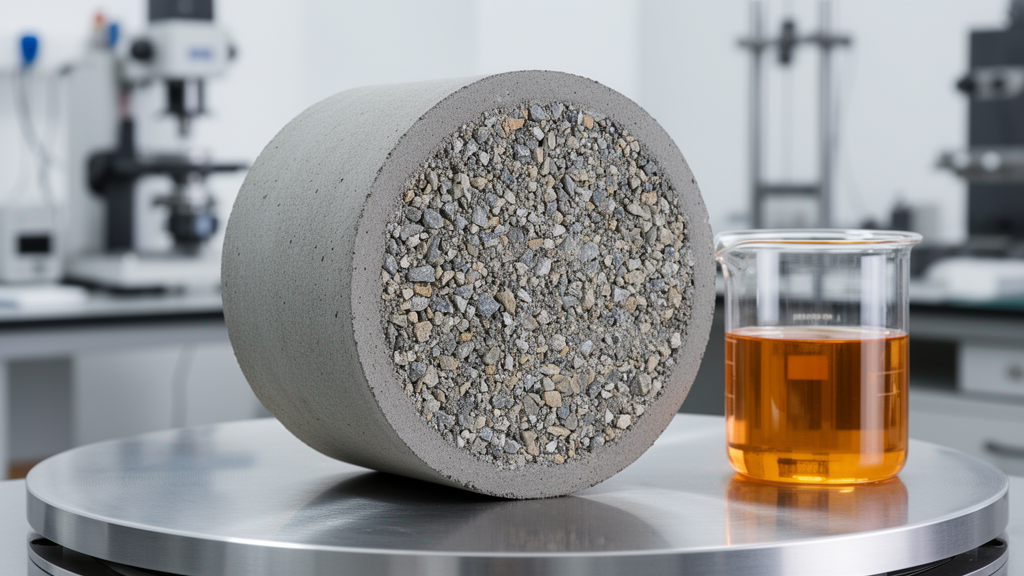
A laboratory investigation into the physical behavior of concrete has demonstrated that utilizing smaller coarse aggregate particles alongside a chemical superplasticizer generates higher compressive and flexural strength, even as smaller aggregates lead to increased long-term drying shrinkage strains. The study evaluated six distinct concrete mix formulations prepared with a prescribed mix ratio of 1:1.5:3, systematically examining the mechanical consequences of pairing three single-sized crushed granite aggregates measuring 12.5 millimeters, 16 millimeters, and 19 millimeters with and without the inclusion of Conplast SP430, a high-performance chemical admixture. The resulting experimental observations revealed distinct trade-offs between mechanical strength development and volumetric dimensional stability across varying curing durations.
The primary experimental focus centered on resolving an existing gap in construction materials literature regarding the simultaneous interaction between coarse aggregate sizing and superplasticizer inclusion. While earlier research had independently addressed aggregate gradations or water-reducing admixtures, fewer investigations had mapped how their combination directly dictates structural performance indicators over prolonged timeframes. In structural applications, concrete undergoes volume changes known as shrinkage, driven predominantly by internal moisture movement and evaporative moisture loss. Drying shrinkage specifically represents water movement escaping outside concrete elements into the surrounding environment, a mechanism that induces microcracking, compromises material durability, and undermines structural serviceability.
To rigorously examine these mechanisms, the research team sourced crushed granite coarse aggregate from Bluestone Quarry in Akija village, Abeokuta, Ogun State, Nigeria, confirming compliance with BS 822 standards. Fine aggregate consisted of natural river sand retrieved from the Ogun River, which sieve analysis categorized within Zone 2 with a maximum particle size of 4.75 millimeters. The cementitious binder utilized was Limestone Portland Cement manufactured by Lafarge Cement Company, meeting BS 12 requirements with a measured initial setting time of 105 minutes and a final setting time of 220 minutes. Mixing procedures employed potable water, maintaining water-to-cement ratios of 0.55 for baseline mixtures prepared without admixtures and a reduced ratio of 0.40 for mixes formulated with Conplast SP430.
Preliminary mechanical and physical testing of the raw materials established baseline geological and structural parameters prior to full specimen fabrication. The apparent specific gravity and particle gradations were determined through standardized laboratory sieving protocols. Sieve analysis showed the fine aggregate possessed a uniformity coefficient of 2.82 and a curvature coefficient of 0.93, designating it as poorly graded soil under the Unified Soil Classification System. Similarly, the coarse aggregate exhibited a uniformity coefficient of 1.89 and a curvature coefficient of 1.92, categorizing it as poorly graded gravel. Standardized mechanical durability evaluations yielded an aggregate crushing value of 18.1 percent under an applied compressive force of 400 kilonewtons and an aggregate impact value of 15.25 percent.
Fresh concrete consistency was monitored immediately following mechanical batching through standardized slump testing governed by BS EN 12350-2 protocols. Batching was conducted by weight, initiating with dry blending of cement, sand, and granite for two minutes, followed by three minutes of wet mixing after adding water and pre-diluted superplasticizer. Slump measurements categorized the unadmixed mixtures into class S3 with values between 100 and 150 millimeters, whereas the superplasticized batches reached class S4 with slumps spanning 160 to 250 millimeters. Overall workability improved noticeably when aggregate sizes increased and when the chemical admixture was incorporated, a physical consequence attributed to reduced total aggregate surface area and the electrostatic deflocculation of fine cementitious particles.
Mechanical compressive performance was assessed across 54 cast concrete cubes measuring 150 by 150 by 150 millimeters, cured in water tanks and tested at 7, 21, and 28 days using compressive testing equipment loaded at constant rates between 0.140 and 0.350 megapascals per second. Compressive capacity peaked in samples formulated with 12.5-millimeter aggregate and superplasticizer, achieving a maximum 28-day strength of 34.85 newtons per square millimeter. When comparing aggregate sizes directly, the 12.5-millimeter mixtures exhibited average compressive strength increases of 6.5 percent over 16-millimeter aggregates and 9.7 percent over 19-millimeter aggregates. The inclusion of superplasticizer produced substantial gains, raising 28-day compressive values by 52.72 percent, 48.85 percent, and 50.60 percent for the 12.5-millimeter, 16-millimeter, and 19-millimeter aggregate groups, respectively.
Flexural behavior was systematically evaluated across 36 unreinforced concrete beams measuring 150 by 150 by 750 millimeters, tested under third-point loading configurations at curing intervals of 28 and 56 days. Maximum flexural resistance was recorded in the 12.5-millimeter coarse aggregate mixtures containing superplasticizer, which attained 4.72 newtons per square millimeter at 56 days. At this extended curing age, the addition of superplasticizer yielded flexural strength enhancements of 26.88 percent, 25.62 percent, and 26.76 percent for the 12.5-millimeter, 16-millimeter, and 19-millimeter aggregates compared to their unadmixed counterparts. Overall, the 12.5-millimeter concrete achieved average flexural increments of 3.10 percent and 4.85 percent over the 16-millimeter and 19-millimeter mixtures, while structural failure under transverse loading occurred abruptly along fracture planes situated within the middle-third span.
The underlying mechanical differences observed between coarse aggregate fractions are closely tied to the microstructure of the interfacial transition zone surrounding aggregate boundaries. Larger coarse aggregate stones destabilize spatial packing within fresh concrete, preventing fine cement grains from consolidating tightly at particle interfaces and generating a looser, more porous boundary layer. This porous interfacial transition zone fosters the precipitation of large, oriented calcium hydroxide crystals and ettringite needles rather than dense calcium-silicate-hydrate gel, creating localized planes of structural weakness under mechanical stress. Conversely, smaller aggregate fractions provide greater internal surface area for cohesive gel bonding and promote matrix homogeneity, facilitating more uniform stress distributions across loaded elements.
Long-term dimensional stability was tracked using 18 cast short columns measuring 100 by 100 by 500 millimeters, monitored over a continuous 90-day testing period following an initial 7-day wet-curing stage. Columns were mounted on specialized steel shrinkage test rigs equipped with measuring gauges calibrated to 0.01 millimeters, positioned under environmental conditions averaging 28 degrees Celsius and 80 percent relative humidity. After 90 days, unadmixed columns registered high shrinkage strains of 1929.8, 1684.8, and 1604.5 times ten to the negative sixth power for 12.5-millimeter, 16-millimeter, and 19-millimeter aggregates. Superplasticized specimens exhibited lower strains of 1717.6, 1595.4, and 1519.4 times ten to the negative sixth power, reflecting reduced evaporable water contents.
Crucially, drying shrinkage strain scaled inversely with coarse aggregate size, displaying a behavioral pattern opposite to that recorded during compressive and flexural testing. In mixtures without superplasticizer, using smaller 12.5-millimeter aggregate produced shrinkage strain increases of 14.50 percent and 20.30 percent relative to 16-millimeter and 19-millimeter mixes. In superplasticized concrete, the 12.5-millimeter aggregate generated increases of 7.77 percent and 13.04 percent over the larger sizes. These dimensional dynamics occur because larger aggregate particles establish a stiffer, interconnected skeleton that provides greater internal mechanical restraint against cement paste contraction. The researchers emphasized that the findings reflect experimental laboratory conditions with single aggregate gradations and a single admixture dosage without direct microstructural imaging.
To quantify the relative importance of each production parameter, the researchers conducted an analysis of variance on the experimental strength data. The statistical evaluation revealed that curing duration, coarse aggregate dimension, and superplasticizer incorporation each exerted a statistically significant influence on compressive and flexural performance, with all variables satisfying significance thresholds below 0.05. According to calculated F-values and corresponding Pareto distribution plots, chemical admixture addition produced the single greatest relative effect on concrete compressive capacity, followed by curing duration, whereas aggregate dimension exhibited the smallest comparative impact. The resulting regression models demonstrated high predictive accuracy based on their coefficients of determination and adjusted values, affirming that the mathematical framework reliably projects mechanical strength responses across varied mixture configurations.
The pronounced mechanical gains attributable to the admixture stem directly from its chemical formulation as a sulfonated naphthalene polymer. In commercial concrete production, where ready-mixed operations generate most in-situ material worldwide, synthetic admixtures function by imparting a uniform negative electrostatic charge across individual cement grains. This mutual electrostatic repulsion causes clustered cement particles to deflocculate and disperse thoroughly throughout the mixing water rather than agglomerating into tight clumps. This dispersion releases entrapped water to lubricate the fresh matrix, expedites early ettringite crystal formation during initial hydration, and enables significant reductions in mixing water without forfeiting workability or consolidating density.
Ambient environmental fluctuations during the prolonged monitoring period also played an active role in governing cumulative column shrinkage. Because drying shrinkage reflects a combination of internal autogenous reactions and external desiccation from evaporating moisture, transient climate shifts measurably altered deformation rates. Elevated ambient temperatures above 28 degrees Celsius accelerated cement hydration kinetics and structural pore restructuring while driving moisture outward into surroundings with relative humidity varying between 60 and 90 percent. Across the ninety-day observation window, incorporating the superplasticizer reduced total shrinkage strain by 12.35 percent in the 12.5-millimeter aggregate specimens, while achieving identical 5.60 percent strain reductions in both the 16-millimeter and 19-millimeter mixtures. These coordinated findings establish clear empirical relationships that allow structural engineers to project mechanical capacity while proactively mitigating excessive shrinkage cracking in field applications.
Subject of Research: Mechanical properties and drying shrinkage of concrete influenced by superplasticizer and coarse aggregate size
Article Title: The effects of superplasticizer and coarse aggregate sizes on the mechanical properties of concrete and its drying shrinkage
Article References: Abiodun, Y. O., Fatokun, A. A., Orisaleye, J. I., & Kolawole, S. O. (2026). The effects of superplasticizer and coarse aggregate sizes on the mechanical properties of concrete and its drying shrinkage. Discover Concrete and Cement, 2(1), Article 44. https://doi.org/10.1007/s44416-026-00084-2
Image Credits: AI Generated
DOI: 10.1007/s44416-026-00084-2
Keywords: concrete technology, coarse aggregate size, superplasticizer, compressive strength, flexural strength, drying shrinkage, shrinkage strain, workability, slump test, interfacial transition zone, construction materials, curing duration, water-cement ratio, Conplast SP430, aggregate impact value, aggregate crushing value, structural engineering
News Source: Denise Maddox. (November 13, 2026). Smaller Coarse Aggregates and Superplasticizer Boost Concrete Strength While Increasing Shrinkage. Scienmag.