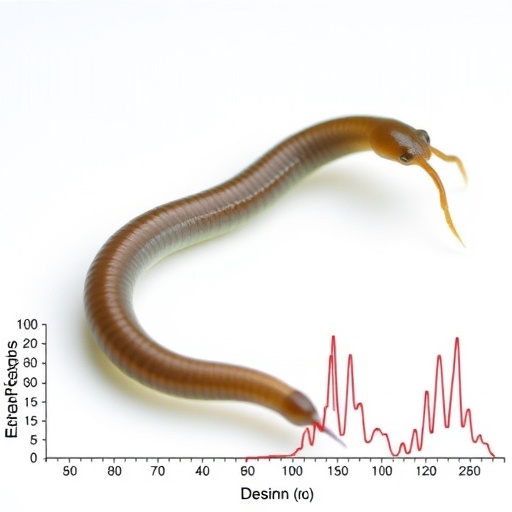
In a groundbreaking study slated for publication in Nature Communications, researchers Zhang and Gems challenge a long-held assumption in the biology of aging by elucidating the true nature of lifespan extension in the nematode Caenorhabditis elegans. Contrary to the prevailing belief that slowed Gompertzian ageing in these long-lived worms reflects a deceleration of the aging process itself, their findings reveal that increased longevity is instead attributable to an expansion of the period of decrepitude — the phase of frailty and decline prior to death — rather than a slowing down of biological aging per se. This paradigm-shifting insight compels a reevaluation of how lifespan extension is interpreted not only in C. elegans but more broadly across species and experimental paradigms.
Ageing research has long relied on the Gompertz law, a mathematical model describing the exponential increase in mortality rates with advancing age, as a cornerstone for interpreting longevity interventions. Traditionally, a flattened Gompertz curve, with a reduced mortality acceleration, has been equated with slowed intrinsic aging. However, Zhang and Gems meticulously dissect the mortality dynamics of C. elegans, a widely used model organism prized for its simplicity, genetic tractability, and conserved aging pathways, uncovering that a slower increase in death rates is accompanied not by prolonged healthspan — the duration of life free from significant functional impairment — but by a marked lengthening of the decrepit phase.
By analyzing large cohorts of long-lived C. elegans mutants and wild-type controls, the authors observed that interventions known to increase lifespan, such as genetic mutations affecting insulin/IGF-1 signaling and dietary restriction, paradoxically lead to an elongation of frailty. Through rigorous quantitative survival analysis coupled with detailed phenotypic characterization, their work differentiates between two critical components of lifespan: the healthy, robust period, and the decrepitude phase characterized by diminished motility, feeding, and stress resistance. Importantly, this protracted terminal phase accounts for the observed deceleration of mortality increase, not a fundamental slowing of aging mechanisms.
This revelation challenges the widely held notion that longevity interventions unequivocally promote healthy aging. Instead, the findings suggest a more complex scenario where lifespan extension reflects increased survival despite a prolonged terminal decline rather than a compression of morbidity. From a mechanistic perspective, the work invites a critical reassessment of how aging biomarkers are interpreted and urges the development of more nuanced metrics that distinguish between life extension with preserved function and outright prolongation of dysfunction.
The authors delve into the biological underpinnings of this phenomenon, hypothesizing that the extended decrepitude may arise from a decoupling of damage accumulation from death onset or from alterations in stress resistance pathways that reshape mortality trajectories without fundamentally reducing the rate of deteriorative processes. Zhang and Gems’ study utilizes state-of-the-art statistical modeling to separate baseline mortality risk from the age-dependent acceleration of mortality, revealing that while baseline risk is substantially lowered by interventions, the exponential increase in vulnerability remains largely unaltered.
Moreover, the research provides new insights into the evolutionary trade-offs underlying longevity and frailty. The expansion of the decrepit phase might represent a biological compromise wherein resources are allocated to prolong survival in a debilitated state, perhaps providing evolutionary advantages under certain ecological contexts but complicating interpretations of “successful” aging. This nuanced appreciation is critical as C. elegans serves as a foundational system for aging research with translational aspirations towards human health.
Zhang and Gems also address the translational implications of their findings. In the quest for interventions that promote healthy human aging, biomarkers and endpoints that do not discriminate between healthspan and mere lifespan extension may yield misleading conclusions. Their work highlights the urgency of integrating functional phenotyping and quality-of-life indices into longevity studies to differentiate between true rejuvenation therapies and those that simply delay death without improving organismal vitality.
The study further discusses the methodological implications for aging research. Frequently employed lifespan assays, reliant on mortality curves alone, may fail to capture the complexity of age-related decline, underscoring the importance of multi-dimensional phenotyping. The expansion of decrepitude observed in C. elegans serves as a cautionary tale, illustrating how an overt focus on longevity can obscure the multidimensional nature of aging processes.
In addition to the biological and methodological contributions, the narrative framed by Zhang and Gems is poised to stimulate lively debate within the gerontology community about the definitions of aging and successful aging interventions. Their findings challenge the field to rethink objectives from simply extending lifespan to enhancing healthspan, emphasizing the need for comprehensive evaluation frameworks.
The implications extend beyond C. elegans, as the study poses provocative questions about whether similar patterns of extended decrepitude underpin other model organisms exhibiting increased longevity. It prompts a critical re-examination of existing data in mammals and potentially humans, considering that prolonged frailty could mask or mimic slowed aging at the phenotypic level.
Furthermore, the authors propose that the expansion of decrepitude in long-lived worms might reflect fundamental constraints inherent in biological systems, where radical slowing of aging is difficult to achieve without deleterious trade-offs. This view aligns with emerging theories in geroscience about the limits of lifespan extension and the complex interplay between survival, function, and senescence.
In conclusion, the work by Zhang and Gems redefines how aging and lifespan extension are conceptualized in one of biology’s premier model organisms. By separating slowed mortality increase from slowed intrinsic aging and emphasizing the expansion of the frail phase, they provide a more sophisticated framework that will influence experimental design, interpretation of data, and translational strategies across the aging research spectrum. This study is a clarion call to reorient aging research towards understanding and compressing decrepitude, ensuring that life extension equates to life worth living.
As the gerontology field grapples with these insights, future investigations will likely focus on identifying mechanisms capable of sustaining both lifespan and functional robustness, aiming to uncouple longevity from frailty. The challenge ahead is clear: to move beyond simple lifespan metrics to holistic aging interventions that promote vitality and health alongside extended years.
Subject of Research: Aging dynamics and mortality in long-lived Caenorhabditis elegans
Article Title: Slowed Gompertzian ageing in long-lived C. elegans results from expansion of decrepitude, not decelerated ageing
Article References:
Zhang, B., Gems, D. Slowed Gompertzian ageing in long-lived C. elegans results from expansion of decrepitude, not decelerated ageing. Nat Commun (2026). https://doi.org/10.1038/s41467-026-71780-7
Image Credits: AI Generated
Tags: age-related frailty phasebiological aging decelerationC. elegans aging researchexpanded period of declineexperimental aging paradigmsGompertz law in agingintrinsic aging vs decrepitudelifespan extension mechanismslifespan interpretation in model organismsmortality rate dynamicsnematode longevity studiesslowed Gompertzian aging