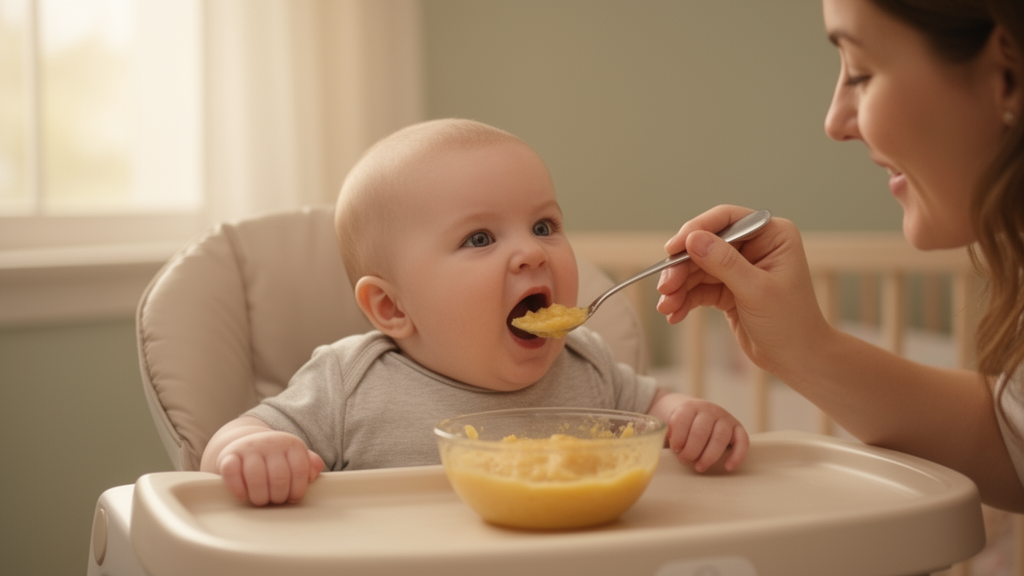
Every parent knows the scene: one baby demolishes a bowl of purée in minutes while another takes half an hour to nibble a single piece of toast. Whether that difference matters for a child’s future health has long been debated, because eating quickly is widely considered an obesogenic behaviour in older children and adults. Now, one of the largest and most technically rigorous studies ever conducted on infant eating speed suggests that the story begins far earlier than most researchers assumed. In a sample of 625 infants aged just 7 to 10 months, faster eaters consumed substantially more energy from solid foods each day, while babies who fed themselves, and those who were still breastfed, ate noticeably more slowly than their spoon-fed and formula-fed peers.
The findings come from First Foods New Zealand, an observational study led by Alice M. Cox of the University of Otago and colleagues, published in the International Journal of Obesity. What sets the work apart is its methodological ambition. Rather than relying on a single measure of eating speed, the team triangulated three distinct approaches: two multiple-pass 24-hour diet recalls capturing 4,405 individual eating occasions, the ‘slowness in eating’ subscale of the Children’s Eating Behaviour Questionnaire completed by caregivers, and, for a subsample of 205 Dunedin families, a GoPro video recording of a real home mealtime. That combination of subjective and objective measurement is rare in infant nutrition research, where most previous studies have depended entirely on parental questionnaires that are vulnerable to recall and reporting bias.
The technical details of the video analysis reveal how demanding this kind of measurement is. Researchers defined the start and end of each eating occasion as the first and last time any complementary food passed through the infant’s lips, then subtracted any ‘interruption to the food supply’ longer than 30 seconds, periods when the baby had no food within arm’s reach and was not actively being offered any. Videos were discarded if filming began after eating had started, if the meal appeared to finish early, or if the infant did not eat. The result was 176 analysable mealtime recordings, most filmed in the evening, in which caregivers reported that the occasion was typical for their child.
Across the diet recalls, infants averaged 3.6 eating occasions per day, spent about 19 minutes eating at each one, and consumed roughly 1,322 kilojoules daily from complementary foods, eating at an average speed of 22 kilojoules per minute. The associations with total intake were striking. Each 10 kilojoule per minute increase in eating speed was linked to an extra 253 kilojoules consumed per day, and each additional 10 minutes of eating duration was associated with 198 more kilojoules daily. Because the average eating speed in the sample was itself only 22 kilojoules per minute, a 10 kilojoule per minute difference represents roughly half of typical eating speed, making the effect size far from trivial. Caregiver perceptions told the same story: each one-unit increase on the ‘slowness in eating’ scale corresponded to 125 fewer kilojoules per day.
Perhaps the most surprising result, however, is what did not appear. Despite the clear link between eating speed and energy intake, eating speed showed no significant relationship with infant weight status as measured by BMI z-scores calculated against World Health Organization growth standards. Only one measure, eating duration from the diet recalls, was associated with BMI, and that weakly: each extra 10 minutes of eating was linked to a slightly lower BMI z-score. The authors caution that several explanations are plausible. Without measures of energy expenditure, it is impossible to know whether faster eating produced genuinely excessive intake, and at 7 to 10 months these infants had only recently been introduced to solid food, so any weight consequences may simply not have had time to emerge. The evidence in older children is also mixed, and nearly all of it, including this study, is cross-sectional, which rules out any claim of causation.
The study also tested a contemporary parental anxiety: the squeeze pouch. Critics, including the German Society for Pediatrics and Adolescent Medicine, have warned that pouches, with their smooth purées and easy-access nozzles, might train babies to eat rapidly. The New Zealand data offer little support for that fear in this age group. Infants defined as frequent pouch users, those eating from a pouch five or more times a week, did not eat faster than other babies on any measure. The only significant difference was shorter meal duration on the video measure, about three minutes less, and even that did not translate into faster eating speed. Notably, only around 5 percent of infants in the study actually sucked food directly from the pouch nozzle, so the findings say little about that specific mode of consumption, which the authors suggest should be the focus of future research.
Baby-led weaning told a much clearer story. Infants classified as following ‘full’ baby-led weaning, meaning they mostly or always fed themselves rather than being spoon-fed, spent nearly four minutes longer per eating occasion and ate about 3 kilojoules per minute more slowly than traditionally spoon-fed infants according to the diet recalls, with similar patterns in the video data. On the caregiver questionnaire, the difference was moderate in size, a standardised difference of 0.6 standard deviations. This is the first published evidence on eating speed and baby-led weaning in infants this young, and it aligns with a retrospective study of slightly older infants, though two studies in toddlers aged one to four found no lasting differences, possibly because of recall bias in how feeding method was measured.
Milk-feeding status mattered too. Breastfed infants, who made up two-thirds of the sample, ate complementary foods more slowly than formula-fed infants on every measure: about 3 kilojoules per minute slower in the recalls, 9 kilojoules per minute slower on video, with 3.4 minutes longer eating duration and higher ‘slowness in eating’ scores. One plausible mechanism is overlap between feeding styles, since baby-led weaning was more prevalent among breastfed infants in this cohort, and previous research has consistently linked breastfeeding with self-feeding approaches. The study could not determine whether breastfed babies were fed milk immediately before meals, which might also influence how eagerly they attacked solid food.
The appetite psychology underneath these behaviours is equally revealing. Faster eating, measured objectively, was correlated with lower satiety responsiveness and lower food fussiness, both food-avoidance traits, and with higher food responsiveness and higher enjoyment of food, both food-approach traits. In other words, the babies who ate fastest were also the ones most driven by food and least sensitive to fullness cues, a combination that in older children predicts higher adiposity risk. The correlations were statistically robust but individually weak, each below 0.3 standard deviations, and eating duration showed fewer and less consistent associations with these traits, hinting that speed and duration, though related, are genuinely distinct behaviours that may follow different developmental paths.
The study’s strengths, a large, ethnically and socioeconomically diverse sample, careful dietary assessment using the Multiple Source Method to estimate usual intake, standardised anthropometry, and naturalistic video measurement, make it a landmark first description of eating speed during the earliest phase of complementary feeding. Its limitations are equally clear: a cross-sectional design that cannot establish direction, a video subsample that was younger and less ethnically diverse than the full cohort, and a single filmed meal that may not represent every baby’s typical behaviour, though most caregivers rated the occasion as usual and the video estimates closely matched the recall data. What the research ultimately delivers is a provocative early snapshot. The seeds of eating pace, and its links to appetite and intake, appear to be sown in the first months of solid food, shaped in part by whether a baby is handed a spoon or handed the meal itself.
Subject of Research: Eating speed and its associations with energy intake, weight status, breastfeeding, baby food pouch use and baby-led weaning in infants aged 7 to 10 months
Article Title: Eating speed in complementary fed infants: associations with energy intake, weight status, breastfeeding, baby food pouch use and baby-led weaning
Article References: Cox, A. M., Heath, A.-L. M., Haszard, J. J., Conlon, C. A., Beck, K. L., von Hurst, P. R., Te Morenga, L. A., Daniels, L., Jones, E. A., Katiforis, I., Brown, K. J., Rowan, M., Casale, M., McLean, N. H., Bruckner, B. R., Jupiterwala, R. M., & Taylor, R. W. (2026). Eating speed in complementary fed infants: associations with energy intake, weight status, breastfeeding, baby food pouch use and baby-led weaning. International Journal of Obesity. https://doi.org/10.1038/s41366-026-02234-9
Image Credits: AI Generated
DOI: 10.1038/s41366-026-02234-9
Keywords: infant nutrition, eating speed, complementary feeding, baby-led weaning, baby food pouches, breastfeeding, energy intake, childhood obesity, eating behaviour, satiety responsiveness, BMI z-score, First Foods New Zealand
News Source: Harold Sullivan. (October 9, 2026). Slow Eaters, Fast Eaters: What 625 Babies Reveal About How Feeding Styles Shape Infant Appetite. Scienmag.