When a female Aedes aegypti mosquito goes searching for a place to lay her eggs, she is making one of the most consequential decisions of her life. Choose well, and her offspring will find food, shelter, and freedom from predators; choose poorly, and her entire reproductive investment can be wiped out. For decades, researchers have studied how this relentless urban mosquito — the primary vector of dengue, yellow fever, Zika, and chikungunya viruses — evaluates the artificial water-holding containers where it thrives. Most of that attention has fallen on properties of the vessel and the water itself: container size and color, water quality, dissolved organic matter, and free-living microorganisms. A new study published in Parasites & Vectors turns the spotlight on a long-overlooked feature of these breeding sites, one that many of us have seen with our own eyes without ever thinking about what it means to a mosquito: the slimy film of microorganisms coating the inner walls of water containers.
That film, known as periphyton, is a complex community of algae, bacteria, and other microorganisms that grows on submerged surfaces wherever light and nutrients are available. In natural aquatic ecosystems, periphyton is well studied as a foundation of food webs and a sensitive indicator of water quality. But in the tiny, human-made ecosystems of buckets, tires, and other discarded containers where Aedes aegypti lays its eggs, periphyton has remained essentially unstudied. The research team, led by Luisa M. Otero-Lopez and Roberto Barrera of the Entomology and Ecology Team at the Centers for Disease Control and Prevention’s Dengue Branch in San Juan, Puerto Rico, together with Alexandra J. Bauer and Eric P. Caragata of the Florida Medical Entomology Laboratory at the University of Florida, suspected that these microbial films might serve a dual role: as a chemical signpost signaling a container’s suitability, and as a ready-made food source for the larvae that would hatch there.
The logic behind that hypothesis is rooted in mosquito sensory biology. Gravid female mosquitoes rely on a diverse array of chemosensory cues to evaluate potential oviposition sites. Volatile compounds released by water, bacteria, and decaying organic material can tell a female whether a container holds nutrients her larvae will need, or whether it harbors predators, pathogens, or competitors that could doom them. A well-developed periphyton community, sitting visibly on the container wall, integrates information about light exposure, water stability, and microbial productivity over time. In other words, it is a biological record of the container’s history — and potentially an honest signal that this is a place where mosquito larvae have flourished before.
To test the idea, the researchers began in the field, collecting periphyton from an artificial water-collecting container that visibly harbored Aedes aegypti larvae and pupae. That choice mattered: rather than growing a synthetic microbial community in the laboratory, they worked with a natural assemblage that real mosquito generations had already coexisted with, preserving the ecological complexity that laboratory cultures often strip away. The harvested periphyton was then propagated in 36 plastic buckets filled with water, and the team waited until the films were firmly established on the bucket walls before beginning behavioral testing.
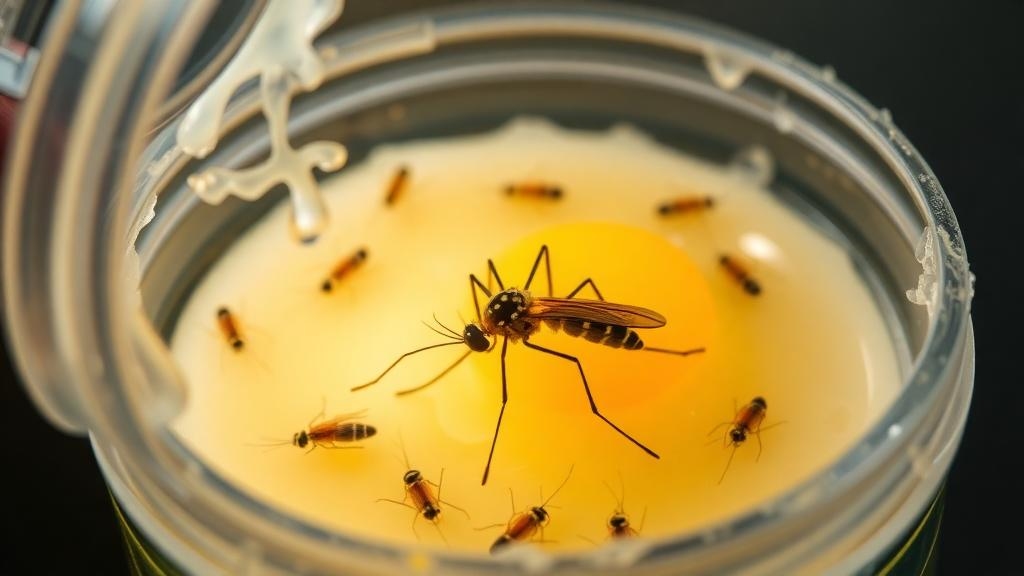
The behavioral assays took place in a semi-field cage, a setting that strikes a balance between the realism of the outdoors and the control of the laboratory. Gravid female Aedes aegypti were released into the cage and presented with choices: buckets bearing periphyton films, buckets containing only water that had been exposed to periphyton, or buckets of plain dechlorinated water. This design allowed the researchers to disentangle two possible routes of attraction. If the mosquitoes responded to chemicals diffusing from the microbial film into the water, then periphyton-exposed water alone should attract them. If contact with or visual detection of the film itself mattered, only the buckets with intact periphyton layers would stand out. Across two different experimental designs encompassing eleven replicate trials, the answer was consistent: females laid significantly more eggs in buckets with periphyton than in the controls, demonstrating that these microbial films actively promote oviposition by this medically important mosquito.
Consistency across replicate trials is what gives the finding its weight. Oviposition behavior in mosquitoes can be notoriously variable, influenced by female age, egg load, humidity, and subtle environmental gradients. Yet across eleven independent trials spanning two experimental configurations, the pattern held: periphyton-containing buckets outperformed controls every time. That repeatability in a semi-field setting suggests the effect is robust enough to matter in real-world container habitats, not just an artifact of laboratory conditions.
The behavioral results raise an obvious follow-up question: what exactly lives in these films? To answer it, the team turned to 16S ribosomal RNA fingerprinting, a DNA sequencing technique that targets a gene found in all bacteria and archaea. By amplifying and sequencing this marker gene from periphyton samples, researchers can catalog the microbial taxa present and estimate their relative abundances, generating a fingerprint of the community’s composition without needing to culture each organism in the lab. The sequences are sorted into zero-radius operational taxonomic units, or zOTUs, which serve as fine-scale proxies for bacterial species, and from these the team can compute diversity metrics that describe how rich and even the communities are.
The fingerprinting results revealed that container periphyton is far from a simple bacterial smear. The communities proved complex, but were predominantly composed of taxa from three phyla: Bacteroidetes, Cyanobacteria, and Pseudomonadota. Each of these groups carries ecological significance. Cyanobacteria are photosynthetic microbes that anchor the community’s energy supply by converting sunlight into biomass, much like microscopic plants. Bacteroidetes are prolific degraders of complex organic molecules, breaking down the detritus and algal exudates that accumulate in standing water. Pseudomonadota, one of the largest and most metabolically diverse bacterial phyla, includes species known to produce volatile compounds that mosquito sensory systems can detect. Any of these groups — or the volatile chemistry they generate collectively — could be responsible for the attractant signal that drew gravid females to the periphyton-bearing buckets. The sequencing data have been deposited in the National Institutes of Health Sequence Read Archive under BioProject PRJNA1374143, making the raw community data available to other researchers.
The implications of the work extend well beyond basic ecology. Current Aedes aegypti control relies heavily on source reduction — eliminating standing water — and on insecticides, tools that face growing resistance and logistical challenges in dense urban environments. If the specific chemical cues that make periphyton attractive can be identified, they could be formulated into novel oviposition attractants, luring gravid females into traps or into treated containers where their eggs never survive. Conversely, understanding these cues could inform repellent strategies, making harmless containers deliberately unattractive. Attract-and-kill approaches of this kind have long been a goal of vector biology, and the study’s authors note that understanding periphyton’s attractive properties could prompt exactly such developments. The work was supported by internal funding from the U.S. Centers for Disease Control and Prevention, and the authors caution that the findings and conclusions are their own and do not necessarily represent the views of the CDC.
There is also a broader scientific lesson here about the ecology of urban disease vectors. The containers that Aedes aegypti breeds in are not sterile pools of water; they are miniature ecosystems with walls coated in photosynthetic and heterotrophic microbes, water conditioned by their metabolic byproducts, and chemical landscapes that rival any natural wetland in complexity. By showing that a feature as mundane as a greenish film on a bucket wall can steer the egg-laying decisions of one of the world’s most important disease vectors, this study opens a new window onto the sensory ecology of urban mosquitoes — and onto the possibility that the next generation of mosquito control tools might be built from the very microbes these insects have been quietly reading all along. The open-access article, published on 14 October 2026, was citable from its acceptance with a permanent DOI, ensuring that the underlying data and methods are immediately available to the vector biology community worldwide.
Subject of Research: Periphyton as an oviposition attractant for the mosquito Aedes aegypti in artificial containers
Article Title: The role of container periphyton as an oviposition attractant for female Aedes aegypti
Article References: The role of container periphyton as an oviposition attractant for female Aedes aegypti. (n.d.). https://doi.org/10.1186/s13071-026-07714-5
Image Credits: AI Generated
DOI: 10.1186/s13071-026-07714-5
Keywords: Aedes aegypti, periphyton, oviposition, mosquitoes, microbial communities, Bacteroidetes, Cyanobacteria, Pseudomonadota, 16S rRNA, vector control, chemosensory cues, Parasites & Vectors
News Source: Drew Townsend. (October 14, 2026). Slimy Container Films Act as a Chemical Beacon Drawing Egg-Laying Aedes aegypti Mosquitoes. Scienmag.