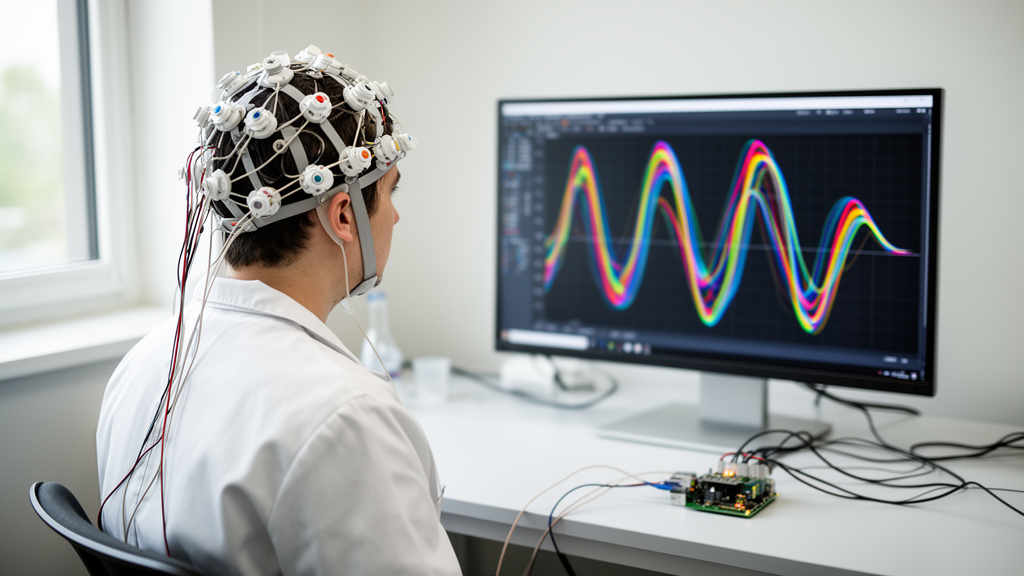
Imagine controlling a robotic arm or a wheelchair purely by thinking about moving your hand. That is the promise of motor imagery brain-computer interfaces, systems that decode the brain’s imagined movements directly from electrical signals recorded on the scalp. Now, a team of researchers at SRM University-AP in India has unveiled a streamlined framework that reads those signals more accurately while running fast enough to fit on a credit-card-sized computer, a combination that could bring brain-controlled devices closer to everyday clinical use.
The new framework, described in Frontiers in Computational Neuroscience, stitches together three components: a sliding window technique that chops each brain signal into overlapping segments, a Fourier decomposition method that splits each segment into distinct frequency bands, and a compact one-dimensional convolutional neural network that learns to recognize which imagined movement produced the signal. The result is a pipeline that achieves 93.67 percent accuracy on a two-class motor imagery benchmark and 79.14 percent on a harder four-class task, while requiring only about 120,000 learnable parameters, a fraction of what comparable deep learning models demand.
Motor imagery is the mental rehearsal of movement without actually moving. When a person imagines squeezing their right hand or wiggling their foot, the brain’s sensorimotor cortex produces characteristic rhythms that shift in predictable ways, a phenomenon known as event-related desynchronization in the mu band around 8 to 12 hertz and the beta band from 13 to 30 hertz. Electroencephalography, or EEG, picks up these voltage fluctuations through electrodes on the scalp, offering a noninvasive window into the brain’s intentions. But the signals are notoriously noisy, weak, and variable from person to person, which has long made reliable decoding a stubborn bottleneck for brain-computer interface design.
Many existing approaches rely on handcrafted spatial filters, such as common spatial patterns, or on complex time-frequency transformations that balloon computational cost. The Indian team, led by B. S. S. Tejesh and M. Ramakrishnan, took a different tack. Rather than treating each EEG trial as a single monolithic chunk, they sliced it into seven overlapping windows using a sliding window approach. This simple move multiplies the training data sevenfold and forces the network to learn finer-grained temporal patterns that might otherwise slip through unnoticed. For the binary dataset, each window spanned 2.3 seconds with a 0.2-second shift between consecutive windows; the four-class dataset used 2.8-second windows with the same shift.
Once segmented, each window passes through a Butterworth band-pass filter that isolates the 8 to 30 hertz range where motor imagery signatures live. Then comes the Fourier decomposition method, a technique grounded in classical Fourier theory but adapted for nonstationary biological signals. The method applies a fast Fourier transform to the filtered signal, divides the resulting spectrum into eight sub-bands using binary masks, and reconstructs each sub-band back into the time domain through an inverse transform. The eight resulting components, called Fourier Intrinsic Band Functions, are orthogonal, zero-mean, and data-driven, meaning they adapt to the specific signal rather than imposing fixed frequency boundaries. The researchers found that eight bands hit the sweet spot: fewer bands blurred the spectral detail, while more bands fragmented the signal without adding useful information.
Those eight components per channel then feed into a lean convolutional network with just two convolutional blocks, the first using 64 filters with a kernel size of 7 to capture broad temporal dependencies, the second using 128 filters with a kernel size of 5 to refine finer local structures. Batch normalization and ReLU activations follow each convolution, and an adaptive average pooling layer compresses the features before a fully connected layer makes the final call. Predictions from all seven windows of a trial are aggregated by majority voting to produce a single label. The entire model contains roughly 0.12 million parameters, compared with 2.4 million for EEGNet and over 96 million for some competing architectures.
The framework was tested on two widely used public benchmarks: BCI Competition III Dataset IVa, which contains recordings from five subjects performing right-hand and foot imagery, and BCI Competition IV-2a, which includes nine subjects performing four distinct imagery tasks. Under subject-dependent evaluation, where the model is trained and tested on data from the same person, the system achieved 93.67 percent accuracy on the binary task and 79.14 percent on the four-class task, with two subjects reaching perfect classification on the binary benchmark. An ablation study confirmed that each component pulls its weight: raw EEG fed directly into the network managed only 52.29 percent on the four-class task, jumping to 70.19 percent with sliding windows alone, 67.49 percent with Fourier decomposition alone, and 79.14 percent with both combined.
Cross-subject generalization, the ability to work for someone whose data the model has never seen, remains the field’s toughest challenge, and the new framework is no exception. Using a leave-one-subject-out protocol with brief calibration on the unseen person, the system averaged 76.49 percent on the binary dataset and 55.50 percent on the four-class dataset, with considerable variability between individuals. The researchers were candid about this limitation, noting that the evaluation was calibration-based rather than strictly zero-shot, and that performance on the four-class task varied widely, from 33.70 percent for one subject to 83.60 percent for another. Still, when benchmarked against eight reimplemented deep learning models under identical conditions, including EEGNet, FBCNet, TCANet, and EEG Conformer, the proposed framework posted the highest mean accuracy on both datasets, with statistical tests confirming significant improvements over most competitors.
Perhaps the most striking result is where the system runs. The team deployed the full pipeline on an NVIDIA Jetson Nano, a low-power embedded board with a quad-core ARM processor and a small GPU, and measured complete processing latencies of 58.119 milliseconds per trial for the binary task and 85.055 milliseconds per trial for the four-class task, corresponding to throughputs of 17.21 and 11.76 trials per second. The model’s peak memory footprint was just 32.58 megabytes, and its inference latency undercut comparable lightweight models by 34 to 80 percent. The researchers caution that these figures reflect offline computation on prerecorded data rather than live, real-time brain-computer interface operation, but they demonstrate that the entire chain, from filtering to decomposition to neural inference, can execute on hardware cheap enough to sit beside a hospital bed or a wheelchair.
For patients with amyotrophic lateral sclerosis, stroke, or spinal cord injury, the gap between laboratory demos and deployable assistive technology has always hinged on exactly this kind of engineering: accuracy that matters, latency that feels instant, and hardware that does not require a server rack. By fusing classical signal processing with a deliberately small neural network, the SRM University-AP team has sketched a plausible path across that gap. The authors point to future work on larger and more diverse subject populations, strict zero-shot evaluation, and hardware implementations on field-programmable gate arrays, steps that could one day turn imagined movements into real, immediate control for the people who need it most.
Subject of Research: A lightweight 1D-CNN framework using sliding window segmentation and Fourier decomposition for motor imagery EEG classification in brain-computer interfaces
Article Title: A sliding window and Fourier decomposition method based 1D-CNN framework for motor imagery EEG classification
Article References: Tejesh, B. S. S., Bhaskar, K., Sivaji, M., Dakupati, R., Ram, S. K., Sanki, P. K., & Ramakrishnan, M. (2026). A sliding window and Fourier decomposition method based 1D-CNN framework for motor imagery EEG classification. Frontiers in Computational Neuroscience, 20, Article 1945160. https://doi.org/10.3389/fncom.2026.1945160
Image Credits: AI Generated
DOI: 10.3389/fncom.2026.1945160
Keywords: brain-computer interface, motor imagery, EEG, Fourier decomposition method, 1D-CNN, sliding window, Jetson Nano, signal processing, deep learning, BCI Competition datasets, embedded deployment, neurotechnology
News Source: Cassandra Pierce. (October 17, 2026). Sliding Windows and Fourier Decomposition Give Brain-Computer Interfaces a Lightweight Edge. Scienmag.