


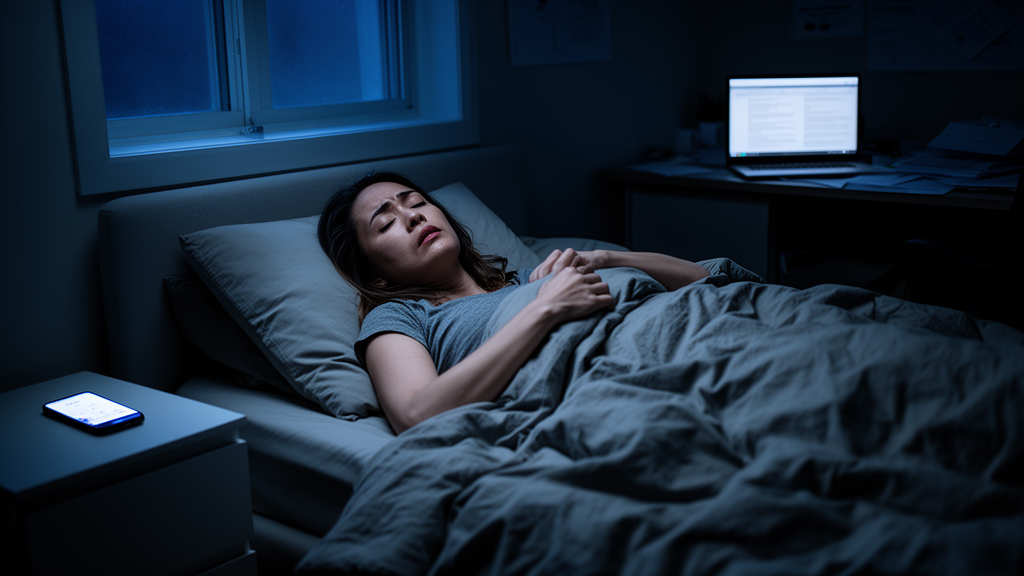
When work stress takes a toll on mental health, not every aspect of sleep contributes equally to that burden. A new cross-sectional study of 9,736 workers in Gansu Province, China, finds that sleep quality and sleep disturbance account for the vast majority of the statistical association between work stress and depressive symptoms, while how long people sleep and how quickly they fall asleep play comparatively minor roles.
The research, published in BMC Public Health, used data from the 2025 Worker Health Survey to estimate the indirect statistical association between work stress and depressive symptoms through overall sleep problems. Using Bayesian mediation analysis, the researchers estimated that this indirect pathway accounted for 27.8% of the total statistical association between work stress and depressive symptoms.
The team then went a step further, breaking sleep into four separate dimensions: sleep quality, sleep disturbance, sleep duration, and sleep latency. Using Bayesian parallel multiple mediation analysis under an assumed ordering of work stress, sleep, and depressive symptoms, they compared how much each dimension contributed to the overall indirect association.
Because the relationship between sleep duration and depressive symptoms may not be a straight line, the researchers evaluated both linear and nonlinear specifications. The nonlinear model showed better predictive performance and indicated a U-shaped association between sleep duration and depressive symptoms, meaning that both too little and too much sleep were associated with higher symptom levels in the model.
Interpreted through that nonlinear parallel model, sleep quality emerged as the dominant contributor, accounting for 50.7% of the estimated total indirect association. Sleep disturbance followed at 37.2%. Sleep duration contributed just 9.2%, and sleep latency a mere 2.9%, suggesting that the subjective experience of poor, disrupted sleep matters far more in this pathway than the clock measures of how long or how quickly people sleep.
The authors conclude that different sleep dimensions may reflect distinct aspects of recovery rather than interchangeable indicators of the same underlying construct. In other words, treating sleep as a single undifferentiated variable may obscure which aspect of nightly recovery is actually doing the statistical work in the link between workplace stress and depression.
The overall pattern was broadly consistent across subgroups, although the relative contributions of individual sleep dimensions varied across demographic, occupational, socioeconomic, and geographic contexts. This suggests that while the hierarchy of sleep dimensions held broadly, the precise weighting of each dimension is not uniform across different populations of workers.
The findings, the researchers suggest, may help inform the development and evaluation of more targeted workplace interventions.
Several caveats are important. The data are cross-sectional, so the analysis estimates statistical associations under an assumed ordering of variables rather than demonstrating causal effects. The study population is drawn from a single Chinese province in 2025, and the authors note the relative contributions were interpreted based on model assumptions, including the nonlinear specification of sleep duration. As an open-access article published on 27 October 2026, the study is shared early as a citable version subject to further edits before the final Version of Record.
Even with those limitations, the study offers a reframing of how sleep fits into the occupational mental health picture. Rather than asking simply whether workers sleep enough, it points toward asking how well they sleep and how disturbed their nights are, positioning sleep as a multidimensional recovery process whose components carry distinctly different weights in the pathway from work stress to depressive symptoms.
Subject of Research: Differential contributions of sleep dimensions to the association between work stress and depressive symptoms in Chinese workers
Article Title: Not all sleep matters equally: differential recovery functions of sleep dimensions linking work stress to depressive symptoms
Article References: Lin, B., Xu, Y., Zhang, H., Meng, Y., Yan, H., Zhou, L., Li, P., & Wu, Y. (2026). Not all sleep matters equally: differential recovery functions of sleep dimensions linking work stress to depressive symptoms. BMC Public Health. https://doi.org/10.1186/s12889-026-30085-6
Image Credits: AI Generated
DOI: 10.1186/s12889-026-30085-6
Keywords: sleep quality, sleep disturbance, work stress, depressive symptoms, Bayesian mediation analysis, occupational health, cross-sectional study, sleep duration, sleep latency, China, worker health survey, mental health
News Source: Glenn Wilkins. (October 29, 2026). Sleep quality, not sleep length, carries the strongest link between work stress and depression. Scienmag.



