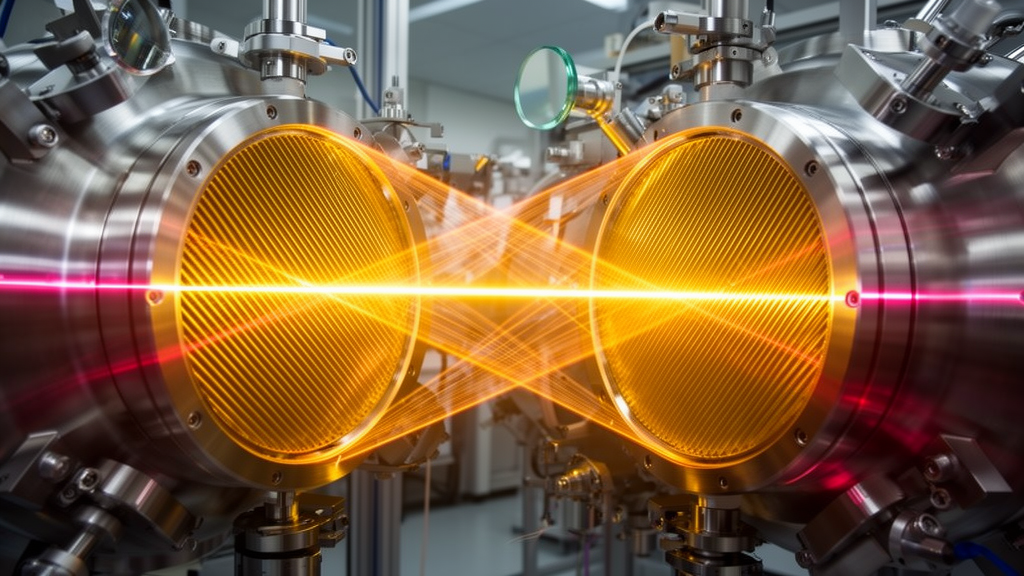
A newly proposed optical pulse compressor architecture utilizing two parallel, Littrow-mounted diffraction gratings with slanted grooves could clear the technical logjam preventing femtosecond research lasers from advancing into the sub-exawatt regime. Developed through analytical modeling and numerical verification, the full-aperture two-grating slanted-groove compressor, designated F2SC, provides an optimized geometry that eliminates the destructive optical hot spots that typically shatter downstream optics while maximizing beam aperture. Theoretical calculations indicate that the architecture can deliver peak output powers exceeding 160 petawatts and achieve focal intensities reaching 5.5 × 10^24 watts per square centimeter when focusing through an F/2 parabolic mirror. By decoupling the incoming and outgoing beam paths through groove slanting rather than complex spatial tilting, the system allows high-energy laser facilities to harness full grating apertures, offering an achievable engineering path for planned 100-petawatt-class research centers in China, Russia, the United States, and Japan without demanding unrealistic advancements in grating fabrication size.
The central bottleneck in modern ultra-high-power femtosecond laser installations is the laser-induced optical damage threshold of the diffraction gratings situated inside the pulse compressor. However, optical materials can withstand significantly higher fluences when illuminated by nanosecond pulses than when subjected to compressed, high-intensity femtosecond radiation. Consequently, the final grating in a pulse compression chain experiences extreme vulnerability, serving as the definitive threshold limiting total system output even though reflection and clipping losses mean that less total energy impinges on the last optical element than on the first. Increasing the damage threshold or manufacturing significantly larger diffraction gratings presents severe material and optical fabrication hurdles, particularly when wide spectral bandwidths and high diffraction efficiencies must be maintained simultaneously across giant optical substrates.
To overcome this damage threshold barrier, previous engineering approaches have explored complex schemes such as coherent beam combining across multiple spatial channels, mosaic tiled-grating arrays, multiple exposure-tiled optics, and multistep compressor architectures employing six or more distinct gratings. While theoretically capable of spreading optical energy across divided surfaces, these architectures introduce formidable mechanical, alignment, and phase-matching challenges that become exceedingly fragile in real-world high-power operations. The conventional baseline architecture deployed across the majority of existing high-power installations remains the classic four-grating Treacy compressor. In this traditional four-grating geometry, two identical pairs of parallel diffraction gratings introduce group velocity dispersion to compress stretched laser pulses. However, avoiding physical overlap between the incoming laser beam and the second grating forces operators to operate at steep incidence angles well beyond the Littrow angle, which intrinsically restricts grating diffraction efficiency across broadband femtosecond spectrums and limits overall energy throughput.
The newly modeled F2SC builds directly upon the full-aperture compressor concept, a configuration in which the cross-sectional size of the input beam matches the full physical projection of the first diffraction grating. In conventional Treacy compressors without beam clipping, the initial beam diameter must remain comparatively small so that every spectral frequency component dispersed across space is completely collected by the second grating without falling off the optical edges. Full-aperture compressors deliberately accept a modest amount of spatial clipping at the perimeter of the second grating in exchange for expanding the input beam to the maximum physical boundary of the first grating substrate. Because the total deliverable beam energy scales quadratically with beam diameter, the geometric power gain afforded by a larger beam significantly outweighs the modest diffraction and energy losses incurred by peripheral spectral clipping, resulting in a net increase in both peak output power and focal intensity on target.
Transitioning from a traditional four-grating compressor to a two-grating asymmetric arrangement yields profound physical advantages in laser-induced damage management. In a two-grating compressor consisting of a single matched grating pair, the continuous spectral dispersion across the beam cross-section introduces an intrinsic spatial-spectral smoothing effect across the output beam profile. This smoothing action washes out local spatial fluence fluctuations and virtually eliminates high-intensity optical hot spots on the surface of the second grating. In standard four-grating compressors, random intensity spikes require operators to maintain an aggressive safety margin, typically restricting the operating fluence to a conservative safety factor of 0.5 relative to the nominal damage threshold. In two-grating systems, the elimination of hot spots permits the safety factor to be safely elevated to 0.75, allowing the system to operate much closer to intrinsic optical material limits. Furthermore, researchers have demonstrated that placing adaptive mirrors before and after a two-grating compressor prevents focal intensity degradation even when the diffraction gratings exhibit surface non-flatness or subtle groove distortions.
Despite these advantages, earlier implementations of two-grating compressors presented distinct physical compromises that limited their practical adoption in broadband femtosecond lasers. The standard planar two-grating Treacy compressor requires a substantial beam separation angle to prevent the output beam from clipping into the input optical path, which forces the angle of incidence far away from the Littrow angle and restricts broadband efficiency. To operate closer to the ideal Littrow configuration, physicists previously introduced the out-of-plane two-grating Littrow compressor, which tilts the grating out of the horizontal dispersion plane using laboratory frame coordinate rotations. However, because this laboratory-axis tilting creates an oblique angle of reflection, the projected beam footprint on the grating surface shears into a skewed parallelogram rather than a clean rectangle. This geometric shearing forces the grating height to be substantially larger than the beam diameter, wasting precious illuminated surface area and severely constraining grating length during holographic exposure.
The full-aperture two-grating slanted-groove compressor circumvents these geometric penalties by rotating the direction of the holographic grooves rather than tilting the entire physical grating substrate across laboratory axes. By slanting the grating grooves at a precisely calculated angle relative to the vertical substrate edge, the system achieves complete vertical decoupling between the incoming and outgoing beam paths while allowing the laser beam to enter and reflect within a strictly orthogonal coordinate reference. Consequently, the projected beam footprint on the first grating remains an exact rectangle that matches the rectangular dimensions of the grating substrate itself, restoring the condition where grating height equals beam diameter. This geometric restoration ensures that the entire rectangular substrate is utilized without geometric wastage, maximizing the effective aperture that can be manufactured within the circular beam illumination zone of standard holographic exposure facilities.
To establish the performance boundaries of the slanted-groove architecture, the research team developed rigorous analytical equations defining optimal compressor parameters under strict holographic manufacturing constraints. The length and height of large-scale diffraction gratings are fundamentally bound by the circular or slightly elliptical illumination spot produced by the off-axis parabolic mirrors in holographic recording setups. By linking substrate dimensions directly to the usable recording aperture diameter, the researchers formulated transcendental equations showing that the optimal operating angles for all compressor geometries depend on only two dimensionless variables: the normalized recording aperture ratio and the normalized groove density. Differentiating the output focal intensity expressions confirmed that maximum intensity occurs at the absolute minimum incidence or slanting angle that satisfies physical beam decoupling, establishing a unified mathematical rule for maximizing energy extraction across plane and out-of-plane compressors.
Quantitative evaluations were conducted using operational parameters from flagship petawatt facilities, specifically examining recording aperture diameters of 190 centimeters and 157 centimeters alongside groove densities between 1080 and 1405 lines per millimeter. Under an optimistic material damage model assuming an incident fluence threshold of 377 millijoules per square centimeter, the F2SC delivers 183 petawatts of peak power, rivaling the planar two-grating Treacy compressor at 186 petawatts and far outperforming the four-grating Treacy baseline of 114 petawatts.
The analytical study also examined how the slanted-groove design behaves under narrower spectral bandwidths, comparing the 240-nanometer bandwidth of the Chinese SEL-100 PW facility with the 150-nanometer bandwidth centered at 910 nanometers planned for Russia’s XCELS project. While conventional compressor theory predicts that peak power drops linearly with decreasing bandwidth due to longer compressed pulse durations, the full-aperture geometry compensates through reduced spectral clipping losses at the second grating. Narrowing the bandwidth by a factor of 1.58 reduces the resulting focal intensity by only a factor of 1.2 to 1.26. Furthermore, operating at the Littrow mounting angle opens up the potential to replace metallic gold gratings with multilayer dielectric gratings. While multilayer dielectric coatings suffer steep diffraction efficiency drops when operated away from Littrow angles, their intrinsic optical damage threshold is dramatically higher under sub-picosecond irradiation, potentially unlocking multi-joule-per-square-centimeter fluence handling and enabling even more compact sub-exawatt compressor footprints.
Because the slanted-groove geometry decouples beams out of the primary dispersion plane, the researchers noted that full optical modeling requires treating beam diffraction as an intrinsically vectorial electromagnetic interaction rather than a simplified scalar problem. Vectorial reflections introduce slight elliptical polarization shifts and phase variations between orthogonal polarization components, which could theoretically cause minor reductions in diffraction efficiency or polarization purity. However, previous experimental evaluations confirm that efficiency losses remain below two percent for vertical decoupling angles under 15 degrees, while spectral depolarization effects scale quadratically with normalized bandwidth and remain negligible for the targeted operating regimes. Additionally, while spatial-spectral beam smoothing introduces an intensity front tilt across the focal region, theoretical analyses show that axial focal intensity remains unaffected, ensuring robust target coupling and establishing the two-grating slanted-groove compressor as a viable foundation for next-generation sub-exawatt laser physics.
Subject of Research: Full-aperture two-grating slanted-groove optical compressor design for sub-exawatt femtosecond lasers
Article Title: A way toward a sub-exawatt laser: the full-aperture two-grating slanted-groove compressor
Article References: Khazanov, E., & Vyatkin, A. (2026). A way toward a sub-exawatt laser: the full-aperture two-grating slanted-groove compressor. High Power Laser Science and Engineering, 14, Article e31. https://doi.org/10.1017/hpl.2026.10113
Image Credits: AI Generated
Keywords: femtosecond lasers, pulse compression, diffraction gratings, slanted-groove compressor, optical damage threshold, sub-exawatt physics, petawatt lasers, Treacy compressor, Littrow mounting, spectral smoothing, beam clipping, multilayer dielectric gratings, SEL-100 PW, XCELS project, focal intensity, chirped pulse amplification, high-power optics
News Source: Denise Maddox. (November 24, 2026). Slanted-Groove Two-Grating Compressor Clears Path Toward Sub-Exawatt Laser Power. Scienmag.