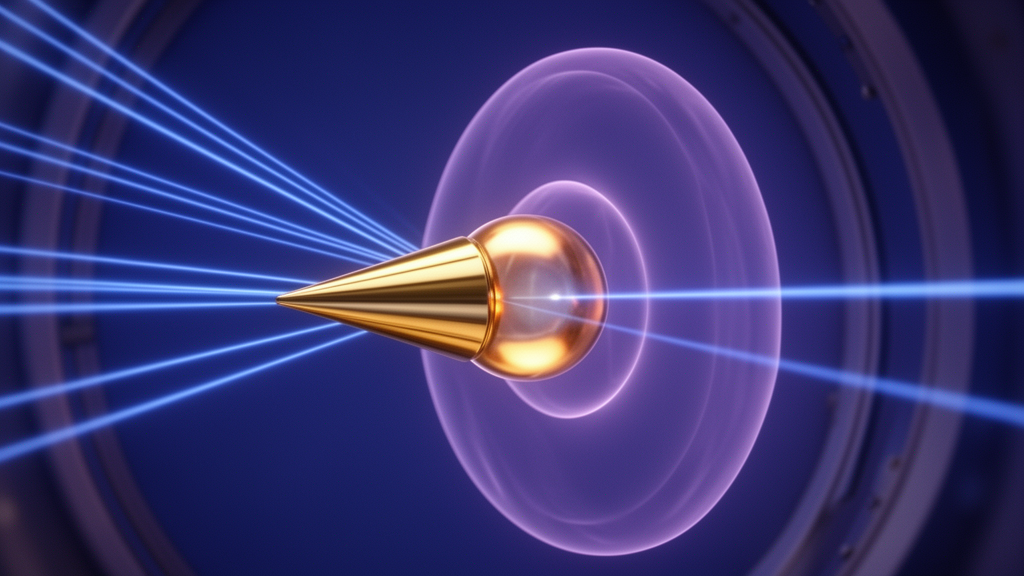
Researchers have experimentally confirmed that the heating cone tip in the double-cone ignition (DCI) scheme remains intact during the critical window for picosecond laser heating. Published in High Power Laser Science and Engineering, the study investigates the hydrodynamic impact of implosion-driven colliding plasmas on the heating cone structure. The central finding is that the shock wave generated by the colliding plasmas breaks through the cone tip later than the injection time of the heating laser, thereby not significantly affecting the fast-electron generation process essential for fusion ignition.
The double-cone ignition scheme is designed to optimize laser energy coupling efficiency by decoupling the compression and heating processes. In this configuration, nanosecond laser pulses first compress the fuel through a quasi-isentropic process. The compressed fuel then erupts from head-on gold compression cones and collides, forming a high-density central region. Subsequently, picosecond laser pulses are focused inside a separate heating cone to generate fast electrons. These electrons transport through the cone tip into the high-density pre-compressed plasma, where they deposit their energy to trigger fusion.
The quality of fast-electron generation is critically sensitive to the inner surface condition of the heating cone tip. If the cone tip is disrupted before the heating laser arrives, the laser interacts with plasma prematurely under non-ideal focusing conditions. This premature interaction degrades the production efficiency of fast electrons and increases beam divergence, severely diminishing the energy deposition efficiency into the compressed fuel. Therefore, ensuring the cone tip remains structurally sound at the moment of laser injection is a critical design constraint for the DCI scheme.
To investigate this issue, the team conducted experiments on the SG-II upgrade laser facility. The target configuration consisted of a pair of symmetrically arranged gold compression cones with an opening angle of 100 degrees, containing fuel shells composed of C16H14Cl2, aluminum, and C8D8. A third gold cone, serving as the heating cone, was inserted in the equatorial plane with its tip positioned less than 60 micrometers away from the target chamber center. The researchers systematically varied the insertion depth of the heating cone to 40 and 50 micrometers to control the plasma conditions inside the cone at the moment of laser injection.
The experimental setup included a visible light imaging system to record the temporal evolution of self-emission within the heating cone. This system collected self-emission at two central wavelengths, 450 and 660 nanometers, using an optical streak camera as a one-dimensional imaging detector. To mitigate background noise from laser-plasma interactions, the optical path included a 380 nanometer long-pass filter and notch filters at 351 and 527 nanometers to block scattered light. Additionally, a Kirkpatrick-Baez X-ray framing camera system was employed to collect keV-range X-rays from the collision region, providing time-resolved physical information on plasma evolution.
Measurements of the optical self-emission revealed a highly consistent temporal evolution at both wavelengths, indicating that the emission was primarily governed by thermal radiation mechanisms rather than bremsstrahlung. The researchers observed that the emission behavior at the inner walls of the cone differed significantly from that at the cone tip. While the side walls showed gradual emission increases likely due to plasma diffusion or X-ray ionization, the cone tip exhibited an abrupt rise in intensity. This sudden change corresponds to hydrodynamic processes involving material state transitions, specifically the arrival of a shock wave front.
The shock wave driving the cone tip breakout is generated by the strong pressure gradient from the colliding high-density plasmas. The total shock-driving pressure is composed of electron degeneracy pressure, thermal pressure, dynamic pressure, and radiation pressure. Analysis of the pressure components revealed that thermal pressure accounts for the highest fraction, providing the dominant contribution to the pressure required for shock breakout. Using the simulated plasma pressure and Rankine-Hugoniot relations, the researchers calculated the transient propagation velocity of the shock wave and determined the time at which it would break through the cone tip.
For a heating cone insertion depth of 40 micrometers, the experimentally measured time for shock breakout at the heating cone tip was approximately 1 nanosecond after the main nanosecond laser pulse ended. In contrast, for an insertion depth of 50 micrometers, the shock breakout was observed at approximately 2.3 nanoseconds after the laser pulse ended. The theoretical calculation predicted a shock breakout time of approximately 0.6 nanoseconds for the 40 micrometer depth. The slight discrepancy between the theoretical and experimental values is attributed to the ideal one-dimensional planar shock assumption used in the calculation, whereas the actual cone structure mitigates the shock through its sidewalls, and turbulent structures in the colliding plasmas introduce an oblique impact angle.
The X-ray diagnostics provided crucial timing information for the optimal injection of the picosecond heating laser. The peak density of the plasma in the collision region temporally coincides with the moment when the X-ray emission intensity reaches its maximum. Statistical analysis of the time-resolved X-ray intensity across multiple shots indicated that the peak emission occurs approximately 0.6 nanoseconds after the termination of the nanosecond laser pulse. This timing aligns with the MULTI-2D simulation results, which also identified the peak density time as approximately 0.6 nanoseconds after the laser pulse ends.
The comparison between the shock breakout timing and the optimal laser injection timing demonstrates that the heating cone remains intact during the critical heating phase. For the 40 micrometer insertion depth, the shock wave breaks the cone tip at 1 nanosecond, which is later than the 0.6 nanosecond injection time. This timing window ensures that the picosecond laser interacts with the intact cone tip, allowing for efficient fast-electron generation. The results confirm that under the current target design and laser conditions, the shock wave does not significantly affect the heating process.
The study also highlights a distinct advantage of the DCI scheme over traditional fast ignition approaches. In conventional fast ignition, the heating cone is continuously immersed in low-density deuterium-tritium gas and subjected to persistent plasma pressure. In contrast, the heating cone in the DCI scheme experiences significant pressure only at a later stage when the colliding plasmas exit the compression cones and begin to stagnate. This delayed loading fundamentally mitigates cone damage and provides a previously unquantified advantage for the DCI scheme.
The researchers note that fully validating cone survivability under ignition-scale conditions remains an open question. At the ignition scale, the nanosecond laser energy required for implosion will be far greater than that used in the present experiment, coupled with a higher fuel mass. However, the larger amount of laser energy is distributed and deposited across the increased fuel mass, suggesting that the plasma pressure may remain comparable to that described in this paper. The current results provide physical insight and quantitative constraints on the coupling between compression dynamics and short-pulse heating, offering experimentally validated guidance for target design and timing optimization in future high-energy-density experiments.
The experimental configuration relied on sixteen nanosecond laser beams, each delivering 1750 joules formatted into the tailored DCI-R9 pulse shape to drive the implosion. Target fabrication featured carefully dimensioned fuel shells nested within the paired gold compression cones. These shells possessed an outer radius of approximately 570 micrometers and an inner radius of about 470 micrometers, structured into three distinct functional layers. An outer chlorinated plastic layer served as the ablator while enabling temperature diagnostics via chlorine characteristic emission lines. Beneath it, an intermediate 100-nanometer aluminum layer acted as an optical shield to prevent transmitted laser light from penetrating inward, while a deuterated plastic layer functioned as the primary fuel for compression and heating. To relay the optical self-emission from within the heating cone, the diagnostic beamline coupled a primary lens having a focal length of 300 millimeters at threefold magnification with relay optics, delivering a tenfold overall magnification to the optical streak camera.
In evaluating the slower-rising self-emission recorded along the heating cone sidewalls at negative 0.2 millimeters, the authors eliminated hard X-ray preheating as the driving cause. Prior fast-ignition investigations established that a 14-micrometer gold barrier sufficiently suppresses X-ray preheating, whereas the experimental cone walls measured 20 micrometers in thickness. Instead, this wall signal is attributed to coronal plasma diffusing rapidly to form a conductive bridge, inducing cold electron return currents that ionize and expand the inner cone surface. Radiative hydrodynamics calculations further demonstrated that a shock wave would require approximately 17.8 nanoseconds after the drive pulse to penetrate the sidewall, confirming that early sidewall light does not represent premature shock penetration. Additionally, radiation pressure contributed negligibly to shock driving compared to electron degeneracy, dynamic, and thermal pressures.
Complementary X-ray observations from the dual-energy framing camera utilized a beryllium filter to suppress radiation below 1 kiloelectronvolt across its sixteen frames, which operated with 90-picosecond exposure times and 100-picosecond framing intervals. Radiation modeling confirmed that optically thin bremsstrahlung emission vastly exceeded optically thick blackbody radiation during core stagnation. Following the 1-nanosecond tip breakout, an ensuing rarefaction wave ruptured the tip, permitting collision plasma to stream inside until cooling reduced self-emission after 4 nanoseconds.
Subject of Research: Shock breakout driven by colliding plasmas in the double-cone ignition scheme
Article Title: Shock breakout driven by colliding plasmas in the double-cone ignition scheme
Article References: Qiu, Z., Shi, C., Fang, K., Zhang, C., Zhang, Y., Wei, H., Lei, Y., Wu, F., Yuan, D., Yuan, X., Zhang, Z., Li, Y., & Zhang, J. (2026). Shock breakout driven by colliding plasmas in the double-cone ignition scheme. High Power Laser Science and Engineering, 14, Article e65. https://doi.org/10.1017/hpl.2026.10164
Image Credits: AI Generated
Keywords: Shock, breakout, driven, colliding, plasmas, double-cone, ignition, scheme
News Source: Denise Maddox. (November 24, 2026). Shock Wave Timing Confirms Heating Cone Integrity in Fusion Experiments. Scienmag.