• HOME
  • NEWS
  • EXPLORE
    • CAREER
      • Companies
      • Jobs
    • EVENTS
    • iGEM
      • News
      • Team
    • PHOTOS
    • VIDEO
    • WIKI
  • BLOG
  • COMMUNITY
    • FACEBOOK
    • INSTAGRAM
    • TWITTER
Sunday, June 14, 2026
BIOENGINEER.ORG
No Result
View All Result
  • Login
  • HOME
  • NEWS
  • EXPLORE
    • CAREER
      • Companies
      • Jobs
        • Lecturer
        • PhD Studentship
        • Postdoc
        • Research Assistant
    • EVENTS
    • iGEM
      • News
      • Team
    • PHOTOS
    • VIDEO
    • WIKI
  • BLOG
  • COMMUNITY
    • FACEBOOK
    • INSTAGRAM
    • TWITTER
  • HOME
  • NEWS
  • EXPLORE
    • CAREER
      • Companies
      • Jobs
        • Lecturer
        • PhD Studentship
        • Postdoc
        • Research Assistant
    • EVENTS
    • iGEM
      • News
      • Team
    • PHOTOS
    • VIDEO
    • WIKI
  • BLOG
  • COMMUNITY
    • FACEBOOK
    • INSTAGRAM
    • TWITTER
No Result
View All Result
Bioengineer.org
No Result
View All Result
Home NEWS Science News Chemistry

Skoltech team developed on-chip printed ‘electronic nose’

Bioengineer by Bioengineer
January 28, 2021
in Chemistry
Reading Time: 3 mins read
0
IMAGE
Share on FacebookShare on TwitterShare on LinkedinShare on RedditShare on Telegram

IMAGE

Credit: Skoltech

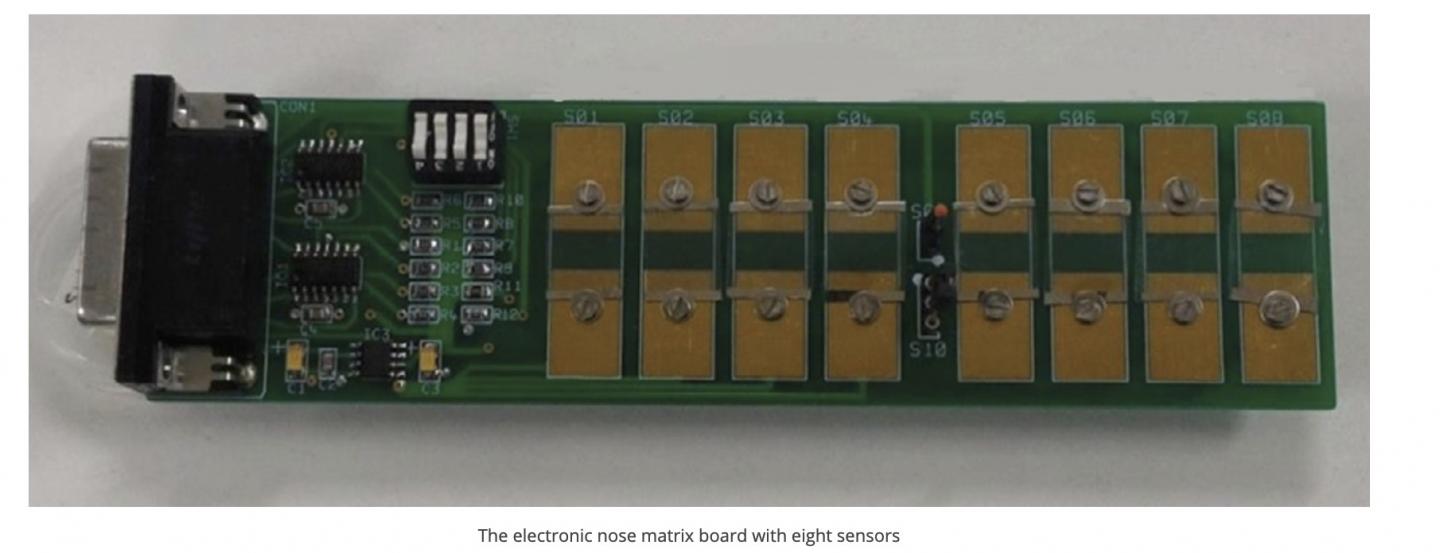
Skoltech researchers and their colleagues from Russia and Germany have designed an on-chip printed ‘electronic nose’ that serves as a proof of concept for low-cost and sensitive devices to be used in portable electronics and healthcare. The paper was published in the journal ACS Applied Materials Interfaces.

The rapidly growing fields of the Internet of Things (IoT) and advanced medical diagnostics require small, cost-effective, low-powered yet reasonably sensitive, and selective gas-analytical systems like so-called ‘electronic noses.’ These systems can be used for noninvasive diagnostics of human breath, such as diagnosing chronic obstructive pulmonary disease (COPD) with a compact sensor system also designed at Skoltech. Some of these sensors work a lot like actual noses — say, yours — by using various sensors to detect the complex signal of a gaseous compound.

One approach to creating these sensors is by additive manufacturing technologies, which have achieved enough power and precision to produce the most intricate devices. Skoltech senior research scientist Fedor Fedorov, Professor Albert Nasibulin, research scientist Dmitry Rupasov, and their collaborators created a multisensor ‘electronic nose’ by printing nanocrystalline films of eight different metal oxides onto a multielectrode chip (they were manganese, cerium, zirconium, zinc, chromium, cobalt, tin, and titanium). The Skoltech team came up with the idea for this project.

“For this work, we used microplotter printing and true solution inks. There are a few things that make it valuable. First, the printing resolution is close to the distance between electrodes on the chip, which is optimized for more convenient measurements. We show these technologies are compatible. Second, we managed to use several different oxides, enabling more orthogonal signals from the chip resulting in improved selectivity. We can also speculate that this technology is reproducible and easy to be implemented in industry to obtain chips with similar characteristics, and that is really important for the ‘e-nose’ industry,” Fedorov explained.

In subsequent experiments, this ‘nose’ was able to sniff out the difference between different alcohol vapors (methanol, ethanol, isopropanol, and n-butanol), which are chemically very similar and hard to tell apart, at low concentrations in the air. Since methanol is extremely toxic, detecting it in beverages and differentiating between methanol and ethanol can save lives. To process the data, the team used linear discriminant analysis (LDA), a pattern recognition algorithm, but other machine learning algorithms could also be used for this task.

So far, the device operates at rather high temperatures of 200-400 degrees Celsius. Still, the researchers believe that new quasi-2D materials such as MXenes, graphene, and so on could be used to increase the sensitivity of the array and ultimately allow it to operate at room temperature. The team will continue working in this direction, optimizing the materials used to lower power consumption.

###

Other organizations involved in this research include Kurnakov Institute of General and Inorganic Chemistry of the Russian Academy of Sciences, Yuri Gagarin State Technical University of Saratov; Karlsruhe Institute of Technology; Moscow Institute of Physics and Technology; and Breitmeier Messtechnik GmbH.

Media Contact
Ilyana Zolotareva
[email protected]

Original Source

https://www.skoltech.ru/en/2021/01/skoltech-team-developed-on-chip-printed-electronic-nose/

Related Journal Article

http://dx.doi.org/10.1021/acsami.0c14055

Tags: Atmospheric ScienceBiologyBiomedical/Environmental/Chemical EngineeringBusiness/EconomicsChemistry/Physics/Materials SciencesComputer ScienceElectrical Engineering/ElectronicsMedicine/HealthTechnology/Engineering/Computer Science
Share12Tweet8Share2ShareShareShare2

Related Posts

Conducting Charge Along Linear Carbon Chains — Chemistry

Conducting Charge Along Linear Carbon Chains

June 13, 2026
Thiolated Biochar Enhances Soil’s Ability to Retain Toxic Mercury Amid Climate-Induced Wet-Dry Cycles — Chemistry

Thiolated Biochar Enhances Soil’s Ability to Retain Toxic Mercury Amid Climate-Induced Wet-Dry Cycles

June 12, 2026

AI Advances the Design of Enhanced Biochar Catalysts to Combat Antibiotic Pollution

June 12, 2026

Anti-Inflammatory Molecule Demonstrates Promise in Parkinson’s Treatment in Mouse Study

June 12, 2026
Please login to join discussion

POPULAR NEWS

  • ESMO 2025: mRNA COVID Vaccines Enhance Efficacy of Cancer Immunotherapy

    325 shares
    Share 130 Tweet 81
  • Saying Goodbye to PGY-6: Pediatric Fellowship Realities

    99 shares
    Share 40 Tweet 25
  • Multi-Hospital Study Reveals Long Covid Burden Is Twice as High as Current Estimates

    91 shares
    Share 36 Tweet 23
  • Common Food Preservatives Associated with Elevated Blood Pressure and Increased Heart Disease Risk

    59 shares
    Share 24 Tweet 15

About

We bring you the latest biotechnology news from best research centers and universities around the world. Check our website.

Follow us

Recent News

Admission Creatinine Predicts Outcomes in Elderly ICU

Unraveling PET-MPs’ Role in Inflammatory Bowel Disease

GPR84 Drives Lung Inflammation via ZBP1-PANoptosome Activation

Subscribe to Blog via Email

Enter your email address to subscribe to this blog and receive notifications of new posts by email.

Join 82 other subscribers
  • Contact Us

Bioengineer.org © Copyright 2023 All Rights Reserved.

Welcome Back!

Login to your account below

Forgotten Password?

Retrieve your password

Please enter your username or email address to reset your password.

Log In
No Result
View All Result
  • Homepages
    • Home Page 1
    • Home Page 2
  • News
  • National
  • Business
  • Health
  • Lifestyle
  • Science

Bioengineer.org © Copyright 2023 All Rights Reserved.