• HOME
  • NEWS
  • EXPLORE
    • CAREER
      • Companies
      • Jobs
    • EVENTS
    • iGEM
      • News
      • Team
    • PHOTOS
    • VIDEO
    • WIKI
  • BLOG
  • COMMUNITY
    • FACEBOOK
    • INSTAGRAM
    • TWITTER
Sunday, July 12, 2026
BIOENGINEER.ORG
No Result
View All Result
  • Login
  • HOME
  • NEWS
  • EXPLORE
    • CAREER
      • Companies
      • Jobs
        • Lecturer
        • PhD Studentship
        • Postdoc
        • Research Assistant
    • EVENTS
    • iGEM
      • News
      • Team
    • PHOTOS
    • VIDEO
    • WIKI
  • BLOG
  • COMMUNITY
    • FACEBOOK
    • INSTAGRAM
    • TWITTER
  • HOME
  • NEWS
  • EXPLORE
    • CAREER
      • Companies
      • Jobs
        • Lecturer
        • PhD Studentship
        • Postdoc
        • Research Assistant
    • EVENTS
    • iGEM
      • News
      • Team
    • PHOTOS
    • VIDEO
    • WIKI
  • BLOG
  • COMMUNITY
    • FACEBOOK
    • INSTAGRAM
    • TWITTER
No Result
View All Result
Bioengineer.org
No Result
View All Result
Home NEWS Science News Chemistry

Skoltech scientists break Google’s quantum algorithm

Bioengineer by Bioengineer
March 5, 2020
in Chemistry
Reading Time: 2 mins read
0
IMAGE
Share on FacebookShare on TwitterShare on LinkedinShare on RedditShare on Telegram

IMAGE

Credit: Physical Review Letters


Google is racing to develop quantum enhanced processors that utilize quantum mechanical effects to one day dramatically reduce the speed at which data can be processed.

In the near term, Google has devised new quantum enhanced algorithms that operate in the presence of realistic noise. The so called quantum approximate optimisation algorithm, or QAOA for short, is the cornerstone of a modern drive towards noise-tolerant quantum enhanced algorithm development.

The celebrated approach taken by Google in QAOA has sparked vast commercial interest and ignited a global research community to explore novel applications. Yet, little actually remains known about the ultimate performance limitations of Google’s QAOA algorithm.

A team of scientists, hailing from Skoltech’s Deep Quantum Laboratory, took up this contemporary challenge. The all-Skoltech team led by Prof. Jacob Biamonte discovered and quantified what appears to be a fundamental limitation in the wildly adopted approach initiated by Google.

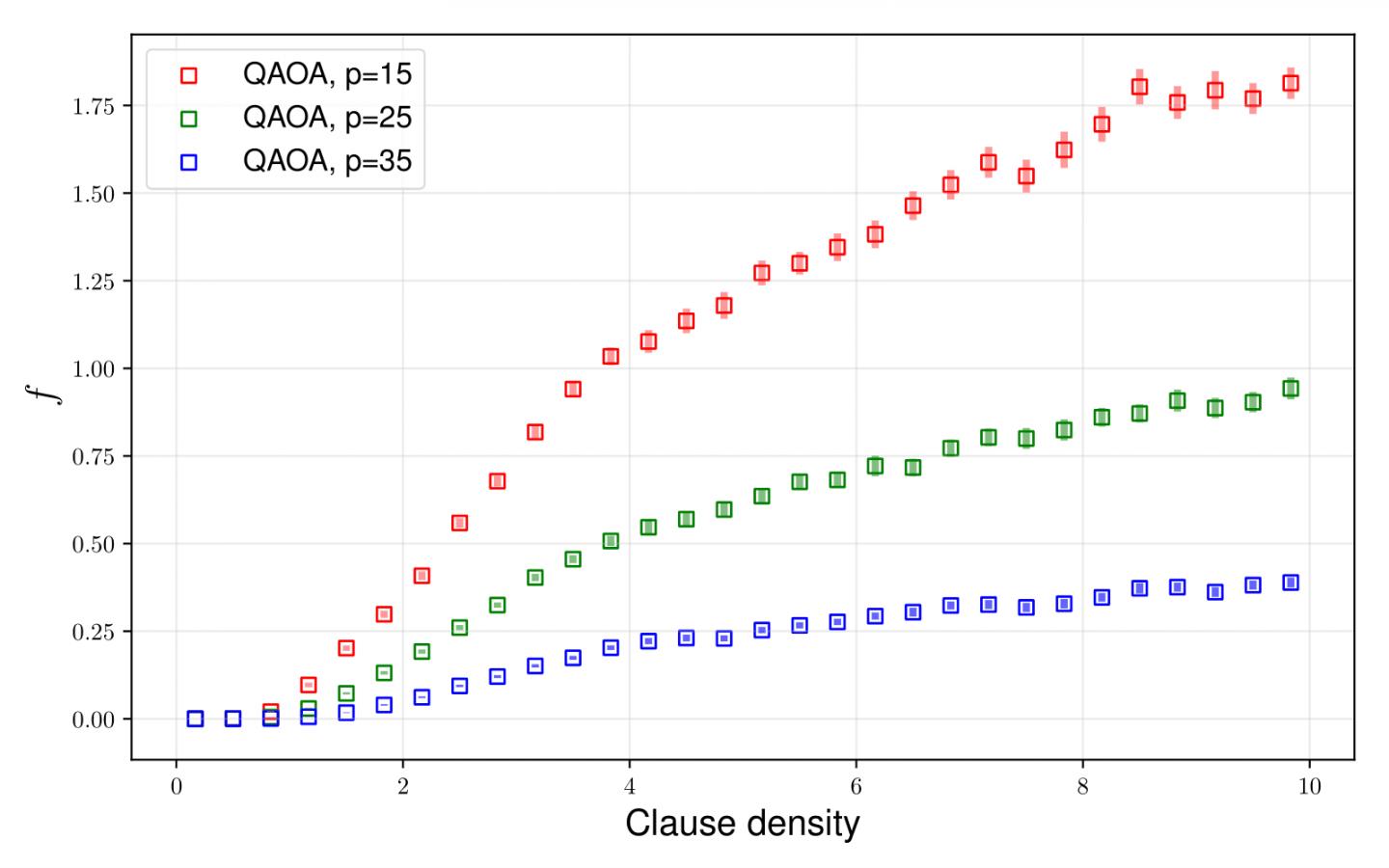
Reporting in Physical Review Letters, the authors detail the discovery of so called reachability deficits – the authors show how these deficits place a fundamental limitation on the ability of QAOA to even approximate a solution to a problem instance.

The Skoltech team’s findings report a clear limitation of the variational QAOA quantum algorithm. QAOA and other variational quantum algorithms have proven extremely difficult to analyse using known mathematical techniques due to an internal quantum-to-classical feedback process. Namely, a given quantum computation can only run for a fixed amount of time. Inside this fixed time, a fixed number of quantum operations can be executed. QAOA seeks to iteratively utilize these quantum operations by forming a sequence of increasingly optimal approximations to minimize an objective function. The study places new limits on this process.

The authors discovered that QAOA’s ability to approximate optimal solutions for any fixed depth quantum circuit is fundamentally dependent on the problems “density.” In the case of the problem called MAX-SAT, the so called density can be defined as the ratio of the problems constraints to variable count. This is sometimes called clause density.

The authors discovered problem instances of high density whose optimal solutions cannot be approximated with guaranteed success, regardless of the algorithms’ run-time.

###

Media Contact
Alina Chernova
[email protected]
7-905-565-3633

Related Journal Article

http://dx.doi.org/10.1103/PhysRevLett.124.090504

Tags: Chemistry/Physics/Materials SciencesOptics
Share12Tweet8Share2ShareShareShare2

Related Posts

Blue Light and Chemistry Simplify Complex Drug Production Steps

Blue Light and Chemistry Simplify Complex Drug Production Steps

July 10, 2026
New Discovery Promises Brighter, More Energy-Efficient Digital Displays

New Discovery Promises Brighter, More Energy-Efficient Digital Displays

July 10, 2026

New Crystalline 3D Frameworks Linked by Spiroborates Developed

July 10, 2026

IBEC Joins Major European Grant on Living Matter Physics

July 10, 2026
Please login to join discussion

POPULAR NEWS

  • Detection of EDCs in Breast Milk and Infant Urine Up to Six Months Highlights Early Exposure Risks

    77 shares
    Share 31 Tweet 19
  • New Drug Candidate Developed at McMaster Shows Potential for Treating Brain Cancer

    58 shares
    Share 23 Tweet 15
  • KTU Researchers Explore Ultrasound’s Role in Enhancing Blood Flow Beyond Diagnostics

    53 shares
    Share 21 Tweet 13
  • 高齢者の骨粗鬆症治療の持続性比較

    51 shares
    Share 20 Tweet 13

About

We bring you the latest biotechnology news from best research centers and universities around the world. Check our website.

Follow us

Recent News

YEARS Algorithm Enhances Pulmonary Embolism Diagnosis in Cancer Patients

Diverse Symptom Burdens and Care Needs in Older Ischemic Stroke Patients

KAIST Creates AI to Detect Early Cerebrovascular Disease Signs at Home

Subscribe to Blog via Email

Enter your email address to subscribe to this blog and receive notifications of new posts by email.

Join 85 other subscribers
  • Contact Us

Bioengineer.org © Copyright 2023 All Rights Reserved.

Welcome Back!

Login to your account below

Forgotten Password?

Retrieve your password

Please enter your username or email address to reset your password.

Log In
No Result
View All Result
  • Homepages
    • Home Page 1
    • Home Page 2
  • News
  • National
  • Business
  • Health
  • Lifestyle
  • Science

Bioengineer.org © Copyright 2023 All Rights Reserved.