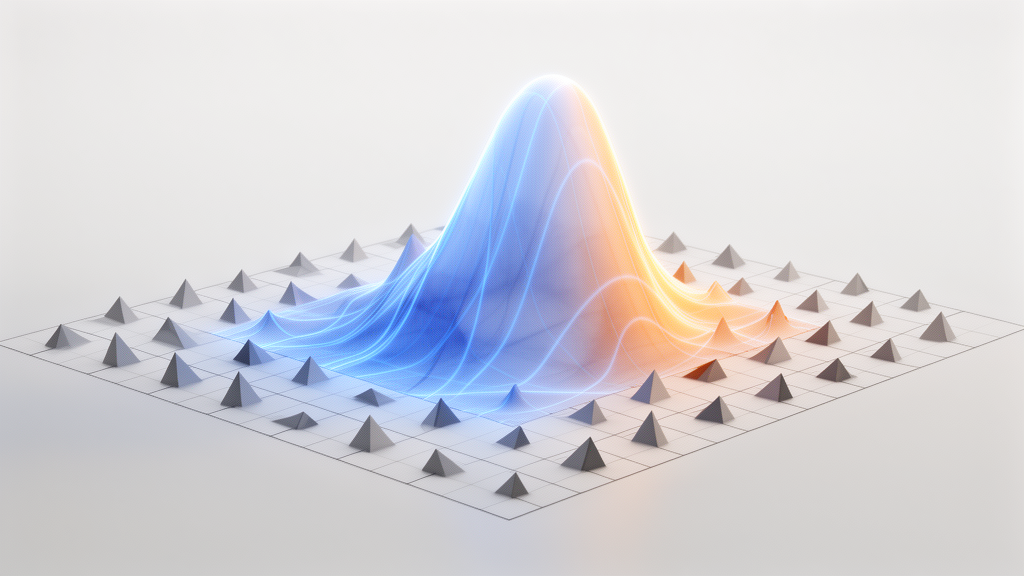
A new mathematical framework developed within Symbolic Data Analysis establishes a rigorous method for evaluating multivariate triangular-valued data, overcoming long-standing limitations inherent in traditional interval modeling. In contemporary data science, aggregating granular observations into summary entities frequently produces sets of numbers rather than single scalar values. While classical statistical tools focus on individual data points, symbolic methods treat entire distributions or boundaries as unique analytical units. Previous approaches to interval data routinely assumed that values within an observed window followed a uniform distribution, leading researchers to rely on standard normal-Wishart models. However, natural phenomena such as daily weather shifts and financial returns frequently exhibit marked asymmetry, rendering symmetric midpoint assumptions inadequate. By establishing an inferential structure grounded in multivariate skew-normal and generalized Wishart distributions, the newly published work demonstrates that explicitly modeling the internal mode of an interval captures complex asymmetric patterns that conventional uniform methods routinely distort.
Symbolic Data Analysis originated as an overarching conceptual methodology to analyze complex data structures while preserving valuable distributional information that traditional data reduction eliminates. Initial foundations established by early theorists demonstrated that symbolic entities could represent lists, intervals, and histograms, significantly broadening the analytical toolkit for structured records. Despite these conceptual strides, the formal inferential foundations of the discipline, particularly regarding exact likelihood formulations, developed more recently. Early interval-valued regression and classification frameworks predominantly focused on midpoints, bound constraints, or ranges under the assumption of internal uniformity. When applied to real-world phenomena, these conventional methods assume that any value between the observed minimum and maximum is equally probable. Climatological measures, asset returns, and industrial tolerance thresholds regularly violate this premise, as daily observations cluster closer to one boundary than another. The persistent failure of uniform assumptions to capture internal skewness created an urgent demand for richer parametric formulations.
To overcome the structural shortcomings of simple boundaries, the study introduces triangular-valued data characterized by an ordered triplet containing the minimum value, the mode, and the maximum value. Unlike basic intervals that provide only lower and upper limits, triangular representations supply crucial details about central tendency and probability concentration. The inclusion of the mode identifies the exact point where the underlying probability density attains its peak, allowing researchers to represent asymmetric distributions directly. Because the triplet is observed directly from aggregated historical records, domain expertise, or physical constraints, the framework bypasses the mathematical identifiability problems that complicate models attempting to estimate internal density solely from two bounding coordinates. Furthermore, the triangular distribution possesses distinct mathematical benefits over alternative bounded formulations, such as Epanechnikov kernels, because it provides analytically tractable expressions for its lower-order moments, enabling direct derivations of likelihood functions and Bayesian posterior distributions across multivariate dimensions.
The mathematical formulation relies on transforming each observed triangular triplet into an internal mean vector and an internal variance-covariance matrix. For a multivariate observation of dimension p, the componentwise mean corresponds to one-third of the sum of the minimum, mode, and maximum. Simultaneously, the diagonal variance component for each variable is calculated from the squared values and pairwise products of the three defining parameters divided by eighteen. In rare cases where the mode sits exactly halfway between the lower and upper bounds, the distribution remains symmetric, and classical multivariate normal and Wishart models may provide adequate approximations. However, whenever empirical measurements exhibit skewness, the resulting distributions of these summary moments deviate substantially from standard symmetric shapes. This mathematical divergence necessitates more expressive distributional families capable of accommodating non-zero skewness and flexible cross-variable covariance without imposing artificial constraints on the underlying data generation process.
To model the behavior of the derived mean vectors, the authors implement the multivariate skew-normal distribution, which extends the classical multivariate normal density through an additional skewness parameter vector. Under this model, the probability density function incorporates a standard p-variate normal density alongside a univariate cumulative standard normal distribution that modulates asymmetry. The parameter set consists of a location vector, a fully populated symmetric positive-definite scale matrix, and a skewness vector that governs the direction and magnitude of asymmetry. By allowing the scale matrix to remain non-diagonal, the model explicitly captures cross-component dependencies among variables rather than assuming mutual independence. This parsimonious formulation permits the mean vector to skew in multiple directions across dimensions, ensuring that empirical aggregations reflecting positive or negative distributional imbalances are accurately tracked within the likelihood function without sacrificing mathematical tractability.
To model the internal dispersion matrices, the framework introduces a generalized Wishart distribution that extends classical covariance modeling. In traditional interval analysis, the variance of uniformly distributed intervals follows a standard Wishart distribution governed by an integer degrees-of-freedom parameter linked to sample size. In the triangular setting, the generalized Wishart distribution shares the same functional probability density structure but removes the restriction that the degrees of freedom must be an integer. The parameter d is allowed to take any positive real value, functioning as a continuous dispersion parameter that flexibly accommodates non-uniform and skewed internal variations. Combined with a fully populated scale matrix that dictates the orientation and magnitude of multivariate dispersion, the generalized Wishart formulation accounts for heteroskedasticity and covariance among multiple interval variables, providing the inferential flexibility necessary to describe complex multidimensional uncertainty.
Parameter estimation within the proposed architecture is established through both frequentist maximum likelihood and Bayesian methodologies. Because the joint log-likelihood functions derived from the skew-normal mean and generalized Wishart dispersion components do not yield closed-form solutions, the maximum likelihood estimates are obtained numerically. The authors formulated a specialized numerical optimization algorithm that iteratively maximizes the separate log-likelihood expressions with respect to the location, scale, skewness, degrees of freedom, and dispersion parameters. Extensive numerical assessments confirmed that optimization routines converge reliably under standard tolerance criteria. The maximum likelihood estimators provide consistent point estimates across multiple dimensions, validating the feasibility of applying full likelihood-based inference to symbolic data models that explicitly incorporate non-uniform internal distributions.
Alongside frequentist estimation, the researchers constructed a comprehensive Bayesian framework employing weakly informative prior distributions to ensure robust parameter shrinkage. The Bayesian setup assigns multivariate normal priors to the location and skewness vectors, an inverse Wishart prior to the skew-normal scale matrix, a second inverse Wishart prior to the generalized Wishart dispersion matrix, and a gamma prior to the continuous degrees-of-freedom parameter. Because the skew-normal likelihood introduces non-conjugate structures that preclude analytical integration, the conditional posterior distributions cannot be evaluated in closed form. To sample from the joint posterior distribution, the authors developed a hybrid Markov Chain Monte Carlo algorithm combining Gibbs sampling with Metropolis-Hastings steps. This computational routine generates empirical posterior distributions, from which the posterior means serve as optimal Bayes estimators under a squared error loss criterion.
The performance of the proposed estimators was thoroughly evaluated through a controlled simulation study using synthetic three-dimensional triangular data. Rather than generating means and variances independently, the researchers simulated empirical triplets directly by drawing latent vectors from skew-normal and generalized Wishart distributions and applying moment-inversion techniques to preserve natural boundary orderings. The simulations evaluated four distinct sample sizes of twenty-five, fifty, one hundred, and two hundred and fifty observations across two thousand independent replications. Both the maximum likelihood and Bayesian estimators demonstrated consistency, with mean squared errors decreasing monotonically as sample sizes grew. Notably, at smaller sample sizes, the Bayesian estimators achieved lower mean squared errors for the location and skewness parameters due to the regularizing effect of the prior distributions, while converging toward the maximum likelihood estimates as sample information accumulated.
Model selection and formal hypothesis verification were conducted using both the Akaike Information Criterion and the Bayes factor to test whether the added mathematical complexity was statistically justified. The Bayes factor evaluates the ratio of marginal likelihoods between competing models, providing a quantitative metric of evidence favoring the more flexible distribution over simpler nested alternatives. Because analytical calculation of marginal likelihoods is intractable for skew-normal and generalized Wishart densities, the authors approximated these integrated quantities using harmonic mean estimators applied to post-burn-in Markov Chain Monte Carlo iterations. This verification confirmed that the skew-normal model consistently outperforms the standard symmetric multivariate normal distribution for modeling triangular means, while the generalized Wishart distribution offers substantial fit improvements over the classical Wishart distribution for modeling internal variance matrices.
To illustrate the practical value of the methodology, the framework was applied to an authentic Australian regional climate dataset extracted from the public DAAG package. The investigation evaluated decadal climate behavior between 1900 and 2021, tracking average temperatures and total rainfall records across eastern and northern Australian regions. For each decade, triangular triplets were constructed from the recorded minimum, mode, and maximum observations across the four climatic variables. Model comparison metrics revealed that the skew-normal distribution achieved a lower Akaike Information Criterion and yielded a Bayes factor of 17.74 over the standard normal model, demonstrating decisive statistical support for accommodating skewness. Similarly, the generalized Wishart distribution produced a lower criterion value and a Bayes factor of 24.53 compared to the classical Wishart distribution, while estimated parameters confirmed right-skewed climate patterns and marked regional covariances.
The study concluded by outlining a theoretical generalization of the framework to accommodate trapezoidal-valued symbolic data defined by four parameters: a lower bound, two modes forming a plateau, and an upper bound. The authors showed that the resulting componentwise mean and modified variance of trapezoidal data retain the mathematical structures required by skew-normal and generalized Wishart models. Consequently, the maximum likelihood algorithms and Markov Chain Monte Carlo sampling routines developed for triangular data apply directly to trapezoidal settings with minimal adjustments. By establishing tractable inferential mechanisms that accommodate non-uniformity and asymmetry within aggregated observations, this research substantially broadens the theoretical foundations of Symbolic Data Analysis, equipping data analysts with powerful mathematical tools to analyze complex environmental and multidimensional systems.
Subject of Research: Inferential statistical modeling of multivariate triangular-valued data within symbolic data analysis
Article Title: On multivariate triangular-valued data
Article References: Sadeghkhani, A. (2025). On multivariate triangular-valued data. Discover Data, 3(1), Article 53. https://doi.org/10.1007/s44248-025-00089-5
Image Credits: AI Generated
DOI: 10.1007/s44248-025-00089-5
Keywords: Symbolic Data Analysis, Triangular-Valued Data, Skew-Normal Distribution, Generalized Wishart Distribution, Maximum Likelihood Estimation, Bayesian Inference, Markov Chain Monte Carlo, Bayes Factor, Interval-Valued Data, Climate Data Analysis, Asymmetry Modeling, Akaike Information Criterion, DAAG Package, Trapezoidal-Valued Data, Metropolis-Hastings Algorithm, Gibbs Sampler, Australian Climate Data, Covariance Estimation
News Source: Denise Maddox. (November 17, 2026). Skew-Normal Framework Accurately Models Asymmetric Multivariate Triangular Data in Climate Science. Scienmag.