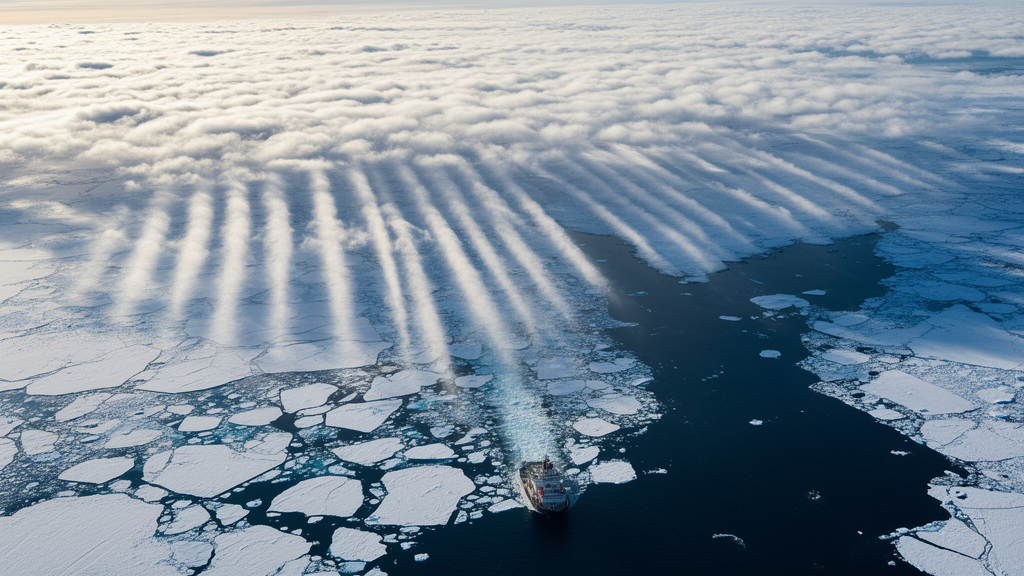
When frigid Arctic air surges off the sea ice and pours across the open ocean, it triggers one of the most dramatic air-mass transformations on the planet. The ocean is often ten to twenty degrees warmer than the air above it, and the resulting exchange of heat and moisture can drive sensible heat fluxes exceeding 800 watts per square metre, spin up organised cloud streets visible from space, and ultimately reshape weather far beyond the polar region. Now, a team of atmospheric scientists has revealed that an often-overlooked ingredient, the slow downward drift of the large-scale atmosphere itself, plays a decisive role in determining how these clouds grow, freeze, and fall apart.
The study, published in Atmospheric Chemistry and Physics, was led by Fiona Paulus of the University of Cologne together with colleagues from Leipzig University, the University of Bergen, and the University of Cologne. The team combined rare aircraft observations from the HALO–(AC)³ campaign of March 2022 with high-resolution cloud-resolving simulations to follow a single parcel of Arctic air for two full days as it travelled from the sea ice north of the Fram Strait southward over open water. Their central finding is striking: strong mesoscale subsidence, the gentle sinking of air over scales of tens to hundreds of kilometres, suppresses boundary-layer growth, delays and weakens cloud glaciation, limits precipitation, and shortens cloud lifetimes, while weak subsidence allows clouds to deepen, decouple from the surface, and glaciate earlier.
Marine cold air outbreaks, or MCAOs, are a cornerstone of the Arctic climate system. As cold, dry polar air crosses the sea ice edge, the intense temperature contrast with the warmer ocean generates vigorous turbulent mixing that rapidly deepens the atmospheric boundary layer. Clouds first appear as long, parallel roll structures known as cloud streets, then break up into deeper, broken cloud fields as the air continues to warm and moisten. These evolving clouds modulate the exchange of radiation between the surface and space, determine how much precipitation falls, and even increase surface wind speeds. Through this ocean–atmosphere coupling, MCAOs influence atmospheric and oceanic circulations and contribute to the heat and moisture exchange between the Arctic and the mid-latitudes, linking them to the feedback mechanisms behind Arctic amplification.
Yet a key piece of the puzzle has been missing. The role of mesoscale vertical motion, particularly subsidence, in shaping these transformations has remained poorly understood, largely because measuring it at high latitudes is extraordinarily difficult. Small errors in horizontal wind gradients translate into large uncertainties when vertical motion is inferred from mass conservation. The most robust technique applies a regression analysis to dropsondes, small instrument packages dropped from aircraft that profile temperature, humidity, and wind as they descend. This method was pioneered during two aircraft campaigns in the subtropical trades, and the HALO–(AC)³ campaign became the first to apply it systematically to an Arctic cold air outbreak, producing the first robust high-latitude subsidence dataset of its kind.
During the campaign, the German research aircraft HALO flew two consecutive research flights on 29 and 30 March 2022, tracking a weak but well-defined MCAO with an outbreak index of four. At four locations along the predicted trajectory of the air mass, HALO released dropsondes in circular patterns with a diameter of 150 kilometres. The initial circle, centred at 84.4 degrees north over sea ice, was followed by three further circles on the second day as the air mass moved south over the marginal ice zone and open ocean. A regression algorithm applied to each circle yielded vertical profiles of divergence and subsidence, along with advective tendencies of temperature, humidity, and wind. The derived subsidence rates reached mean values of about −0.74 and −0.60 centimetres per second in the lowest three kilometres at the initial and second circles respectively, with uncertainties below 0.025 centimetres per second.
These observations formed the backbone of a quasi-Lagrangian large-eddy simulation using the Dutch Atmospheric Large-Eddy Simulation model, DALES, equipped with a double-moment microphysics scheme that predicts the mass and number of five hydrometeor classes: cloud water, cloud ice, rain, snow, and graupel. The simulation domain spanned 12.8 by 12.8 kilometres at 50-metre horizontal resolution, and the model was initialised with dropsonde profiles from the far north, with surface conditions prescribed from airborne thermal-infrared imagery and large-scale forcings interpolated along the trajectory. Over a 45-hour simulation, the control run reproduced the observed boundary-layer height within roughly 150 metres, captured the integrated water vapour to within a few tenths of a kilogram per square metre, and tracked the liquid water path within the spread of the radiometer observations, despite a slight cold and dry bias of two to three kelvin near the surface.
With this validated baseline in place, the team ran four sensitivity experiments in which the observed subsidence was scaled by factors of zero, 0.1, 0.5, and 2.0, spanning rates from −0.12 to roughly −2.3 centimetres per second. The results exposed a systematic chain of consequences. Without subsidence, the boundary layer deepened fastest, approaching the theoretical parabolic growth rate, and produced the largest cloud water and ice contents, with liquid water paths peaking at 173 grams per square metre and precipitation rates reaching 60 millimetres per hour. Under doubled subsidence, the boundary layer never exceeded one kilometre, clouds remained thin and shallow, and precipitation was confined to a brief early phase at a maximum of only 2.1 millimetres per hour. Graupel, the heavily rimed ice that forms in vigorous convective updrafts, appeared in every experiment except the strongest-subsidence case.
The most consequential insight concerns decoupling, the process by which the cloud-topped boundary layer splits into a surface-influenced lower layer and a cloud-bearing upper layer that no longer exchange heat and moisture efficiently. The simulations revealed that decoupling first announces itself in the buoyancy flux: a layer of negative buoyancy flux develops below cloud base, disrupting the boundary layer’s single overturning circulation. This buoyancy-based decoupling, previously documented in the warm subtropics but not before identified during Arctic cold air outbreaks, always preceded a characteristic sequence of events: a peak in cloud liquid water, then a peak in graupel, then a peak in surface precipitation, and finally full thermodynamic decoupling diagnosed from jumps in humidity and temperature across the sub-cloud layer. The entire sequence typically spanned about one degree of latitude and shifted systematically southward as subsidence strengthened.
This sequence explains a familiar but previously unexplained feature of cold air outbreaks: the typical evolution of the cloud liquid water path, which rises to a maximum and then collapses as ice processes take over. Once the boundary layer decouples, shallow cumulus clouds rise from below into the capping mixed-phase layer, and the increased liquid water availability promotes depositional ice growth through the Wegener–Bergeron–Findeisen process before riming produces graupel. The resulting precipitation depletes the cloud’s liquid reservoir, while evaporation and sublimation beneath cloud base cool and moisten the sub-cloud layer, further stabilising it and suppressing vertical mixing. Subsidence, the authors conclude, does not directly dictate the microphysics; rather, it controls the depth and structure of the boundary layer in which glaciation and decoupling unfold, thereby regulating the timing of the entire transition.
The implications reach well beyond a single case study. Cloud transitions during cold air outbreaks determine how much solar and thermal radiation reaches and leaves the Arctic surface, how much moisture is exported to lower latitudes, and how models should represent the shift from organised roll convection to open cellular convection. The authors caution that their results rest on one weak outbreak, that aerosol concentrations were held fixed, and that secondary ice production was limited to a single mechanism, so extending the analysis to stronger events and varying aerosol and ice-nucleating particle conditions is the natural next step. Even so, the conceptual framework they propose, in which subsidence sets the clock for decoupling, glaciation, and precipitation, offers weather and climate modellers a physically consistent reference for interpreting one of the Arctic’s most consequential cloud transformations.
Subject of Research: The influence of mesoscale atmospheric subsidence on cloud glaciation and boundary-layer decoupling during Arctic marine cold air outbreaks
Article Title: Impacts of mesoscale atmospheric subsidence on cloud glaciation and decoupling in Arctic marine cold air outbreaks
Article References: Paulus, F., Müller, J. J., Kirbus, B., Sodemann, H., van Gelder, L., Walbröl, A., Wendisch, M., & Neggers, R. A. J. (2026). Impacts of mesoscale atmospheric subsidence on cloud glaciation and decoupling in Arctic marine cold air outbreaks. Atmospheric Chemistry and Physics, 26(19), 13983-14014. https://doi.org/10.5194/acp-26-13983-2026
Image Credits: AI Generated
DOI: 10.5194/acp-26-13983-2026
Keywords: Arctic, marine cold air outbreak, subsidence, mixed-phase clouds, boundary layer, decoupling, cloud glaciation, graupel, large-eddy simulation, dropsondes, HALO-AC3, Fram Strait
News Source: Russell Cooper. (October 8, 2026). Sinking Air Shapes Arctic Clouds: New Study Tracks Cold Air Outbreaks Over the Fram Strait. Scienmag.