• HOME
  • NEWS
  • EXPLORE
    • CAREER
      • Companies
      • Jobs
    • EVENTS
    • iGEM
      • News
      • Team
    • PHOTOS
    • VIDEO
    • WIKI
  • BLOG
  • COMMUNITY
    • FACEBOOK
    • INSTAGRAM
    • TWITTER
Saturday, January 10, 2026
BIOENGINEER.ORG
No Result
View All Result
  • Login
  • HOME
  • NEWS
  • EXPLORE
    • CAREER
      • Companies
      • Jobs
        • Lecturer
        • PhD Studentship
        • Postdoc
        • Research Assistant
    • EVENTS
    • iGEM
      • News
      • Team
    • PHOTOS
    • VIDEO
    • WIKI
  • BLOG
  • COMMUNITY
    • FACEBOOK
    • INSTAGRAM
    • TWITTER
  • HOME
  • NEWS
  • EXPLORE
    • CAREER
      • Companies
      • Jobs
        • Lecturer
        • PhD Studentship
        • Postdoc
        • Research Assistant
    • EVENTS
    • iGEM
      • News
      • Team
    • PHOTOS
    • VIDEO
    • WIKI
  • BLOG
  • COMMUNITY
    • FACEBOOK
    • INSTAGRAM
    • TWITTER
No Result
View All Result
Bioengineer.org
No Result
View All Result
Home NEWS Science News Chemistry

Singlet oxygen selectively degrades oxytetracycline in fenton-like oxidation

Bioengineer by Bioengineer
July 6, 2021
in Chemistry
Reading Time: 2 mins read
0
IMAGE
Share on FacebookShare on TwitterShare on LinkedinShare on RedditShare on Telegram

IMAGE

Credit: HONG Peidong

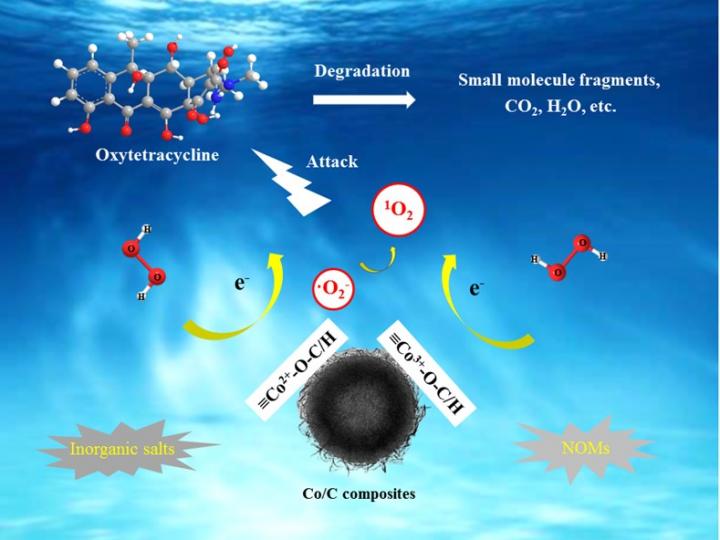
Recently, a research team led by Prof. KONG Lingtao at the Hefei Institutes of Physical Science (HFIPS) of the Chinese Academy of Sciences (CAS) has prepared a type of hollow amorphous Co/C composites to activate hydrogen peroxide (H2O2) to generate singlet oxygen, achieving selective elimination of oxytetracycline (OTC) in complicated water matrices. The relevant results was published in Chemical Engineering Journal.

OTC is the most common tetracycline antibiotic in the field of animal husbandry. It can be detected in water, soil and other areas which features on strong biological stability and cannot be effectively removed by conventional technical means.

As a simple and efficient advanced oxidation technology, Fenton-like oxidation has been considered as an effective way for water pollution. singlet oxygen, as an electrophilic non-radical, exhibits excellent anti-interference to background substrates, and can help to achieve the selective removal of organic pollutants containing electron-rich groups. However, in most Fenton-like reactions, the yield of singlet oxygen is low and the contribution is small.

In this study, the researchers designed and prepared a hollow amorphous Co/C composites with a large number of oxygen-containing functional groups such as carbonyl and hydroxyl distributed on the surface.

They obtained Co/C-3 material by optimizing the ratio of cobalt and carbon, and realized the optimal degradation of 20 ppm OTC by activating H2O2 under neutral pH conditions. The catalytic degradation system exhibited excellent repeatability, stability and anti-interference ability. Quenching experiments and Electron Paramagnetic Resonance results confirmed that converted singlet oxygen was the main oxidizing species, and hydroxyl radical didn’t not appear in the system.

The synergistic interaction between cobalt and oxygen-containing functional groups within materials played the key role on activating H2O2 in the formation of singlet oxygen. In addition, the possible degradation pathways and potential ecological toxicities of OTC and its intermediates were revealed.

The above job is supported by projects and units such as the National Key R&D Program, the National Natural Science Foundation of China, the Anhui Provincial Major Science and Technology Project, and the USTC Supercomputing Center.

###

Media Contact
ZHAO Weiwei
[email protected]

Original Source

http://english.hf.cas.cn/new/news/rn/202107/t20210701_273280.html

Related Journal Article

http://dx.doi.org/10.1016/j.cej.2021.129594

Tags: Chemistry/Physics/Materials SciencesMaterialsMolecular Physics
Share12Tweet8Share2ShareShareShare2

Related Posts

blank

Advancing Alkene Chemistry: Homologative Difunctionalization Breakthrough

January 8, 2026
Biocompatible Ligand Enables Safe In-Cell Protein Arylation

Biocompatible Ligand Enables Safe In-Cell Protein Arylation

January 8, 2026

Monovalent Pseudo-Natural Products Boost IDO1 Degradation

January 7, 2026

Catalytic Enantioselective [1,2]-Wittig Rearrangement Breakthrough

January 7, 2026
Please login to join discussion

POPULAR NEWS

  • Enhancing Spiritual Care Education in Nursing Programs

    154 shares
    Share 62 Tweet 39
  • PTSD, Depression, Anxiety in Childhood Cancer Survivors, Parents

    145 shares
    Share 58 Tweet 36
  • Impact of Vegan Diet and Resistance Exercise on Muscle Volume

    47 shares
    Share 19 Tweet 12
  • SARS-CoV-2 Subvariants Affect Outcomes in Elderly Hip Fractures

    45 shares
    Share 18 Tweet 11

About

We bring you the latest biotechnology news from best research centers and universities around the world. Check our website.

Follow us

Recent News

Lacticaseibacillus rhamnosus MP108 Eases Childhood Constipation, Alters Gut Microbiota

Decoding the PAUSS in First Episode Psychosis

Exploring Heterosis in Abaca BC2 Hybrid Dioscoro 1

Subscribe to Blog via Email

Enter your email address to subscribe to this blog and receive notifications of new posts by email.

Join 71 other subscribers
  • Contact Us

Bioengineer.org © Copyright 2023 All Rights Reserved.

Welcome Back!

Login to your account below

Forgotten Password?

Retrieve your password

Please enter your username or email address to reset your password.

Log In
No Result
View All Result
  • Homepages
    • Home Page 1
    • Home Page 2
  • News
  • National
  • Business
  • Health
  • Lifestyle
  • Science

Bioengineer.org © Copyright 2023 All Rights Reserved.