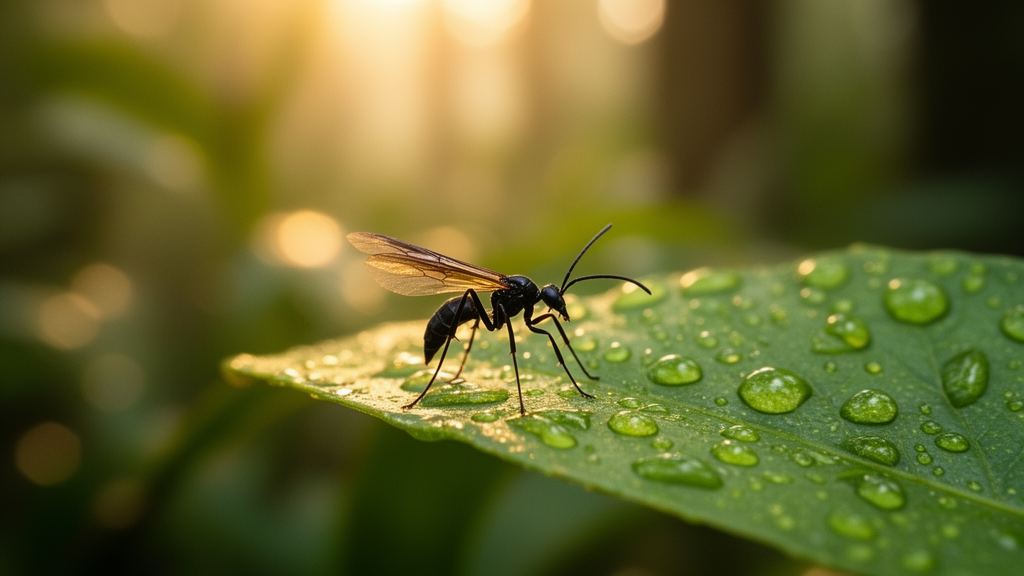
A taxonomic study documents the first Chinese record of the rare braconid genus Hemiglyptinus and the first record of the genus outside the Philippines. The finding is based on one adult female specimen of Hemiglyptinus flavus collected in a rubber forest in Nankai Town, Hainan Province, China. The researchers reviewed the genus diagnosis, re-described and illustrated the species, and compared the Hainan individual with the holotype from the Philippines.
Hemiglyptinus belongs to the tribe Braconini within the subfamily Braconinae of the family Braconidae. Before this record, the genus was known only from the Oriental Region and had been reported only from Luzon in the Philippines. Shenefelt established the name Hemiglyptinus in 1978 as a replacement for Hemiglyptus Ashmead, 1905. The Hainan occurrence therefore adds the genus to the fauna of China and extends its documented occurrence beyond the Philippines.
The study examines a single female specimen catalogued as CDNU 2026022, with record numbers HN10 and LSX1324. Shupeng Dong collected it with a Malaise trap between 15 May and 30 June 2021 at 19°4′43.32″N, 109°23′38.74″E. The specimen was initially kept in 100% ethanol and then point-mounted on a small triangular card. It is deposited in the collection of the College of Chemistry and Life Sciences at Chengdu Normal University in Chengdu. Yang Li and Cornelis van Achterberg are listed as the identifiers.
Taxonomic terminology and measurements followed the methods published by van Achterberg in 1988 and 1993. The researchers used an Olympus SZX7 stereomicroscope for descriptions and measurements. Photographs were made with a Canon EOS 6D Mark II digital camera fitted with a Laowa 25 mm f2.8 lens and 2.5–5.0× magnification, while additional images of the claws and the apices of the antenna and ovipositor were obtained with a Mitutoyo 10× lens. The images were lightly processed in Photoshop 2026, principally through cropping and background modification.
The revised diagnosis characterizes Hemiglyptinus as a small wasp with a body length of 3.2–3.8 mm. Diagnostic features include a strongly protruding outer margin of the antennal socket, anterolaterally toothed antennal sockets, middle antennal flagellar segments longer than wide, and an acute apical antennal segment bearing a short spine. The eye is glabrous and weakly emarginated, the face is punctate, and the clypeus bears a dorsal carina. The mesosoma is largely smooth apart from some punctures, and the propodeum has a medio-longitudinal carina and posterior lateral carinae.
Wing venation and body sculpture provide additional characters. In the forewing, the angle between veins 1-SR and C+SC+R is approximately 75 degrees, vein 1-SR+M is straight, and vein cu-a is interstitial. The second submarginal cell is relatively long and narrows slightly toward its distal end. At least the second and third metasomal tergites are largely and coarsely striate-sculptured. The first tergite lacks dorsal carinae, has a median area that is not convex, and bears wide, crenulate lateral grooves.
The Hainan female measured 3.8 mm in body length, 3.5 mm in forewing length, and 1.9 mm in ovipositor-sheath length. Its antenna had 32 segments. The second metasomal tergite was 3.5 times wider than medially long and largely coarsely striate-sculptured, while the third was largely longitudinally striate-sculptured. The fourth and fifth tergites were rugose, and the following tergites were smooth and shiny. Its hypopygium was acute apically and extended beyond the apex of the metasoma, and the ovipositor sheath was 0.54 times as long as the forewing.
The specimen was pale brownish-yellow, with paired dark-brown sublateral marks on the second through fourth metasomal tergites; on the second tergite, the marking was confined to the posterolateral area. Most of the antenna apart from the scapus was brown, as were the hind tarsus, mandibular apex, claws, and ovipositor sheath. The wing membrane was hyaline, while the pterostigma and veins were brown. The identified female and the documented collection and preparation methods constitute the complete Hainan material examined in this taxonomic treatment.
Comparison with the Philippine holotype revealed differences in metasomal colouration: the Hainan specimen had paired dark-brown sublateral marks, whereas the type specimen was uniformly brownish-yellow. No structural differences were observed between the two specimens. The authors noted that colour patterns in Braconinae can be highly variable and stated that such differences are often correlated with environmental factors, including temperature. Because colour differences alone were considered insufficient to justify recognizing a separate taxon, particularly without additional material, the researchers treated the Hainan specimen as conspecific with Hemiglyptinus flavus.
The principal limitation is that the study relies on a single Hainan specimen. That restricted scope limits assessment of within-species variation and the significance of the observed colour differences. The evidence supports a new country and regional occurrence record for H. flavus and a new genus record for China, but it does not establish changes in abundance, prevalence, or distribution over time. The study instead provides a reviewed genus diagnosis, a species redescription, specimen data, comparative observations, and illustrations documenting the newly recorded Chinese occurrence.
Subject of Research: Taxonomic documentation of Hemiglyptinus flavus from Hainan, China
Article Title: One newly-recorded rare genus of Braconini ( Hymenoptera , Braconidae , Braconinae ) from Hainan, China
Article References: Zheng, M.-M., Li, Y., van Achterberg, C., Zhu, J.-C., & Chen, X.-X. (2026). One newly-recorded rare genus of Braconini (Hymenoptera, Braconidae, Braconinae) from Hainan, China. Biodiversity Data Journal, 14, Article e210019. https://doi.org/10.3897/bdj.14.e210019
Image Credits: AI Generated
Keywords: Hemiglyptinus, H. flavus, Braconini, Braconidae, Hainan, China, taxonomic revision, new country record, Malaise trap, insect specimen, newly-recorded, rare
News Source: Drew Townsend. (October 20, 2026). Single-specimen taxonomic study records Hemiglyptinus flavus in Hainan, China. Scienmag.