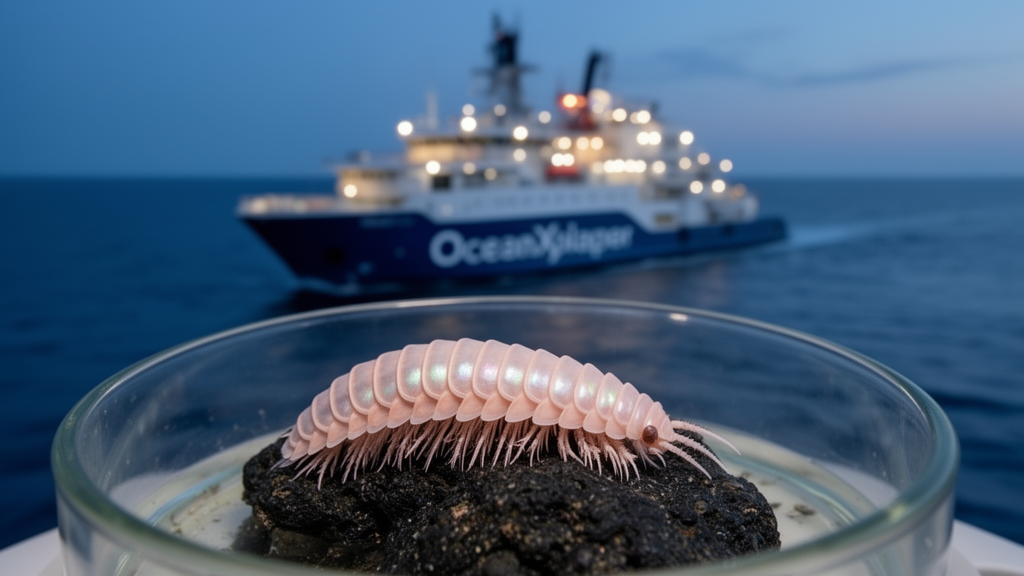
A taxonomic study has described Bathyeliasona oceanxplorer sp. nov., a new species of polynoid scale worm collected from the abyssal plain between Christmas Island and the Cocos (Keeling) Islands in the eastern Indian Ocean. The description, based on one specimen, raises the number of valid species in the genus from four to five and represents the first described Bathyeliasona species from the eastern Indian Ocean.
The holotype was collected at 4,977 metres on 18 October 2025 during the National University of Singapore–OceanX expedition. Researchers aboard the research vessel OceanXplorer observed the approximately 10-centimetre-long animal during one of seven dives by the remotely operated vehicle ROV Chimaera. The ROV suction sampler collected the worm from a sparsely populated abyssal seafloor at a water temperature of 1.2 °C. The specimen was initially stationary and showed no obvious movement when the ROV landed nearby, but it attempted to move away as the sampler approached.
Live and preserved morphology were examined using photography, stereomicroscopy and scanning electron microscopy. The holotype, catalogued as ZRC.ANN.2366, is 85 millimetres long and 48 millimetres wide at its widest point, with 18 body segments. It is robust, compact and dorsoventrally flattened, with eight pairs of large, overlapping, thick and semi-transparent elytra covering the dorsum. The elytra were iridescent in vivo when illuminated but became opaque and greyish after preservation. Short, non-uniformly sized conical papillae occurred along the posterior half of their margins.
The intact collection allowed the elytral morphology of a Bathyeliasona species to be described and figured for the first time. Earlier specimens often lacked their elytra because these structures are readily shed and can be lost during collection. The authors said this illustrates the value of ROV- or submersible-based sampling, which can yield more intact specimens than bottom trawling or dredging. Missing elytra and chaetae complicate identification because many members of the genus closely resemble one another in overall form.
Molecular evidence was obtained from two mitochondrial markers, cytochrome c oxidase subunit I and 16S rRNA, and two nuclear markers, 18S rRNA and 28S rRNA. DNA was extracted from an elytron and amplified through PCR before Sanger sequencing. A partitioned maximum-likelihood analysis of the concatenated four-gene dataset placed the new species in a well-supported Bathyeliasona clade with 100 percent SH-aLRT and ultrafast bootstrap support. Within that clade, it was sister to B. nigra with 98.9 percent SH-aLRT support and 100 percent ultrafast bootstrap support, while B. mariaae was sister to the pair.
Uncorrected pairwise COI p-distances were 17.7 percent between the new species and B. nigra and 18.6 percent between it and B. mariaae. These values indicated genetic differentiation from the two congeners for which sequences were available; sequence data were unavailable for the other two valid species. The analysis was intended to support species delineation and placement within Bathyeliasona, rather than resolve broader relationships among genera.
Several morphological characters distinguish the new species. Its prostomium has two rounded lobes, each bearing a slender, short frontal filament, and it lacks eyes. Nuchal organ pits were visible in fresh material but became indiscernible after preservation. Dissection revealed a long, dark-grey pharynx reaching segment 11, nine pairs of subtriangular distal pharyngeal papillae, two pairs of smooth-margined jaws and a sac-like buccal bulb. The authors included the bulb in the diagnosis but noted that its taxonomic value could not be established without re-examining comparative material. The species also has small nephridial papillae from segment 5 onward and ventral pygidial lobes with weakly undulate distal margins.
The holotype shares its 18-segment body with B. abyssicola and B. nigra, but its frontal filaments are slender and short rather than subulate. It resembles B. kirkegaardi in filament form, while differing in segment number, the presence of a reported buccal bulb and pygidial lobe shape. Compared with B. mariaae, it has shorter frontal filaments, nuchal organs positioned near the posterior part of the prostomial lobes and nephridial papillae that are absent in the latter. A central rib on the subacicular neurochaetae was included in the diagnosis, but the authors cautioned that neurochaetae are frequently lost in preserved collections and its consistency across the genus remains uncertain.
The principal limitation is that the description and genetic placement rely on a single specimen, preventing assessment of intraspecific variation and leaving the species’ geographic range uncertain. The authors noted that some congeners have broad recorded distributions, but limited sampling at abyssal depths may underestimate the new species’ range. Knowledge of deep-water benthic fauna around Christmas Island and the Cocos (Keeling) Islands remains limited: no systematic deep-water benthic sampling had occurred there before 2020, and 2021 and 2022 surveys collected approximately 867 annelid specimens representing 34 families. The discovery therefore adds a species to the documented abyssal annelid fauna of a poorly sampled region while also illustrating how intact targeted collections can expose taxonomic characters missing from conventional samples.
Subject of Research: Taxonomic description of a new deep-sea polynoid scale worm from the eastern Indian Ocean
Article Title: A new species of Bathyeliasona ( Annelida , Polynoidae ) from the abyssal plain of the eastern Indian Ocean
Article References: Chuar, C. H., Iesa, I., & Raquib, T. (2026). A new species of Bathyeliasona (Annelida, Polynoidae) from the abyssal plain of the eastern Indian Ocean. ZooKeys, 1293, 121-140. https://doi.org/10.3897/zookeys.1293.208455
Image Credits: AI Generated
DOI: 10.3897/zookeys.1293.208455
Keywords: Bathyeliasona oceanxplorer, deep-sea annelid, Polynoidae, eastern Indian Ocean, species description, ROV sampling, abyssal plain, phylogenetics, taxonomy, species, Bathyeliasona, Annelida
News Source: Violet Maxwell. (October 20, 2026). Single-specimen study describes first Bathyeliasona scale worm from the eastern Indian Ocean. Scienmag.