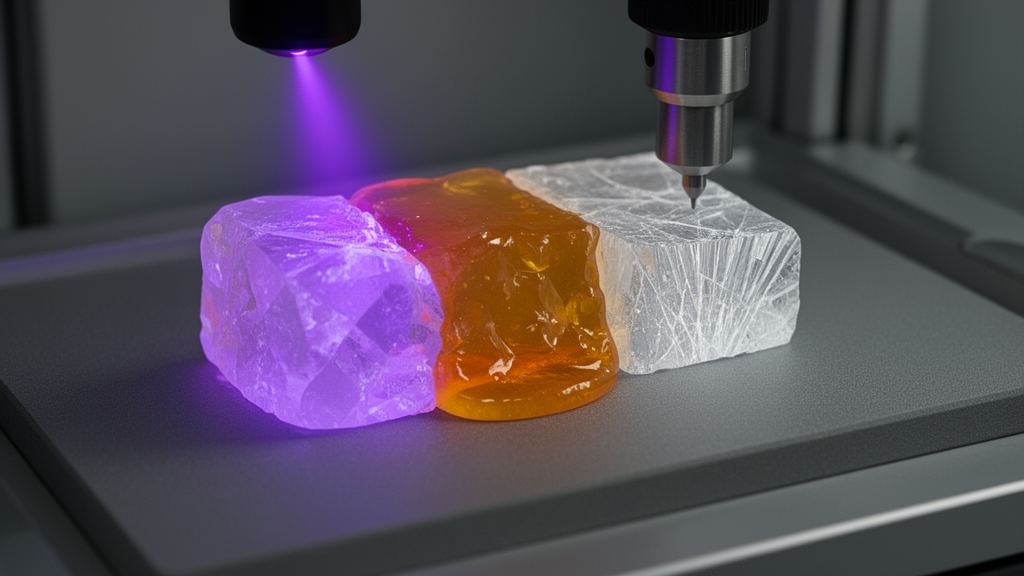
Researchers at the University of Missouri have engineered a single solid material capable of producing distinct physical and chemical behaviors based on the environmental stimulus it encounters. When exposed to light, the substance transitions from yellow to white, signifying an internal chemical reaction. When subjected to heat, the material undergoes a completely different chemical reaction. Furthermore, scratching the surface of the specimen triggers a brief flash of blue light, demonstrating three independent responses within one unified solid structure.
The study highlights how controlling the precise spatial arrangement of molecules enables scientists to incorporate multifaceted behaviors into a single physical matrix. Unlike liquid solutions where free-floating molecules interact fluidly, molecules tightly packed inside a solid possess minimal room to maneuver. Achieving chemical reactivity within such rigid constraints requires positioning the molecular components with extraordinary precision, an obstacle the researchers leveraged to direct specific structural transformations.
Led by Kristin Hutchins, an associate professor of chemistry in the College of Arts and Science and a researcher with the University of Missouri Materials Science and Engineering Institute, the team initially designed the material to respond sequentially to light and heat. Shining light upon the material initiates a reaction that joins neighboring molecules together, turning the sample from yellow to white. Applying heat subsequently causes the connected molecules to separate and rearrange into a different configuration, marking the first known demonstration of these two back-to-back reactions taking place in a solid-state material.
A third, unplanned behavior emerged during physical manipulation of the sample in the laboratory. Lead author Liulei Ma, who conducted the work at the University of Missouri and now serves as a postdoctoral researcher at Colorado State University, scratched the surface of the material and observed an unexpected flash of blue light. Subsequent targeted laboratory testing confirmed that mechanical force serves as an independent physical trigger capable of eliciting this luminous response, revealing that the solid harbored capabilities beyond the two pre-planned chemical reactions.
These experimental observations suggest a broader paradigm for materials design, shifting the focus from single-purpose compounds toward unified molecular architectures that possess multiple programmed capabilities. As noted by Hutchins, conventional assumptions often treat solid objects as inert and static, yet organizing their underlying molecules enables the creation of responsive systems that adapt selectively depending on whether they encounter illumination, thermal energy, or mechanical force.
Demonstrating multiple distinct responses within a single substance offers a foundational blueprint that could inform the future development of multi-functional sensors, protective smart coatings, wearable technologies, and dynamic light-emitting materials. Although translating these molecular mechanisms into practical technological devices will necessitate extensive follow-up investigations, the research provides concrete proof of principle for programming diverse responsive behaviors directly into solid molecular lattices.
The peer-reviewed investigation, titled “Heat- and light-directed cycloadditions enable a pericyclic cascade reaction from a molecular precursor,” was published in Angewandte Chemie International Edition. The research team included co-author Gary C. George III at the University of Missouri, along with Bella Albano and Steven A. Lopez from Northeastern University, with funding provided by the U.S. National Science Foundation across programs supporting chemistry, materials research, and computer science.
Subject of Research: Multi-responsive solid materials engineered through precise molecular organization
Article Title: One material, three responses: Researchers rethink how solids can behave
Article References: One material, three responses: Researchers rethink how solids can behave. Original publication (Bibliographic details unavailable.)
Image Credits: AI Generated
DOI: Not provided
Keywords: materials science, solid-state chemistry, molecular engineering, cycloadditions, photochemistry, mechanoluminescence, smart materials, pericyclic reactions, material, three, responses, Researchers
News Source: Denise Maddox. (November 10, 2026). Single Solid Material Undergoes Distinct Reactions to Light, Heat, and Force. Scienmag.