In a cross-sectional quantitative ethnobotanical investigation conducted in Santiago Ixtaltepec, Oaxaca, Mexico, researchers characterized an extensive medicinal plant agrobiodiversity system comprising 82 operational taxa and 578 individual use reports across participating Indigenous households. Located in Asunción Nochixtlán at approximately 2,264 meters above sea level within the Mixteca Alta, Santiago Ixtaltepec is home to 116 residents, of whom 89.66 percent identify as Indigenous and 49.14 percent speak an Indigenous language. Local livelihoods rely primarily on maize cultivation and small-ruminant production for household consumption. The survey drew upon a sampling frame of 58 households, using simple random sampling without replacement to interview 32 adult household members aged 38 to 91 years after securing community authorization. Administered across three fieldwork phases in 2022, semi-structured questionnaires and guided field walks registered vernacular plant nomenclature, therapeutic applications, collected plant parts, preparation methods, and administration pathways, revealing how local healthcare relies on a diverse botanical repertoire maintained through overlapping household cultivation and wild landscape collection.
Taxonomic standardization and quality control resolved the 578 individual use reports into 82 operational medicinal taxa, of which 78 were assigned to 37 botanical families, while four morphotaxa remained unresolved at the family level. Botanical identifications were conducted at the CHAP Herbarium of the Universidad Autónoma Chapingo, verified against authenticated material from the National Herbarium of Mexico, and standardized using Plants of the World Online and the Medicinal Plant Names Services. The family Asteraceae exhibited the greatest operational richness with 17 taxa, representing 20.7 percent of the medicinal flora. Lamiaceae followed with eight taxa (9.8 percent), and Solanaceae contributed four taxa (4.9 percent). Fabaceae, Lauraceae, Poaceae, and Rutaceae were each represented by three taxa, while seven additional families contributed two taxa each. Notably, 23 families contained only a single medicinal taxon. This dispersion demonstrates that community healthcare practices draw upon diverse phylogenetic lineages across the regional landscape rather than relying on a narrow botanical cluster.
Quantitative evaluation revealed high citation-frequency diversity across the documented flora. The Shannon-Wiener diversity index reached H′ = 3.902, Simpson diversity was 1 − D = 0.972, and Pielou evenness was J′ = 0.885, while the inverse Simpson diversity metric stood at 35.708. Margalef and Menhinick richness indices were calculated at 12.737 and 3.411, respectively, characterizing ethnobotanical reporting patterns rather than biological abundance in the field. Hill diversity numbers further captured citation distributions as effective taxon counts. At diversity order q = 0, the repertoire comprised 82 observed taxa. Weighting taxa by their proportional citation frequencies at q = 1 reduced effective diversity to 49.51 taxa. Under diversity order q = 2, which assigns greater weight to the most frequently cited taxa through inverse Simpson concentration, effective richness settled at 35.71 taxa. This progressive decrease indicates that although medicinal knowledge encompasses a wide variety of plants, use reports remain structured around a substantial core group of frequently mentioned taxa.
Medicinal plant knowledge richness varied markedly among informants, averaging 14.4 distinct taxa per person with a standard deviation of 8.24, an overall median of 12, an interquartile range of 9.75 to 18.25, and a total range of two to 42 taxa. The 24 female respondents reported an average of 14.5 taxa (median = 12.5; range = 2–26), while the eight male respondents averaged 14.1 taxa (median = 9; range = 5–42), including one male informant who cited 42 distinct plants. Nonparametric testing confirmed that knowledge richness did not differ significantly between genders, yielding a Mann-Whitney U of 63.5 with a nominal p-value of 0.156 and a rank-biserial correlation of r_rb = −0.339. However, knowledge richness correlated negatively with age (Spearman ρ = −0.357, nominal p = 0.045) and positively with years of formal education (Spearman ρ = 0.428, nominal p = 0.015). Because all surveyed adults were at least 38 years old, the authors cautioned that these correlations reflect intracultural variation among mature household members rather than intergenerational knowledge decline.
Analysis of relative frequency of citation highlighted clear differences in the cultural prominence of individual taxa. Calea ternifolia ranked highest, cited by 25 of the 32 informants (RFC = 0.781) and accumulating 39 individual use reports. Tournefortia mutabilis followed with 22 citations (RFC = 0.688) and 29 use reports. Marrubium vulgare and Pinaropappus roseus were each cited by 19 informants (RFC = 0.594), accounting for 29 and 26 use reports, respectively. Heterotheca inuloides was reported by 18 informants (RFC = 0.562; 23 reports), while Juniperus poblana and Senecio salignus were each cited by 17 informants (RFC = 0.531; 26 reports each). Additional prominent taxa included Ruta graveolens (16 citations; RFC = 0.500), Dodonaea viscosa (15 citations; RFC = 0.469), Artemisia vulgaris (14 citations; RFC = 0.438), Aloe barbadensis (13 citations; RFC = 0.406), and Gymnosperma glutinosum (12 citations; RFC = 0.375). Casimiroa edulis, Cestrum oblongifolium, and Rosmarinus officinalis were each cited by 11 informants (RFC = 0.344), showing widespread recognition across households.
Fidelity Level analyses evaluated informant agreement on principal therapeutic indications for given plants. Among taxa cited by at least five informants, Artemisia vulgaris demonstrated an 85.7 percent fidelity level for stomach pain (12 of 14 informants). Cestrum oblongifolium achieved 72.7 percent fidelity for fever (eight of 11 informants), Pinaropappus roseus reached 68.4 percent for fever (13 of 19 informants), and Calea ternifolia reached 64.0 percent for stomach pain (16 of 25 informants). Furthermore, Tournefortia mutabilis recorded 54.5 percent fidelity for infections, Juniperus poblana showed 52.9 percent for mal de aire, and Heterotheca inuloides recorded 50.0 percent for wounds. Several taxa showed complete consensus with a 100 percent fidelity level, including Ricinus communis for fever (8/8 informants), Phragmites australis for postpartum care (7/7), Psidium guajava for diarrhea (6/6), Equisetum arvense for kidney ailments (6/6), and Verbascum thapsus, Bougainvillea glabra, and Citrus limon for cough (5/5 each). Mentha arvensis and Ageratina espinosarum achieved 85.7 percent fidelity for stomach pain and mal de aire, respectively.
The 578 standardized use reports spanned 14 therapeutic categories adapted from ICD-10. Digestive system conditions formed the largest domain with 146 use reports across 36 taxa and an Informant Consensus Factor of 0.759. Respiratory conditions followed with 84 reports across 29 taxa (ICF = 0.663), and infectious and parasitic diseases accumulated 71 reports across 23 taxa (ICF = 0.686). Among categories meeting the five-report threshold, culturally defined illnesses registered the highest consensus factor at 0.809, encompassing 69 use reports and 14 taxa. Skin conditions matched digestive disorders with an ICF of 0.759 across 30 reports and eight taxa. Musculoskeletal disorders yielded an ICF of 0.697 (34 reports, 11 taxa), reproductive health 0.682 (45 reports, 15 taxa), and eye conditions 0.667 (seven reports, three taxa). Lower consensus values appeared for circulatory (0.556), genitourinary (0.500), endocrine and metabolic (0.474), nervous system (0.474), and unclassified symptoms (0.429), while ear conditions (ICF = 1.000; two reports, one taxon) were excluded from narrative comparison.
Culturally defined illnesses represented an essential therapeutic domain comprising 69 use reports, 14 taxa, and 21 informants. Mal de aire accounted for 38 reports from 17 informants across 12 taxa, representing 55.07 percent of cultural reports and 6.57 percent of all use reports. Mal de ojo comprised 20 reports from nine informants across eight taxa (28.98 percent of cultural reports), and susto comprised 11 reports from five informants across seven taxa (15.94 percent). Juniperus poblana led citations for mal de aire with nine reports, followed by Ageratina espinosarum and Senecio salignus with six reports each. For mal de ojo, Senecio salignus led with seven reports, while Juniperus poblana, Casimiroa edulis, and Ruta graveolens recorded three reports each. Juniperus poblana led susto with three reports. Five taxa—Juniperus poblana, Senecio salignus, Ruta graveolens, Rosmarinus officinalis, and Schinus molle—were used across all three conditions. Treatment relied heavily on branches (89.9 percent of reports), cleansing bundles (78.3 percent), and cleansing rituals (84.1 percent).
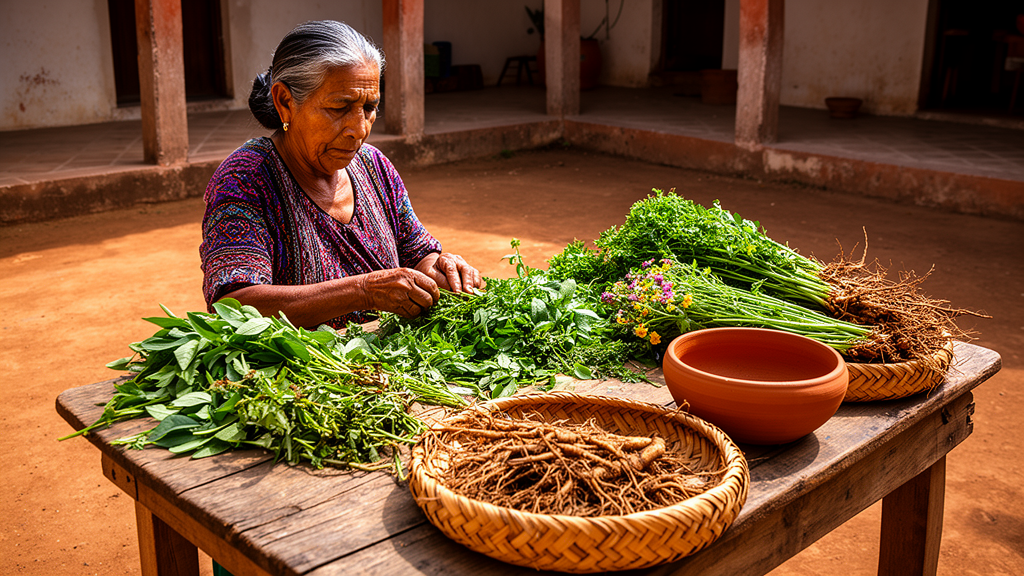
Plant acquisition reflected an integrated management continuum connecting wild environments with household backyards. Landscape collection supplied 63 of the 82 taxa (76.8 percent), backyard cultivation provided 33 taxa (40.2 percent), commercial purchasing accounted for seven taxa (8.5 percent), and four taxa (4.9 percent) came from other sources. In combined terms, 48 taxa (58.5 percent) were obtained exclusively by collection, 12 taxa (14.6 percent) solely from backyards, and 12 taxa (14.6 percent) through both pathways. Informants cited year-round availability in 431 reports (74.6 percent) and rainy-season availability in 112 reports (19.4 percent). Branches were the most common plant part used, appearing in 303 use reports (52.4 percent), followed by leaves or cladodes in 188 reports (32.5 percent). Preparation methods were dominated by teas and infusions in 386 of 576 reports (67.0 percent), followed by poultices (11.8 percent), squeezed preparations (9.9 percent), and cleansing bundles (9.4 percent). Oral administration led routes with 366 of 578 reports (63.3 percent), followed by topical application (15.7 percent) and cleansing rituals (10.0 percent).
Multivariate analyses demonstrated that community medicinal knowledge forms a shared repertoire structured by distinct therapeutic categories rather than demographic divisions. Non-metric multidimensional scaling on Jaccard dissimilarities produced stress values of 0.222 in two dimensions and 0.164 in three dimensions. PERMANOVA models revealed no significant compositional differentiation across gender (R2 = 0.028, p = 0.660), age (R2 = 0.035, p = 0.332), education (R2 = 0.038, p = 0.231), or agricultural involvement (R2 = 0.034, p = 0.413), with PERMDISP confirming homogeneous dispersion. Correspondence analysis of 23 taxa and 12 therapeutic domains representing 399 reports explained 44.0 percent of total inertia, where dimension one separated digestive from infectious ailments, and dimension two isolated culturally defined illnesses. The authors emphasized that high consensus reflects cultural prominence rather than clinical efficacy. Field datasets were governed under the CARE Principles for Indigenous Data Governance, and the researchers concluded that sustainable management requires community-based oversight paired with ecological population assessments to evaluate local harvesting impacts.
Subject of Research: Medicinal plant agrobiodiversity, therapeutic practices, and ethnobotanical knowledge in a Mixtec Indigenous community in Oaxaca, Mexico
Article Title: Medicinal plant agrobiodiversity, biocultural management, and conservation in a Mixtec indigenous community in Oaxaca, Mexico
Article References: Méndez-Cabrera, J. G., Cadena-Iñiguez, J., Vidaña, M. D. R. S., Cadena-Zamudio, J. D., Cadena-Zamudio, D. A., Iñiguez-Luna, M. I., & Sosa-Cabrera, E. (2026). Medicinal plant agrobiodiversity, biocultural management, and conservation in a Mixtec indigenous community in Oaxaca, Mexico. Frontiers in Conservation Science, 7, 1999723. https://doi.org/10.3389/fcosc.2026.1999723
Image Credits: AI Generated
DOI: 10.3389/fcosc.2026.1999723
Keywords: ethnobotany, medicinal plants, agrobiodiversity, biocultural heritage, Mixtec, Oaxaca, Santiago Ixtaltepec, traditional ecological knowledge, home gardens, culturally defined illnesses, informant consensus factor, fidelity level, Calea ternifolia, Tournefortia mutabilis, CARE principles, data governance, plant conservation
News Source: Drew Townsend. (November 11, 2026). Study Documents 82 Medicinal Plants Shared Across Mixtec Community in Oaxaca. Scienmag.