• HOME
  • NEWS
  • EXPLORE
    • CAREER
      • Companies
      • Jobs
    • EVENTS
    • iGEM
      • News
      • Team
    • PHOTOS
    • VIDEO
    • WIKI
  • BLOG
  • COMMUNITY
    • FACEBOOK
    • INSTAGRAM
    • TWITTER
Saturday, July 4, 2026
BIOENGINEER.ORG
No Result
View All Result
  • Login
  • HOME
  • NEWS
  • EXPLORE
    • CAREER
      • Companies
      • Jobs
        • Lecturer
        • PhD Studentship
        • Postdoc
        • Research Assistant
    • EVENTS
    • iGEM
      • News
      • Team
    • PHOTOS
    • VIDEO
    • WIKI
  • BLOG
  • COMMUNITY
    • FACEBOOK
    • INSTAGRAM
    • TWITTER
  • HOME
  • NEWS
  • EXPLORE
    • CAREER
      • Companies
      • Jobs
        • Lecturer
        • PhD Studentship
        • Postdoc
        • Research Assistant
    • EVENTS
    • iGEM
      • News
      • Team
    • PHOTOS
    • VIDEO
    • WIKI
  • BLOG
  • COMMUNITY
    • FACEBOOK
    • INSTAGRAM
    • TWITTER
No Result
View All Result
Bioengineer.org
No Result
View All Result
Home NEWS Science News Chemistry

Single photon emission from isolated monolayer islands of InGaN

Bioengineer by Bioengineer
September 23, 2020
in Chemistry
Reading Time: 2 mins read
0
IMAGE
Share on FacebookShare on TwitterShare on LinkedinShare on RedditShare on Telegram

IMAGE

Credit: by Xiaoxiao Sun, Ping Wang, Tao Wang, Ling Chen, Zhaoying Chen, Kang Gao, Tomoyuki Aoki, Li Mo, Jian Zhang, Tobias Schulz, Martin Albrecht, Weikun Ge, Yasuhiko Arakawa, Bo Shen, Mark…

Non-classical light sources such as single photon emitters are essential devices for the realization of future optical quantum technologies including optical quantum computing and quantum key distribution. To date several strategies, including single atoms, quantum dots (QDs), single molecules, and point defects, have been used to explore the development of single photon emitters. Although great strides have been made in the development of solid-state single photon emitters, including high purity and indistinguishability from QDs, and high emission rates from both defects and QDs, each technology has its own drawbacks. Therefore, basic research into the development of single photon emitters using new materials and techniques is crucial.

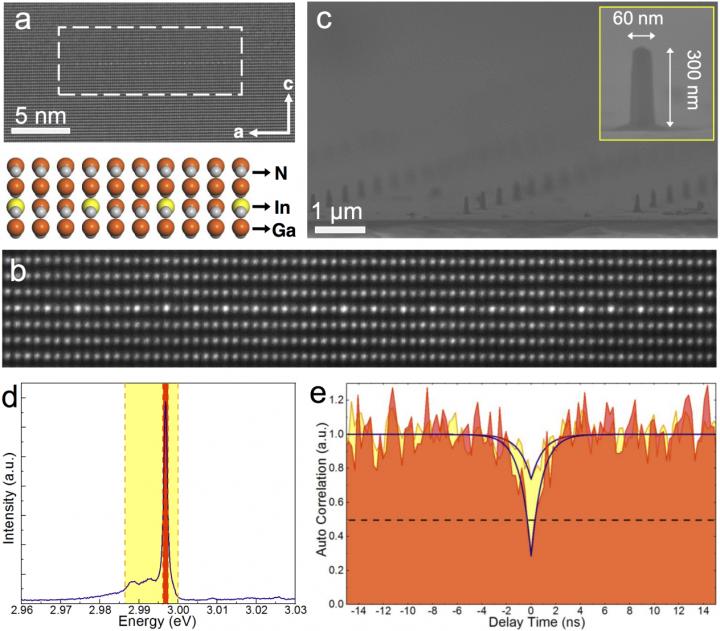
In a new paper published in Light Science & Applications, a team of scientists from State Key Laboratory for Mesoscopic Physics and Frontiers Science Center for Nano-optoelectronics, School of Physics, Peking University, China, and Institute of Industrial Science, The University of Tokyo, Japan have developed a novel type of quantum emitter formed from spatially separated monolayer islands of InGaN sandwiched in a GaN matrix. They first grew a planar structure of InGaN monolayer islands using molecular beam epitaxy, and then patterned the sample into pillars using nanoimprint lithography and inductively-coupled plasma reactive-ion etching. Detailed optical analysis of the emission properties of the isolated monolayer islands showed that the main emission line could be spectrally filtered to act as a bright, and fast single photon emitter at a wavelength of ~ 400 nm, with a high degree of photostability.

“III-nitride materials were chosen for this study because they are expected to offer several advantages for the development of future devices, including a wide tunability in emission wavelength, compatibility with silicon substrates for growth, and support from a worldwide industrial infrastructure for device fabrication due to their extended use in modern day optoelectronics and power device applications”, say the researchers.

The team also suggest that the next step in the research is to work towards higher emission purity, and that future developments (possibly using other materials) could lead to the realization of emitters operating at wavelengths compatible with conventional fiberoptic systems.

###

Media Contact
Xinqiang Wang
[email protected]

Related Journal Article

http://dx.doi.org/10.1038/s41377-020-00393-6

Tags: Chemistry/Physics/Materials SciencesOptics
Share12Tweet8Share2ShareShareShare2

Related Posts

Intelligent Microgrid Management Promises Lower Household Energy Bills and Reduced Diesel Emissions — Chemistry

Intelligent Microgrid Management Promises Lower Household Energy Bills and Reduced Diesel Emissions

July 4, 2026
Graz University of Technology Deciphers the Structural Secrets of MOF Thin Films — Chemistry

Graz University of Technology Deciphers the Structural Secrets of MOF Thin Films

July 2, 2026

Breaking Thermodynamic Limits: Wavelength-Driven Catalysis Advances Ammonia Synthesis

July 2, 2026

From Quantum Mechanics to AI-Powered Materials Discovery: MARVEL Marks 12 Years of Transforming Computational Science

July 2, 2026
Please login to join discussion

POPULAR NEWS

  • Detection of EDCs in Breast Milk and Infant Urine Up to Six Months Highlights Early Exposure Risks

    77 shares
    Share 31 Tweet 19
  • Saying Goodbye to PGY-6: Pediatric Fellowship Realities

    103 shares
    Share 41 Tweet 26
  • New Drug Candidate Developed at McMaster Shows Potential for Treating Brain Cancer

    58 shares
    Share 23 Tweet 15
  • KTU Researchers Explore Ultrasound’s Role in Enhancing Blood Flow Beyond Diagnostics

    53 shares
    Share 21 Tweet 13

About

We bring you the latest biotechnology news from best research centers and universities around the world. Check our website.

Follow us

Recent News

Quasi-Bound States Boost Quantum Well Photoresponse

Lysine Pyruvylation Links Glycolysis to Epigenetics

Multiphysics Coupling: Single vs. Multiple DeepONet Branches

Subscribe to Blog via Email

Success! An email was just sent to confirm your subscription. Please find the email now and click 'Confirm' to start subscribing.

Join 83 other subscribers
  • Contact Us

Bioengineer.org © Copyright 2023 All Rights Reserved.

Welcome Back!

Login to your account below

Forgotten Password?

Retrieve your password

Please enter your username or email address to reset your password.

Log In
No Result
View All Result
  • Homepages
    • Home Page 1
    • Home Page 2
  • News
  • National
  • Business
  • Health
  • Lifestyle
  • Science

Bioengineer.org © Copyright 2023 All Rights Reserved.