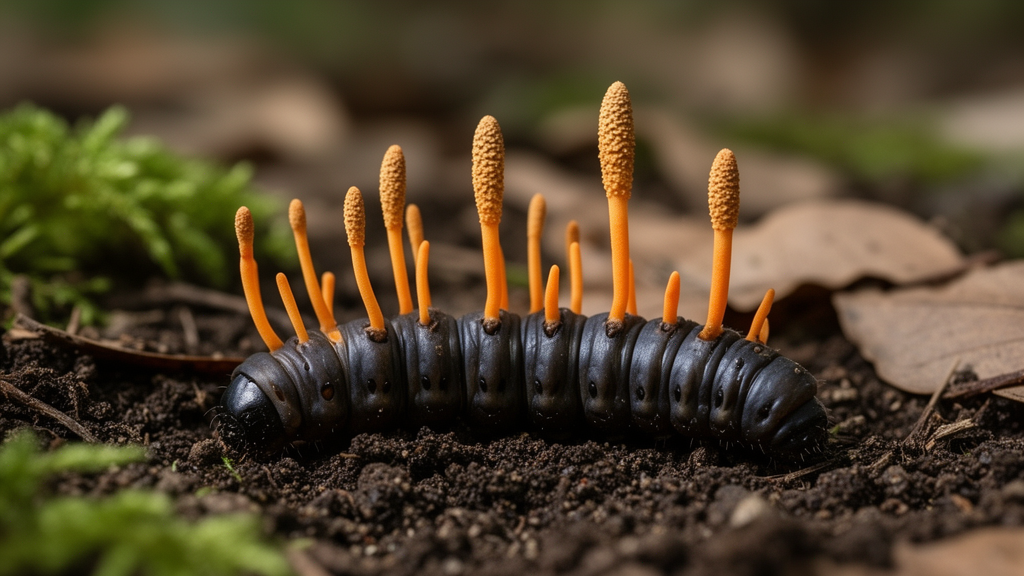
Scientists have identified a single gene that acts as an essential molecular switch for the development of the asexual fruiting bodies of Cordyceps cicadae, a prized medicinal and edible fungus used across East Asia. The gene, named CcMAK2, encodes a mitogen-activated protein kinase homologous to the well-characterized Fus3/MAK2 family of signaling proteins. When researchers deleted this gene from the fungal genome, the organism lost entirely its capacity to produce fruiting bodies, remaining trapped in a vegetative mycelial state. The discovery, published in IMA Fungus, provides the first direct genetic evidence that this conserved signaling pathway governs the reproductive transition in this entomopathogenic fungus and opens new avenues for understanding how filamentous fungi coordinate their complex developmental programs.
Cordyceps cicadae, also known by its synonym Isaria cicadae, is an entomopathogenic fungus that parasitizes cicada nymphs and is widely distributed throughout China and other Asian countries. Unlike many of its relatives, the fungus completes its life cycle primarily through asexual development, and its sexual cycle is rarely observed in nature. Its fruiting bodies, which lack sexual sporulation structures but produce large numbers of conidia at their apex, are highly valued in traditional Chinese medicine and cuisine. Modern research has revealed that the fungus is rich in bioactive compounds including adenosine, polysaccharides, cordycepic acid, and N6-(2-hydroxyethyl)-adenosine, contributing to a broad spectrum of pharmacological activities such as antioxidant, immunomodulatory, anti-fatigue, anti-inflammatory, and anti-diabetic effects. Its pharmacological profile closely resembles that of the better-known Ophiocordyceps sinensis and Cordyceps militaris, making it an ideal alternative resource for the pharmaceutical, food, and cosmetic industries.
The research team, working with a wild-type strain originally isolated from Huaxi District in Guiyang City, Guizhou Province, China, focused on the Fus3/MAK2 homolog within the mitogen-activated protein kinase signaling pathway. This pathway is a central regulator of fungal growth, morphogenesis, and reproduction, and its core component Fus3 has been extensively studied in budding yeast, where it controls cell cycle arrest, polarized growth, and the activation of mating-specific genes through the transcription factor Ste12. In the model filamentous fungus Neurospora crassa, the orthologous gene MAK2 regulates conidiation, hyphal fusion, and sexual development. In entomopathogenic fungi such as Beauveria bassiana and Magnaporthe grisea, homologous kinases are essential for host cuticle penetration and invasive growth. Despite this broad functional conservation, the role of Fus3/MAK2 in the fruiting body development of C. cicadae had never been reported before this study.
To clone the CcMAK2 gene, the researchers performed a BLAST search against the C. cicadae genome using the MAK2 sequence from N. crassa as a query. The resulting gene comprises 1011 base pairs and encodes a protein of 336 amino acids with a predicted molecular weight of approximately 39.1 kilodaltons. Structural analysis revealed that CcMAK2 contains three exons and two introns, a configuration that differs from the four-exon structure found in closely related species including Cordyceps fumosorosea, C. militaris, B. bassiana, and N. crassa. However, the core functional domain remains a single protein kinase catalytic domain, and the putative fourth exon in other species does not encode an independent domain but rather contributes to the same kinase domain. The researchers concluded that CcMAK2 does not represent a case of functional loss but rather achieves equivalent function through a simplified gene structure. Phylogenetic analysis confirmed that CcMAK2 shares a close evolutionary relationship with MAK2 homologs from other cordycipitoid fungi, exhibiting 89 percent homology to C. fumosorosea and 88 percent homology to N. crassa.
Genomic collinearity analysis further revealed that CcMAK2 resides within a highly conserved gene cluster, positioned immediately upstream of a gene encoding a Sec23/Sec24 protein and downstream of genes encoding SGT1 and RecF/RecN/SMC proteins. This distinctive gene arrangement, including both the order and transcriptional orientation of the genes, is maintained with nearly perfect conservation across the compared fungal species. The maintenance of synteny among orthologous genes across different species is generally considered a strong genomic signal suggesting potential functional interrelationships among these genes, likely maintained by evolutionary selective pressure. Sec23 and Sec24 are components of the COPII vesicle coat proteins involved in protein transport from the endoplasmic reticulum to the Golgi apparatus, while SGT1 may participate in proteostasis, cell cycle regulation, or stress response, and RecF, RecN, and SMC proteins are associated with DNA repair and chromosome structure maintenance. The tight linkage suggests possible synergistic interactions in core biological processes including MAPK signaling, protein trafficking, proteostasis, and genome maintenance.
Using Agrobacterium tumefaciens-mediated transformation, the team constructed both overexpression and knockout strains of CcMAK2. Polymerase chain reaction verification confirmed successful integration of the overexpression cassette and homologous recombination replacement of the CcMAK2 locus with a hygromycin resistance cassette in seven independent knockout transformants. Fluorescence microscopy confirmed mCherry expression in the overexpression strains. Phenotypic analysis revealed that both the wild-type and overexpression strains produced normal colonies with yellow central pigmentation and dense mycelia on potato dextrose agar, while the knockout mutant lacked pigmentation and displayed sparse mycelium. On both potato dextrose agar and Sabouraud dextrose agar, the colony diameter of the knockout strain was significantly larger than those of the wild-type and overexpression strains, indicating that CcMAK2 influences mycelial growth rate and aerial hyphal development. Conidial morphology remained unchanged across all three strains, with all producing long-oval conidia.
Sporulation assays revealed a striking nutrient-dependent pattern. On potato dextrose agar, the overexpression strain produced significantly higher conidial yields than the wild-type and knockout strains after both seven and fourteen days of cultivation. However, on Sabouraud dextrose agar, the knockout strain produced significantly higher sporulation yields compared to the other two strains. The researchers hypothesize that this reversal reflects differences in the carbon-to-nitrogen ratio and nitrogen source composition between the two media, which may serve as critical environmental signals transduced through distinct pathways. Under nitrogen-limited conditions, CcMAK2 acts as a positive regulatory factor, while under nitrogen-rich conditions, alternative pathways may be upregulated to compensate for its absence, or CcMAK2 might interact with distinct co-factors to repress certain conidiation-promoting genes.
The most dramatic phenotype emerged during artificial cultivation on rice-based solid medium. Both the wild-type and overexpression strains produced normal fruiting bodies with no significant differences in number, height, or biological efficiency. In stark contrast, the knockout strain completely lost the ability to form fruiting bodies and remained in a white mycelial state throughout the thirty-day cultivation period. Quantitative real-time PCR analysis showed that during the fruiting body development stage, the overexpression strain exhibited significantly upregulated transcript levels of CcMAK2, CcSO, Ste12, and Vea, while Fus1 was significantly downregulated. In the knockout strain, CcMAK2 and CcSO were significantly downregulated, while Fus1 and Far1 were significantly upregulated. These results demonstrate that CcMAK2 is a pivotal gene for the transition from vegetative growth to reproductive growth, acting as an essential molecular switch for fruiting body initiation.
Bioassays using greater wax moth larvae revealed that overexpression of CcMAK2 enhanced fungal virulence, reducing the median lethal time from 74 hours in the wild type to 64 hours. The knockout strain showed no significant difference in median lethal time compared to the wild type, but it lost the ability to penetrate the insect cuticle from inside and form reproductive structures on the host surface. This finding indicates that CcMAK2 is crucial for completing the infection cycle through host penetration and external proliferation, though it appears to have little effect on the initial process of killing the insect within the hemocoel. The result is consistent with reports in B. bassiana, where deletion of the Fus3/Kss1 MAPK homolog completely abolished both cuticle penetration ability and pathogenicity.
Biochemical measurements during the fruiting stage revealed that the knockout strain exhibited significantly reduced levels of hydrogen peroxide and superoxide anion, decreased by approximately 62 percent and 39 percent respectively, compared to the wild type. Concurrently, catalase and glutathione reductase activities were significantly upregulated, while superoxide dismutase activity was significantly downregulated in the knockout strain. Chitinase activity was also significantly elevated in the knockout mutant. These findings suggest that CcMAK2 functions as an upstream regulator maintaining appropriate reactive oxygen species homeostasis during development, and that its deletion leads to insufficient ROS signaling, failing to activate downstream developmental programs. The altered transcript levels of CcSO, a key gene in the cell wall integrity pathway, combined with elevated chitinase activity and abnormal phenotypes, further suggest that CcMAK2 is associated with the maintenance of cell wall integrity-related parameters during fruiting body morphogenesis. Together, these results establish CcMAK2 as an essential regulatory hub coordinating reactive oxygen species signaling, cell wall metabolism, and developmental transitions in this medically important fungus.
Subject of Research: The role of the CcMAK2 MAP kinase gene in regulating asexual fruiting body development, reactive oxygen species homeostasis, and cell wall integrity in the medicinal fungus Cordyceps cicadae
Article Title: The CcMAK2 gene is required for proper asexual fruiting body formation in Cordyceps cicadae
Article References: Chen, L., Tian, X., Chen, L., Xiao, Y., Han, J., & Zhao, J. (2026). The CcMAK2 gene is required for proper asexual fruiting body formation in Cordyceps cicadae. IMA Fungus, 17, Article e185776. https://doi.org/10.3897/imafungus.17.185776
Image Credits: AI Generated
DOI: 10.3897/imafungus.17.185776
Keywords: Cordyceps cicadae, CcMAK2, MAPK signaling, fruiting body development, entomopathogenic fungi, reactive oxygen species, cell wall integrity, medicinal fungus, fungal genetics, asexual reproduction, Ste12 transcription factor, chitinase activity
News Source: Juliet Wilcox. (October 18, 2026). Single Gene Switch Controls Fruit Body Formation in Medicinal Caterpillar Fungus. Scienmag.