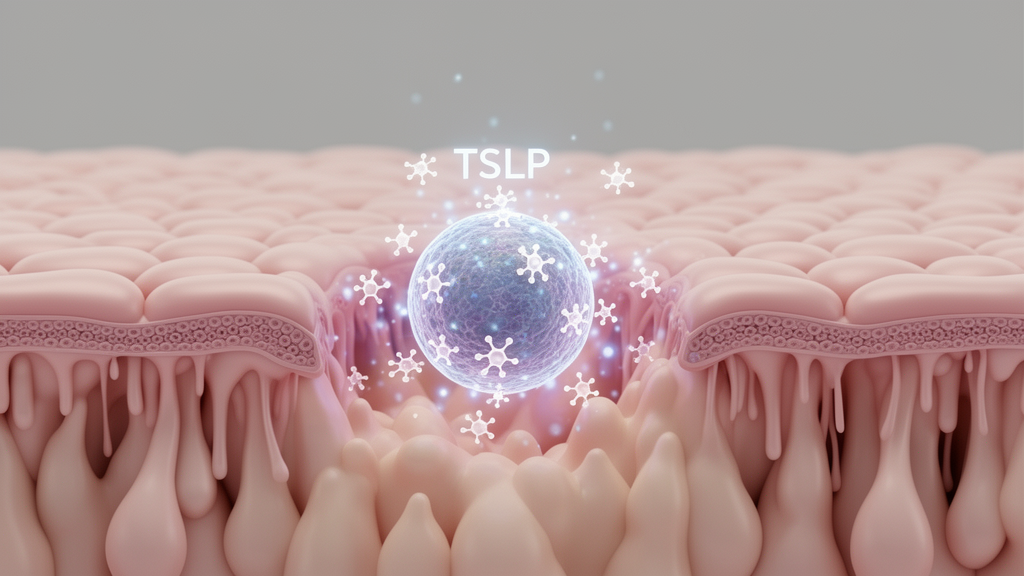
In a comprehensive transcriptomic study investigating the cellular origins of chronic mucosal inflammation, researchers have identified a specialized basal epithelial cell state marked by elevated expression of thymic stromal lymphopoietin in patients with chronic rhinosinusitis with nasal polyps. Clinical relevance for this inflammatory pathway is supported by the demonstrated therapeutic benefits of the anti-TSLP monoclonal antibody tezepelumab in patients suffering from severe, uncontrolled nasal polyposis. Earlier investigations established that basal epithelial cells represent an important cellular source of thymic stromal lymphopoietin and described a BCAM-high basal program linked to type 2 inflammation. However, the precise placement of this alarmin-producing basal state within the epithelial landscape and its interactions with immune cells remained unclear. To clarify these relationships, investigators integrated multiple single-cell transcriptomic datasets to define this basal state and evaluate its immunological connections.
To construct an expansive cellular reference, the research team computationally integrated four published nasal single-cell RNA-sequencing datasets, incorporating data from GSE156285, GSE196169, GSE270953, and the published cohort of Ordovas-Montanes and colleagues. Following quality control filtering, data integration was carried out using the Harmony batch-correction algorithm, yielding a final analytical dataset comprising 66,765 individual cells. This cellular assembly was derived from tissue samples collected from two healthy control subjects, six patients diagnosed with chronic rhinosinusitis without nasal polyps, and sixteen patients presenting with chronic rhinosinusitis with nasal polyps. High-resolution clustering across this integrated cellular collection enabled detailed characterization of epithelial, stromal, and infiltrating immune populations. Unbiased gene expression profiling across all pooled cell types confirmed that basal epithelial cells served as the predominant source of thymic stromal lymphopoietin transcripts throughout the nasal mucosa, surpassing all other epithelial, stromal, and immune subsets in baseline alarmin production.
Within the integrated mucosal dataset, high-resolution clustering of epithelial populations identified a distinct basal epithelial state, designated by the authors as Epi_basal_3, that was defined by a signature of ten marker genes. These identifying markers included MMP10, KRT17, DLK2, KRT15, KRT5, BCAM, WNT4, S100A2, SFN, and DLL1. Across the entire integrated single-cell dataset, this Epi_basal_3 population exhibited the highest overall thymic stromal lymphopoietin expression level and contained the greatest proportion of cytokine-positive cells. Quantitative transcriptomic evaluations revealed that thymic stromal lymphopoietin was detected in 67.7 percent of Epi_basal_3 cells, while interleukin-33 was detected in 78.2 percent of the population. In contrast, transcripts for interleukin-25 were completely undetectable within this cluster. Both thymic stromal lymphopoietin and interleukin-33 showed consistently higher detection frequencies in Epi_basal_3 than in sibling basal populations designated Epi_basal_1 and Epi_basal_2. Notably, Epi_basal_3 shared several marker genes with previously described BCAM-high basal progenitor programs associated with severe type 2 mucosal inflammation.
The investigators next examined whether the Epi_basal_3 transcriptional state could be consistently detected in individual clinical subjects presenting with nasal polyposis. Among the sixteen patients with chronic rhinosinusitis with nasal polyps evaluated in the integrated single-cell dataset, ten individuals yielded adequate basal cell recovery, which was predefined as the capture of ten or more basal epithelial cells. When examined individually, Epi_basal_3 was successfully detected in all ten of these evaluable subjects, demonstrating consistent patient-level presence across adequately sampled polyp specimens. In the remaining six patients with nasal polyps, fewer than ten basal epithelial cells were captured during sequencing, which constrained analytical sensitivity and prevented definitive assessment of Epi_basal_3 detection.
To verify whether these transcriptional characteristics were reproduced in independent clinical cohorts, the investigators evaluated two published bulk transcriptomic datasets from patients with chronic rhinosinusitis with nasal polyps, cataloged as GSE179265 and GSE136825. In both validation cohorts, tissue samples were stratified into TSLP-high and TSLP-low groups based on cohort median thymic stromal lymphopoietin expression levels. Using a composite marker score calculated across the ten signature genes, the authors observed significant enrichment of the Epi_basal_3 program in TSLP-high samples compared to TSLP-low samples in both datasets, with statistical significance reaching p less than 0.01. Detailed gene-level evaluations further demonstrated a graded, progressive increase in marker expression from healthy controls to TSLP-low and TSLP-high polyp specimens. Furthermore, analysis of an independent epithelial single-cell RNA-sequencing cohort published by Liao and colleagues confirmed the existence of a corresponding basal-cell subset characterized by concurrent thymic stromal lymphopoietin expression and elevated Epi_basal_3 signature scores.
To establish the anatomical and developmental context of Epi_basal_3, the authors projected its transcriptional profile onto the Human Lung Cell Atlas. Computational reference mapping assigned 85.7 percent of Epi_basal_3 cells to the resting basal cell compartment and 14.1 percent to suprabasal cells. Complementary pseudotime trajectory analysis positioned Epi_basal_3 along a developmental transition situated between Epi_basal_1 and Epi_basal_2 states and downstream suprabasal and secretory lineages. Expression of both the ten-gene marker signature and thymic stromal lymphopoietin peaked near the Epi_basal_3 region before declining along the secretory differentiation trajectory, indicating that Epi_basal_3 represents an activated, remodeling intermediate state rather than a terminal canonical cell type. Pathway analysis further demonstrated enrichment of gene programs governing wound healing, active epithelial repair, extracellular matrix organization, and cell-junction formation, alongside suggestive enrichment of epithelial-mesenchymal transition markers and relative depletion of cilium organization programs compared to other basal subsets.
Using the CellChat computational framework, the researchers modeled cell-to-cell communication networks mediated by thymic stromal lymphopoietin and its heterodimeric receptor complex, which is composed of IL7R and CRLF2. In tissue from patients with chronic rhinosinusitis with nasal polyps, the model inferred potential signaling interactions connecting epithelial populations, particularly Epi_basal_3, with group 2 innate lymphoid cells, type 2 helper T cells, and cycling T cells expressing MKI67 and TOP2A. In contrast, no significant TSLP-receptor communication interactions were inferred in available cells from healthy control or non-polyp tissue samples. Among all epithelial populations analyzed, Epi_basal_3 generated the highest inferred outgoing communication score, highlighting its primary role as a signal sender within the mucosal microenvironment. Conversely, group 2 innate lymphoid cells displayed the highest inferred incoming communication score, identifying them as the predominant computational targets for epithelial-derived alarmin signaling in polyp tissues.
Because CellChat evaluates ligand-receptor communication probabilities rather than intracellular signaling responses, the authors separately examined inferred transcription-factor activity for STAT5A and STAT5B in subject-matched immune populations. At the individual subject level, the correlation between the Epi_basal_3 signature score and inferred STAT5A activity in group 2 innate lymphoid cells was positive but did not achieve statistical significance, with a Spearman correlation coefficient of rho equal to 0.71 and a p-value of 0.088. However, in a complementary cell-distribution analysis, this positive correlation reached statistical significance, exhibiting a correlation coefficient of rho equal to 0.42 and a false discovery rate of 0.039. No statistically significant associations were observed for STAT5B activity in group 2 innate lymphoid cells or for either STAT5A or STAT5B activity in type 2 helper T cells, although the helper T cell analysis was constrained by being evaluable in only four matched clinical subjects.
To evaluate these interactions within intact spatial tissue architecture, the authors analyzed a GeoMx whole-transcriptome dataset, cataloged as GSE235714, using SpatialDecon across sixty complete polyp region-of-interest pairs in matched epithelial and immune compartments. This spatial analysis demonstrated that Epi_basal_3 abundance was positively associated with cycling T cells, yielding a correlation of rho equal to 0.419 and a false discovery rate of 0.011, alongside a nonsignificant positive correlation with group 2 innate lymphoid cells at rho equal to 0.225. Cycling T cells and innate lymphoid cells were detected in 67.2 percent and 93.4 percent of regions, respectively, whereas an independent helper T cell component was unresolved across all sixty-one regions. In addition, NicheNet ligand-activity analysis linked Epi_basal_3 to candidate upstream signals including interleukin-1, TWEAK, oncostatin M, and matrix-related collagen, laminin, and integrin interactions, with monocytes, macrophages, and fibroblasts identified as key cellular sources.
The investigators noted several important limitations that contextualize these findings. The study relied primarily on transcriptomic sequencing data and computational inference without direct measurements of protein concentrations, receptor activation, or functional cellular interactions. Technical factors including transcript dropout and variable basal-cell sampling depth may influence the detection of Epi_basal_3 in low-cellularity specimens. Furthermore, the small healthy control group comprising only two individuals limited comparative analyses with non-diseased tissue, while differences across sequencing platforms and sample processing protocols may have introduced variation despite computational harmonization. In addition, relevant clinical annotations, including comorbid asthma status, tissue eosinophilia, disease recurrence, and prior treatment exposures, were unavailable or inconsistently reported across the retrospective source datasets. Consequently, the authors emphasized that larger, clinically annotated patient cohorts and dedicated functional and spatial validation studies will be essential to establish the precise biological mechanisms and clinical significance of the Epi_basal_3 basal epithelial state.
Subject of Research: Transcriptomic characterization of TSLP-expressing basal epithelial cells in chronic rhinosinusitis with nasal polyps
Article Title: Single-cell transcriptomic characterization of a TSLP-high basal epithelial state and its associated signals in chronic rhinosinusitis with nasal polyps
Article References: Tran, N. Q. V., Kobayashi, Y., Nakamura, Y., & Nakao, A. (2026). Single-cell transcriptomic characterization of a TSLP-high basal epithelial state and its associated signals in chronic rhinosinusitis with nasal polyps. World Allergy Organization Journal, 19(12), Article 101494. https://doi.org/10.1016/j.waojou.2026.101494
Image Credits: AI Generated
DOI: 10.1016/j.waojou.2026.101494
Keywords: Chronic rhinosinusitis with nasal polyps, Single-cell RNA sequencing, TSLP, Basal epithelial cells, Type 2 inflammation, Epi_basal_3, Harmony integration, CellChat, NicheNet, SpatialDecon, GeoMx transcriptomics, ILC2s, Cycling T cells, STAT5A, Epithelial remodeling, Tezepelumab
News Source: Ophelia Keating. (November 24, 2026). Single-Cell Analysis Reveals TSLP-Producing Basal Epithelial State in Nasal Polyps. Scienmag.