


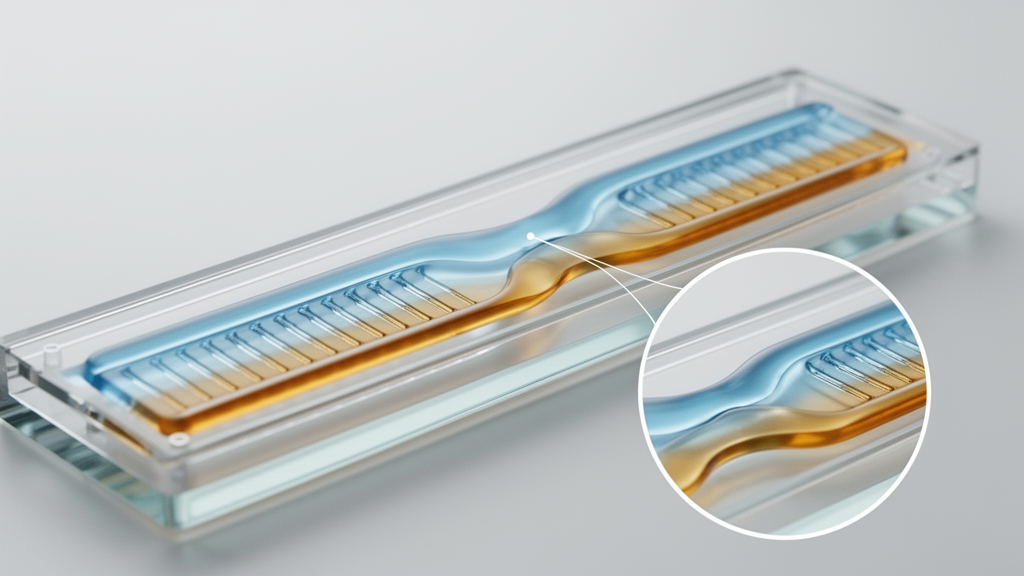
A computer simulation study published in Discover Fluid Mechanics reports that a water–ethanol-like liquid mixture can be partially separated inside a two-dimensional microchannel using nothing but wettability-driven interfacial forces—no external fields, no pressure controllers, and no chemical additives. The work, led by Mohanad Radhi with Derek Tretheway, uses a multi-range, multi-component Shan–Chen Lattice Boltzmann Method (LBM) to show how carefully tuned surface affinities and patterned solid posts can push two fully miscible species toward opposite walls of a channel, creating measurable concentration gradients that could one day feed into energy-efficient microfluidic separation devices.
The central challenge the researchers set out to address is a familiar one in chemical engineering: separating miscible fluids, whose components mix freely at the molecular level, normally demands chemical agents, membranes, or externally controlled pressure systems. Many existing microscale separators exploit wettability differences, but they typically still rely on active pressure control, which adds complexity and can behave unreliably under varying flow conditions. The new study asks whether the intermolecular forces between the fluids and the channel walls alone can do the job passively, simply by arranging the wetting conditions along the surfaces.
The simulation framework is built on the Lattice Boltzmann Method, a mesoscale numerical technique well suited to multiphase and multicomponent flows because it can capture microscopic intermolecular interactions and wetting phenomena directly. The team employed an extended multi-range Shan–Chen pseudo-potential model, in which interaction forces are computed not just from nearest lattice neighbors but across up to six surrounding belts of lattice cells in the two-dimensional lattice. This multi-range extension increases the isotropy of the interaction forces and extends the effective reach of surface forces deeper into the fluid, addressing known weaknesses of the standard Shan–Chen scheme such as spurious currents and thermodynamic inconsistency.
Validation came in two forms. First, the hydrodynamic model was checked against the analytic Navier–Stokes solution for pressure-driven flow between parallel plates, simulated with two species of identical properties so that the multicomponent code should reproduce single-fluid behavior. The agreement was good, with a maximum relative error of less than 17 percent. Second, the predicted near-wall density structuring was compared qualitatively with published molecular dynamics data for water and ethanol near a solid surface. Both approaches showed preferential adsorption and layering of one component at the wall, with the LBM capturing the position of the first density peak and the decay toward bulk values, although—as a continuum-based mesoscopic method—it smooths out the sharp molecular-scale kinks that molecular dynamics resolves.
With the model established, the authors ran systematic parametric studies on a channel whose fluid properties mimic a water–ethanol mixture at 25 degrees Celsius. Varying the cross-interaction coefficient G12, which controls the mutual repulsion or attraction between the two fluid species, changed how strongly the components segregated: increasing G12 enhanced the segregation between the fluids. The solid–fluid interaction coefficients G1s and G2s, varied from −1.0 to 1.0, controlled each species’ affinity for the walls. When G1s was set to −1.0, indicating strong affinity between fluid-1 and the solid, the scaled density of fluid-1 rose by about 25 percent near the walls; at G1s = 1.0 it dropped by roughly 20 percent. For fluid-2, setting G2s to −1.0 produced about a 35 percent increase near the boundaries, while G2s = 1.0 gave a 15 percent reduction.
The relaxation times τ1 and τ2, which govern viscosity and the mapping between lattice and physical units, also mattered—though not by changing force magnitudes. Reducing either relaxation time from 1.0 to 0.6 effectively extended the range over which the intermolecular forces influenced the density profiles by at least 250 percent, because shorter relaxation times correspond to larger effective lattice spacings and thus a physically smaller channel for a fixed number of cells. Separately, reducing the number of lattice cells across the channel height showed that narrower channels amplify wall effects on the attracted species, with the scaled density of fluid-2 dropping progressively as the channel narrowed, while fluid-1’s density magnitude remained largely stable except in the extreme fifteen-cell case.
The key design insight came from uneven wetting. In an evenly wetted channel—both walls hydrophobic to one species and hydrophilic to the other—both walls attract the same fluid, which is of limited use for actual separation because the two species need to exit on different sides. When the team instead gave the top wall strong affinity for fluid-1 and the bottom wall strong affinity for fluid-2, the density changes became asymmetric and substantially larger: increases of up to 30 percent for fluid-1 and 45 percent for fluid-2 near their preferred walls, and maximum drops of about 35 percent under repulsive conditions. Importantly, these significant density variations occur within the short, hard-core range of the intermolecular forces—within roughly 20 to 30 nanometers of the wall—so a practical device would need outlets sized and positioned right at each wall.
To push the surface forces beyond that nanoscale limit, the researchers added patterned solid posts to the channel, each post carrying the wettability of the wall on its side of the channel centerline. In static, no-flow simulations with posts occupying every other lattice node in both directions, each fluid component concentrated in its higher-affinity half of the channel. Complete separation was not achieved—the favorable miscibility interaction between the two species keeps a considerable amount of each fluid in its unfavored half—but the posts clearly extended the influence of the wall forces across the channel interior. Time-evolution plots showed the density profiles redistributing from their initial uniform state and gradually flattening toward a steady state between the centerline and the walls.
Under flow conditions, the team tested a partially patterned channel in which the posts span only the middle half of the channel length, using two different ways to drive the flow: a local body force equivalent to a pressure drop, and prescribed inlet densities with a fixed outlet velocity. Both schemes produced distinct concentration hot spots at the start of the patterned region near each fluid’s preferred wall, with mirrored depletion zones at the far end of the post array. The concentrated regions lost intensity moving downstream, and in the boundary-condition scheme, neutral wetting near the inlet and outlet created small density islands where the interaction forces were effectively switched off. Profiles along the channel showed densities far from the posts staying close to inlet conditions and then rising or falling smoothly as the fluid entered the patterned section.
The authors are careful to frame the work as a demonstration of fundamental viability at the mesoscale rather than a ready-made technology. The simulations are two-dimensional, the separation remains partial, and the strongest gradients live within tens of nanometers of surfaces unless posts are used. Future work, they write, should address full three-dimensional geometries, optimize post patterns for specific applications, incorporate dynamic flow conditions representative of practical devices, and couple the approach with experimental validation. Even so, the study offers a concrete quantitative picture of how wettability contrast, channel height, and simple geometric patterning can be combined to coax two miscible fluids apart using only the forces that already exist at their interfaces—a concept with potential relevance for chemical, biomedical, and environmental separation applications where energy efficiency is at a premium.
Subject of Research: Passive wettability-driven separation of miscible binary fluid mixtures in two-dimensional microchannels simulated with a multi-range Shan–Chen Lattice Boltzmann Method.
Article Title: Simulation of the passive separation of miscible fluid mixtures in two-dimensional micro-channels with uneven wetting conditions
Article References: Radhi, M., & Tretheway, D. (2025). Simulation of the passive separation of miscible fluid mixtures in two-dimensional micro-channels with uneven wetting conditions. Discover Fluid Mechanics, 1(1), Article 3. https://doi.org/10.1007/s44369-025-00004-0
Image Credits: AI Generated
DOI: 10.1007/s44369-025-00004-0
Keywords: microfluidics, lattice Boltzmann method, Shan–Chen model, wettability, miscible fluids, passive separation, interfacial forces, solid posts, water–ethanol mixture, near-wall structuring, molecular dynamics validation, surface forces
News Source: Denise Maddox. (October 29, 2026). Simulations Show Uneven Wettability Can Passively Split Miscible Fluid Mixtures in Microchannels. Scienmag.



