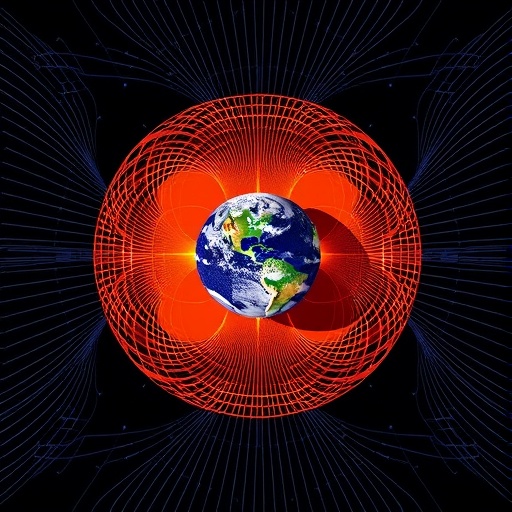
The Earth’s magnetic field has intrigued scientists for centuries, serving as an invisible compass guiding navigators and explorers alike. Central to this phenomenon is the magnetic dipole that envelops our planet, shifting and occasionally reversing its polarity in ways that have long mystified researchers. Recent advances in computational simulation from a team at the National Institute for Fusion Science (NIFS) and the Graduate University for Advanced Studies, SOKENDAI, have cast new light on the enigmatic behavior of the Earth’s magnetic field, particularly its irregular polarity reversals.
Historically, the compass’s steadfast ability to point north was recognized by the second century AD, laying early groundwork for humanity’s understanding of geomagnetism. By the seventeenth century, the notion of Earth as a giant magnet took shape, famously proposed by William Gilbert. Yet, the source and dynamics of Earth’s magnetic field remained elusive well into modern times. Albert Einstein himself considered the origin of this magnetic field one of the most challenging puzzles in physics. Today, the scientific consensus points to a dynamo process: the convection of liquid iron in the Earth’s outer core generates powerful magnetohydrodynamic interactions that sustain the field.
Magnetohydrodynamic (MHD) simulations—numerical models that elucidate the complex interplay between fluid motions and electromagnetic fields—underline this dynamo mechanism. Nearly simultaneously, research groups at NIFS and the University of California, Los Angeles (UCLA) successfully replicated Earth’s dipole magnetic field within their MHD models, marking a pivotal moment in geophysical science. However, understanding geomagnetic reversals—the phenomenon where Earth’s magnetic north and south poles flip—is an ongoing challenge. Paleomagnetic records show that these reversals occur irregularly on timescales ranging from several hundred thousand to tens of millions of years, with transitions unfolding over roughly a millennium.
A landmark breakthrough came over twenty years ago when the NIFS simulation group replicated aperiodic polarity reversals akin to those observed in Earth’s history, an achievement that still resonates within the geophysics community. Despite this progress, the fundamental trigger causing the Earth’s magnetic poles to reverse remains enigmatic. Current studies typically involve highly intricate models that emulate the turbulent convection inside Earth’s outer core, yet they fail to isolate the precise mechanisms causing these polarity shifts.
To address this, the research team at NIFS and SOKENDAI adopted a simplified approach by focusing on how magnetic polarity is initially determined during the dynamo process under controlled, steady convective conditions. Utilizing an innovative three-dimensional MHD simulation code built on the Yin-Yang grid—an advanced computational scheme designed to mitigate numerical issues near polar regions—the team simulated a spherical shell analogous to Earth’s outer core. High-performance supercomputers such as “Raijin” and “Sosei” powered these large-scale simulations, enabling the execution of multiple runs with varying initial magnetic perturbations.
Intriguingly, the simulations revealed a bi-stable nature of the dipole magnetic field: regardless of the initial weak magnetic fluctuations applied, the system evolved into a stable dipole state with either a northward or southward polarity, emerging with almost equal probability. Even when the direction of convection was reversed within the model, the distribution of final polarities remained unchanged. This indicates that the Earth’s magnetic polarity is more influenced by initial micro-level perturbations in the magnetic field rather than the characteristics of large-scale convection.
Further analysis of the simulation data showed that the growth of the magnetic field progresses through two distinct stages. Initially, the polarity flips repeatedly on a timescale associated with magnetic diffusion, a process whereby finite electrical resistivity causes the magnetic field to spread and attenuate. Subsequently, the system settles into a stable state wherein the dipole polarity is fixed, effectively robust against small external perturbations. Remarkably, attempts to induce reversals through additional weak magnetic fluctuations post-stabilization proved futile, underscoring the resilience of the established dipole orientation.
These findings offer profound implications for our understanding of Earth’s magnetic environment. The Earth’s dipole magnetic field appears to inhabit one of two stable equilibrium states, effectively locked in by initial magnetic conditions. This stability suggests that contemporary geomagnetic reversals cannot be purely spontaneous outcomes of magnetohydrodynamic interactions alone—they likely require disruptions from factors beyond classical MHD frameworks.
One compelling hypothesis posited by the research group centers on the role of microscopic plasma instabilities and anomalous transport phenomena. In practical geomagnetic reversal scenarios, the stable dipole state might be destabilized by localized anomalies in magnetic diffusivity or viscosity, caused by particle-level plasma behaviors. Such microphysical dynamics—absent from conventional MHD simulations—may provide the long-sought trigger enabling polarity reversals after prolonged intervals of magnetic stability.
This research aligns intriguingly with historical simulation work, which often interpreted polarity reversals as periodic and diffusion-driven phenomena. Actual paleomagnetic data, however, reveal that reversals are sporadic and occur over significantly longer timescales, implying that conventional models are insufficient. The bi-stability evidenced in this study may initially appear contradictory to irregular reversal patterns but could instead mark critical groundwork towards identifying unique conditions that break magnetic stability.
A major practical concern tied to geomagnetic reversals is the temporary weakening of Earth’s magnetic shield against cosmic radiation during transitional phases. This reduction in geomagnetic shielding can profoundly affect planetary ecosystems and human technological infrastructures, amplifying the urgency to decode reversal mechanisms. Studies like this not only advance basic scientific knowledge but momentously contribute to our ability to anticipate and mitigate the environmental and societal impacts of geomagnetic phenomena.
Looking forward, the research team plans to leverage ultra-high-accuracy MHD simulations to refine our understanding of the dynamo’s limits under classical assumptions. From there, integrating kinetic-scale plasma physics into global-scale models could unveil the elusive triggers behind geomagnetic flips. These interdisciplinary efforts promise to propel geomagnetic research into a new era, blending fluid dynamics, plasma physics, and computational science.
The study also highlights the significance of addressing numerical artifacts prevalent in traditional simulations—particularly related to mesh discretization and finite differencing errors. Such numerical dissipation can amplify instabilities at stagnation points within simulated flows, potentially mimicking physical reversal triggers inaccurately. Transitioning from continuous fluid approximations to particle-based plasma descriptions might reconcile these discrepancies and foster more authentic geomagnetic dynamo models.
In sum, the collaborative work from NIFS and SOKENDAI pioneers a nuanced perspective on the Earth’s magnetic field behavior: a system delicately balanced between two robust polarities shaped by minute initial fluctuations and awaiting perturbations beyond classical frameworks to instigate reversals. These insights deepen our grasp of planetary magnetism and emphasize the critical interplay between large-scale fluid dynamics and microscopic plasma instabilities in shaping our planet’s magnetic future.
Subject of Research: Computational simulation/modeling of Earth’s geomagnetic field dynamics
Article Title: Bi-stable dipole polarity in spherical shell dynamo with quadruple convection
News Publication Date: 3-Mar-2026
Web References: https://doi.org/10.1038/s41598-026-42280-x
Image Credits: National Institute for Fusion Science (NIFS)
Keywords
Earth’s magnetic field, geomagnetic reversal, magnetohydrodynamics, dynamo theory, dipole polarity, plasma instabilities, computational geophysics, Yin-Yang grid, magnetic diffusivity, numerical simulation, Earth’s outer core, magnetohydrodynamic simulation
Tags: computational geophysics modelsdipole magnetic field polarityEarth magnetic field simulationsEarth outer core convectionEarth’s magnetic dipole behaviorgeomagnetic field generationgeomagnetic polarity reversalsliquid iron core dynamicsmagnetohydrodynamic dynamo processmagnetosphere stability studiesnumerical MHD simulationsstable opposite polarity states