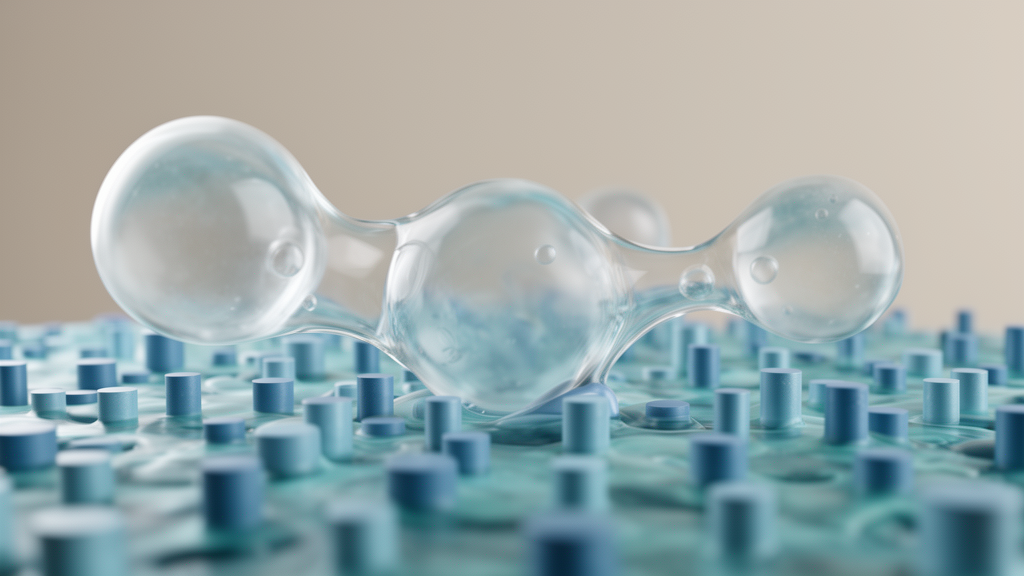
A rising bubble meeting a solid obstacle seems like a small event, but in slurry bubble columns it happens constantly, and its outcome shapes how well an entire chemical reactor performs. A new numerical study has now mapped, in fine detail, what happens in the thin liquid film that forms between a rising air bubble and a fixed cylindrical obstacle, showing how obstacle size and liquid viscosity decide whether the bubble slides past, wraps around, or splits in two.
The study, published in Discover Fluid Mechanics, was carried out by Enatri Enan, M. Saeedipour and Mark W. Hlawitschka. The authors used high-resolution three-dimensional Volume of Fluid (VOF) simulations, implemented in OpenFOAM with the isoAdvector interface-tracking method, to follow the interaction between a freely rising air bubble and a stationary horizontal cylinder. Because the gas-liquid interface is resolved geometrically rather than smeared across cells, the method can capture the micrometer-scale liquid film whose drainage, thinning and rupture determine whether a bubble attaches, slides, detaches or breaks apart.
The motivation comes from slurry bubble columns, reactors in which floating solids such as catalyst particles are suspended in a bubbling liquid. These systems underpin processes including Fischer-Tropsch synthesis, hydrogenation and oxidation, where bubble rise drives mixing, gas-solid contact and the mass and heat transfer on which conversion depends. Catalyst particles in such reactors typically range from 10 to 500 micrometers in diameter. When a bubble approaches a particle or fixed solid support, a thin liquid film forms between the gas and the solid, and the fate of that film links particle-scale physics to reactor-scale hydrodynamics such as gas holdup, circulation patterns and bubble size distributions.
To make sure the simulations could be trusted, the team first confronted them with experiments. A separate three-dimensional simulation reproduced the configuration of earlier high-speed imaging experiments by Outokesh and colleagues, using a bubble of about 5.24 millimeters in diameter rising toward a 4.0-millimeter cylinder in a liquid with a density of 1204 kilograms per cubic meter, a viscosity of 0.135 pascal-seconds and a surface tension of 0.073 newtons per meter. The simulated rise velocity of 0.24 meters per second closely matched the experimental value of 0.23 plus or minus 0.04 meters per second, and quantities such as deformation and interface evolution stayed within 5 percent of the measurements up to about 70 milliseconds, with a slight morphological deviation afterwards attributed to minor geometric asymmetries in the experimental setup.
Mesh resolution proved critical. The researchers tested six refinement levels, reducing the radial cell size near the obstacle from 12 down to 3.5 micrometers. They quantified bubble deformation with a surface-area-based deformation index, DI, defined as the bubble surface area at time t divided by its initial area. The timing of maximum deformation shifted with refinement, and only at the finer levels did the curves converge; the difference in maximum deformation index between the two finest meshes, with 140 and 160 radial cells, was below roughly 2 percent. Coarser meshes under-resolved the thin film and predicted weaker, delayed deformation. The team selected the 140-cell refinement as the reference mesh, with time steps constrained by a Courant number limit of 0.2 to keep the rapidly moving interface numerically stable.
With the validated tool in hand, the authors ran a parametric study with a constant bubble diameter of 3.67 millimeters and obstacle diameters of 0.1, 0.25, 0.5 and 1.0 millimeters, corresponding to bubble-to-obstacle diameter ratios of 36.7, 14.7, 7.34 and 3.67. The obstacle surface was hydrophobic, with a fixed static contact angle of 124 degrees, a value consistent with the validation experiments and typical of hydrophobic materials such as PTFE coatings. Liquid viscosity was varied from 0.001 to 0.1 pascal-seconds, while the gas was treated as incompressible, an assumption justified by a Mach number of roughly 7.3 times ten to the minus four.
The obstacle diameter turned out to be a decisive control parameter. At the smallest obstacle, 0.1 millimeters, the bubble experienced pronounced capillary-dominated elongation with minimal liquid drainage, stretching to roughly 2.5 times its diameter by 95 milliseconds. At the intermediate size of 0.25 millimeters, drainage was delayed and deformation became increasingly asymmetric, with the bubble adopting a squeezed morphology around 85 milliseconds while liquid film partially remained on the surface. At 0.5 millimeters, stronger hydrodynamic confinement took over: the interface began to constrict around the obstacle by 92 milliseconds and showed pronounced asymmetric stretching with clear film thinning and imminent rupture by 92.5 milliseconds. For the two larger obstacles, distinct bubbles formed during the interaction and subsequently merged back into a single bubble.
Pressure in the thin film told the same story from another angle. The authors extracted the maximum pressure along the centerline between the bubble interface and the obstacle, the region of minimum film thickness. The pressure stayed nearly constant during the early approach phase, then rose sharply as the bubble entered the drainage regime, peaking where interface curvature was greatest near the stagnation point, before relaxing rapidly as the bubble detached and the film thickened. Larger obstacles produced consistently higher peak lubrication pressures, because the increased confinement area and reduced drainage pathways intensified the resistance of the squeezed liquid layer. A scaling analysis showed that the ratio of viscous lubrication pressure to capillary pressure grows as the square of the ratio of the effective interaction radius to the film thickness, so viscous pressure can rise rapidly as the film thins, especially for larger obstacles with wider drainage footprints.
Viscosity acted as a complementary, stabilizing control. At 0.001 pascal-seconds, the bubble flattened within the first 50 milliseconds, the deformation index climbed to about 1.19 by 65 milliseconds, and the bubble spread extensively over the obstacle before merging again by 85 milliseconds, with rapid film thinning and early rupture. At 0.01 pascal-seconds, higher viscous resistance slowed everything down: the film stayed intact as the bubble flattened and formed an earlobe-like shape with two symmetric lobes, the deformation index remaining near 1.1 before contact, and the bubble completely covered the obstacle before detaching. At 0.1 pascal-seconds, viscous forces suppressed interfacial motion so strongly that the deformation index rose only to about 1.08, the film remained stable, and the bubble kept a balloon-like shape without rupturing, sliding around the obstacle instead.
The film thickness measurements also lined up with an empirical correlation from the earlier experiments, which predicts a minimum normalized film thickness proportional to the capillary number raised to the power 0.407 and the confinement ratio raised to the power 0.890. For the 1-millimeter obstacle, with a rise velocity of about 0.25 meters per second and a confinement ratio of 3.67, the correlation predicted a theoretical minimum thickness of about 0.0013 in normalized units, in good agreement with the simulation. The authors note that their capillary number is based on the overall bubble rise motion rather than a local film-drainage value, and that no experimental data exist for the smallest obstacles they simulated, so the small-obstacle results stand as new numerical predictions rather than validated measurements.
Overall, the study distinguishes three interaction regimes governed by the balance of inertial, capillary and viscous forces and the bubble-to-obstacle size ratio. At high confinement ratios, capillary forces dominate and the bubble elongates symmetrically; at low ratios, rapid film thinning leads to premature rupture and splitting. The deformation index quantifies these transitions, showing that interface stretching is inversely related to confinement strength. The authors conclude that bubble-obstacle interactions arise from the coupled effects of confinement, viscous damping and interfacial forces, providing a mechanistic basis for predicting film stability and contact outcomes in gas-liquid-solid reactors. As a next step, they plan to extend the analysis to moving obstacles that mimic freely settling catalyst particles, conditions under which film behavior across flow regimes is critical for mass transfer efficiency and where simulations can probe regimes that experiments cannot yet reach.
Subject of Research: Numerical simulation of thin liquid film drainage during interactions between rising bubbles and cylindrical obstacles
Article Title: A numerical study of bubble and obstacle interactions considering liquid film drainage
Article References: Enan, E., Saeedipour, M., & Hlawitschka, M. W. (2026). A numerical study of bubble and obstacle interactions considering liquid film drainage. Discover Fluid Mechanics, 2(1), Article 6. https://doi.org/10.1007/s44369-026-00010-w
Image Credits: AI Generated
DOI: 10.1007/s44369-026-00010-w
Keywords: bubble dynamics, thin film drainage, Volume of Fluid simulations, slurry bubble column, geometric confinement, liquid viscosity, lubrication pressure, bubble deformation, OpenFOAM, multiphase flow, catalyst particles, hydrophobic surface
News Source: Audrey Campbell. (October 29, 2026). Simulations Reveal How Bubbles Split, Slide or Stick on Tiny Obstacles. Scienmag.