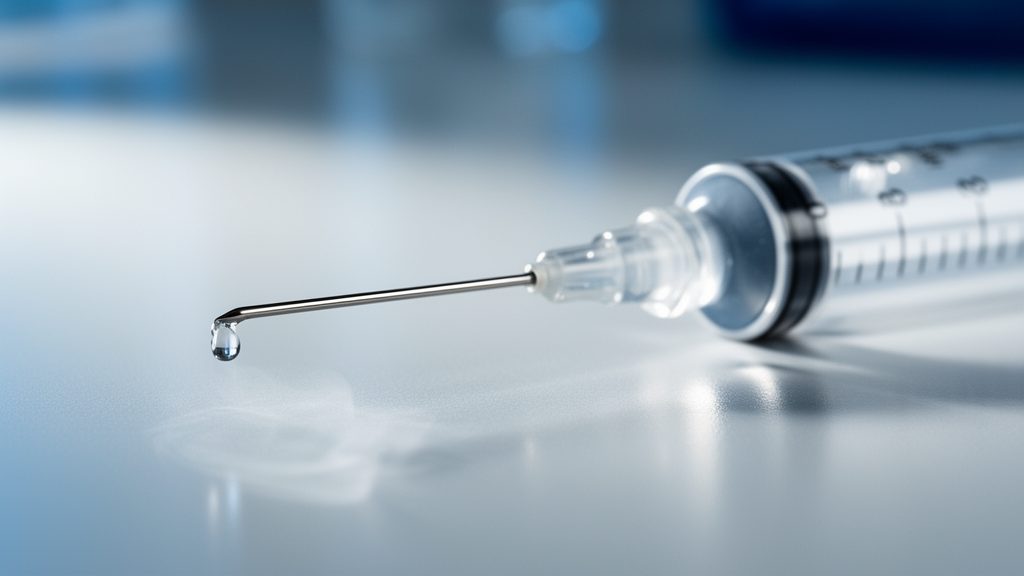
Computational modeling of prefilled syringes indicates that minute liquid droplets trapped in staked-in needles can evaporate over timescales of days to months, leaving concentrated residues that risk clogging delivery channels before patient injection. In a study published in AAPS Open, researchers combined high-resolution imaging with steady-state Fickian diffusion simulations to quantify moisture egress through elastomeric rigid needle shields under various environmental conditions. The team found that water vapor egress rates through permeable elastomeric caps range from 0 to 0.7 nanoliters per day across practical handling and storage temperatures. When evaluated against typical retained liquid volumes of 4.5 to 13.3 nanoliters observed in prior synchrotron phase-contrast imaging, these egress calculations indicate that water loss alone can drive nanoliter-scale formulation droplets to complete dryness under warm, dry conditions. By characterizing this transport mechanism, the framework links storage parameters, shield material permeability, and formulation drying dynamics to evaluate device-level clogging risks.
Prefilled syringes with permanently staked-in needles are widely adopted across biopharmaceutical manufacturing, offering improved patient safety, convenience for self-administration, and reduced microbial contamination risks compared to traditional vial formats. These devices are particularly favored for high-concentration biologic therapies, such as monoclonal antibodies, that require reliable dosing and streamlined administration. Nevertheless, staked-in architectures exhibit a recognized vulnerability: lumen occlusion before administration, which can prevent drug delivery and compromise clinical safety. During syringe filling, stoppering, or environmental pressure shifts during shipping, minute quantities of liquid formulation can enter the needle tip. Trapped liquid subsequently loses water via vapor diffusion through the gas-permeable elastomeric needle shield protecting the cannula. As water evaporates, dissolved proteins, buffers, and excipients concentrate dramatically, precipitating into solid residues within the narrow lumen. These residues can also interact with elastomeric leachables such as zinc ions, accelerating channel blockage through chemical gelation and solidification.
To construct realistic geometries for computational modeling, researchers characterized commercial staked-in-needle syringes equipped with three rigid needle shield formulations designated RNS-A, RNS-B, and RNS-C. Shields RNS-A and RNS-B used distinct synthetic polyisoprene rubber formulations, while RNS-C contained a thermoplastic elastomer. High-resolution X-ray computed tomography on a ZEISS METROTOM 800 tomograph at 130 kilovolts and 150 microamperes, utilizing a 0.5-millimeter copper beam filter, generated volumetric data from sixteen hundred projections across a 360-degree rotation. The resulting 10-micrometer isotropic voxel data underwent non-local means filtering and multi-threshold segmentation into computer-aided design boundaries. The evaluated assemblies featured siliconized Type I borosilicate glass barrels with an outer diameter of 8.65 millimeters and five-bevel stainless steel needles with inner diameters of 0.275 and 0.300 millimeters and an outer diameter of 0.4 millimeters. Polypropylene outer caps featured degassing windows for ethylene oxide sterilization, exposing the underlying elastomer, which had a nominal diameter of approximately 5.6 millimeters intersecting the needle tip.
Because the synthetic elastomers have porosities under one percent, capillary fluid uptake is negligible and water egress proceeds via molecular vapor diffusion. The transport process within the elastomer and surrounding geometry was described by species conservation and Fick’s diffusion laws, modeled at quasi-steady state using the Laplace equation for vapor concentration in COMSOL Multiphysics. Boundary conditions imposed full water vapor saturation inside the needle lumen based on temperature-dependent saturation vapor pressure. Syringe and needle walls were set as impermeable zero-flux surfaces, while the exterior boundary reflected specified ambient relative humidity. At material interfaces, equilibrium partitioning obeyed Henry’s law based on solubility ratios. Because measuring vapor diffusivity and solubility independently is experimentally challenging, the steady-state model utilized their mathematical product, which directly equals measured permeability. Elastomer permeability values were obtained from manufacturer testing at 38 degrees Celsius and 90 percent relative humidity, while polypropylene cap permeability was approximated at 1.5 gram-millimeters per square meter per day per atmosphere.
Simulations of the normalized steady-state concentration field revealed that water vapor diffuses non-uniformly around the beveled needle tip before penetrating the surrounding elastomeric body. Importantly, the computational results demonstrated that ninety percent of the total concentration drop occurs within approximately one millimeter of the needle tip. Because this concentration decay length is substantially smaller than the 5.6-millimeter outer diameter of the elastomer, the overall elastomer diameter exerts a negligible effect on total egress rates. The highest diffusional flux lines concentrate in the immediate vicinity of the beveled needle lumen opening. Consequently, the local interface geometry adjacent to the needle tip and the intrinsic permeability of the elastomer dominate the mass transfer resistance across the closure assembly. In contrast, the outer polypropylene cap plays a secondary role because dominant diffusional resistance resides directly within the rubber matrix. Geometric uncertainties and interface gaps near the needle tip are therefore the primary local physical features governing the magnitude of moisture egress.
Calculated egress rates across all evaluated conditions ranged from 0 to 0.7 nanoliters per day, with the highest rate occurring in assemblies using shield RNS-A with a 0.300-millimeter needle diameter at 40 degrees Celsius and zero percent humidity. Measured elastomer permeabilities were 4.98 gram-millimeters per square meter per day per atmosphere for RNS-A, an intermediate value for RNS-B, and 1.54 for RNS-C. From these results, the authors derived a closed-form analytical expression relating egress rate to needle inner diameter, elastomer permeability, saturation vapor pressure, and ambient vapor deficit, divided by liquid density and scaled by a dimensionless geometric factor. This analytical expression closely reproduces finite-element simulations, offering engineers a rapid method to calculate egress rates without executing full numerical models.
To evaluate parameter sensitivity, the researchers performed a Pareto analysis examining environmental variables, material properties, and needle dimensions across realistic handling ranges. The results identified temperature between 1 and 40 degrees Celsius as the single largest contributor, responsible for more than forty percent of total variance in egress rates. This strong influence reflects the exponential rise of saturation vapor pressure with increasing temperature. Ambient relative humidity across thirty to one hundred percent was the second most significant factor, accounting for more than thirty-four percent of total variance by dictating the external vapor concentration gradient. Differences in elastomer permeability across formulations explained approximately seventeen percent of egress variation.
The Pareto sensitivity ranking highlights environmental controls during storage and transportation as the most effective levers for limiting water loss throughout syringe shelf life. Lowering storage temperature via refrigeration delivers the largest reduction in vapor egress by suppressing saturation vapor pressure. Elevating ambient relative humidity within secondary packaging provides a complementary strategy to suppress drying. Manufacturers can achieve elevated packaging humidity by minimizing enclosed packaging headspace, shrink-wrapping secondary cartons, or incorporating dedicated humidification sources within blister packs. Although material selection exerts a secondary effect relative to storage temperature and humidity, selecting low-permeability elastomer materials provides meaningful risk mitigation. Thermoplastic elastomers such as RNS-C, with a permeability of 1.54 gram-millimeters per square meter per day per atmosphere, exhibit water egress rates less than one-third of those seen in higher-permeability polyisoprene formulations like RNS-A. Combining cold-chain storage with humidity-retaining packaging and low-permeability shield materials establishes a practical strategy to delay trapped droplet desiccation.
When comparing computational predictions to previous empirical studies, the researchers noted that their calculated egress rates of 0 to 0.7 nanoliters per day are approximately ten times lower than gravimetrically measured rates reported by De Bardi and colleagues, which ranged from 1.8 to 19.7 nanoliters per day. A major reason for this difference is elastomer permeability; the earlier study tested synthetic polyisoprene and ethylene propylene diene monomer shields with measured permeabilities of 48 and 34 gram-millimeters per square meter per day per atmosphere, an order of magnitude higher than the materials characterized here. Normalizing the empirical data produced dimensionless constants between 22 and 32, approximately four to five times higher than the simulated values of 6.25 and 6.42. The authors noted that assuming vapor saturation occurs solely along the inner beveled needle opening, rather than across potential outer bevel gaps or imperfect elastomer seals, yields conservative baseline estimates of vapor egress and droplet evaporation timelines.
While this simulation framework clarifies vapor diffusion mechanics, the authors emphasized that liquid retention and needle clogging involve inherently stochastic factors. Unintended liquid entry into the needle varies based on manufacturing filling dynamics and pressure excursions encountered during shipping. Furthermore, complete liquid evaporation does not invariably cause total delivery blockage; dried formulation residues often deposit along lumen walls, resulting in partial occlusions. Injection force testing on partially clogged needles demonstrates an initial plunger force spike followed by force recovery, distinct from completely occluded channels where flow stops permanently. Additionally, the current model assumed constant elastomer permeability across temperatures and omitted chemical interactions, such as leachable extraction from rubber compounds and subsequent protein gelation. Future research combining deterministic vapor diffusion modeling with formulation-specific solidification kinetics and leachable chemistry will advance device design and stability screening for high-concentration biologic therapeutics.
Subject of Research: Water vapor egress and droplet drying dynamics in prefilled syringe needle shields
Article Title: Predicting water vapor egress rate through elastomeric needle shields of prefilled syringes
Article References: Zheng, Z., Barakat, J. M., Wang, K., Hancock, M. J., Li, P., Givand, J., Hsiao, P.-Y., & Hu, G. (2026). Predicting water vapor egress rate through elastomeric needle shields of prefilled syringes. AAPS Open, 12(1), Article 72. https://doi.org/10.1186/s41120-026-00205-y
Image Credits: AI Generated
DOI: 10.1186/s41120-026-00205-y
Keywords: prefilled syringes, staked-in needles, rigid needle shields, water vapor egress, needle clogging, elastomeric formulations, Fickian diffusion, COMSOL Multiphysics, X-ray computed tomography, droplet evaporation, biologic formulations, storage temperature, relative humidity, Pareto sensitivity analysis, polyisoprene rubber, thermoplastic elastomer, moisture permeability, packaging headspace
News Source: Ophelia Keating. (November 13, 2026). Simulations Predict Moisture Loss Rates Driving Prefilled Syringe Needle Clogging. Scienmag.