• HOME
  • NEWS
  • EXPLORE
    • CAREER
      • Companies
      • Jobs
    • EVENTS
    • iGEM
      • News
      • Team
    • PHOTOS
    • VIDEO
    • WIKI
  • BLOG
  • COMMUNITY
    • FACEBOOK
    • INSTAGRAM
    • TWITTER
Saturday, February 7, 2026
BIOENGINEER.ORG
No Result
View All Result
  • Login
  • HOME
  • NEWS
  • EXPLORE
    • CAREER
      • Companies
      • Jobs
        • Lecturer
        • PhD Studentship
        • Postdoc
        • Research Assistant
    • EVENTS
    • iGEM
      • News
      • Team
    • PHOTOS
    • VIDEO
    • WIKI
  • BLOG
  • COMMUNITY
    • FACEBOOK
    • INSTAGRAM
    • TWITTER
  • HOME
  • NEWS
  • EXPLORE
    • CAREER
      • Companies
      • Jobs
        • Lecturer
        • PhD Studentship
        • Postdoc
        • Research Assistant
    • EVENTS
    • iGEM
      • News
      • Team
    • PHOTOS
    • VIDEO
    • WIKI
  • BLOG
  • COMMUNITY
    • FACEBOOK
    • INSTAGRAM
    • TWITTER
No Result
View All Result
Bioengineer.org
No Result
View All Result
Home NEWS Science News Chemistry

Simulating borehole ballooning helps ensure safe drilling of deep-water oil, gas

Bioengineer by Bioengineer
April 28, 2020
in Chemistry
Reading Time: 2 mins read
0
IMAGE
Share on FacebookShare on TwitterShare on LinkedinShare on RedditShare on Telegram

Experimental study on borehole ballooning leads to a device which may help prevent serious drilling accidents
IMAGE

Credit: Reyu Gao

WASHINGTON, April 28, 2020 — A device which simulates borehole ballooning, a detrimental side effect of deep-water drilling operations, is expected to ensure safe and efficient operations. If not prevented, borehole ballooning can lead to irreversible damage and serious drilling accidents, which can result in reservoir pollution and huge economic loss.

In a recent issue of the Review of Scientific Instruments, from AIP Publishing, researchers from the China University of Petroleum-Beijing present a device that can simulate this dangerous phenomenon in the hopes of preventing it.

“In order to promote the development of deep-water drilling technology and ensure the safe and efficient exploitation of deep-water oil and gas, we have conducted research on the problems encountered in deep-water drilling processes, and the borehole ballooning is one of them,” said author Reyu Gao.

Borehole ballooning is reversible mud gains and losses to the wellbore that occur during drilling. Increased understanding and data on the phenomenon can help scientists develop preventative response measures to counteract it.

Unlike previous research, which largely focused on numerical modeling, the authors’ research included experimental results.

“Most research into borehole ballooning has been theoretical, with few experiments,” said Gao. “Our device is the first professional device capable of simulating and studying the borehole ballooning under different conditions.”

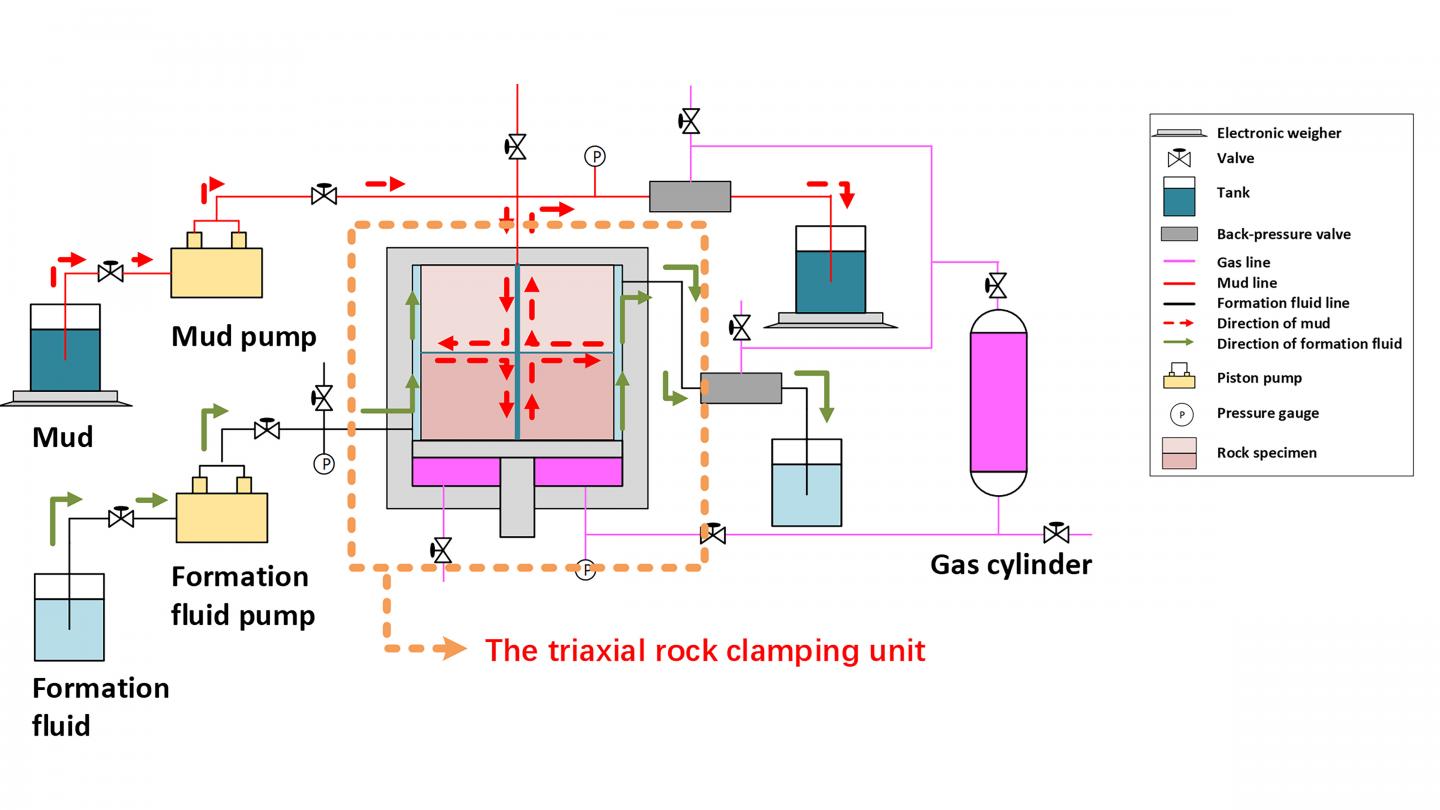
The device, which is made up of four individual units, can simulate conditions like different fracture opening pressures, rock types, and mud circulation pressures. Its sections include the displacement unit, the triaxial clamping unit, the back-pressure unit, and the control and data acquisition system.

“According to the current research, the main mechanism causing borehole ballooning is the opening and closing of the fracture network around the wellbore caused by wellbore pressure fluctuations. Therefore, based on this mechanism, we first designed the core unit of the device, the triaxial clamping unit, which can simulate the opening and closing of fractures,” said Gao.

The researchers proved their device was able to accurately simulate the effects of borehole ballooning through experiments, and they expect these experiments to be able to validate theoretical research on the topic.

###

The article, “An innovative experimental device for borehole ballooning,” is authored by Reyu Gao, Jun Li, Hongwei Yang, Kuidong Luo, Chengwei Tan and Penglin Liu. The article will appear in Review of Scientific Instruments on April 28, 2020 (DOI: 10.1063/1.5139950). After that date, it can be accessed at https://aip.scitation.org/doi/10.1063/1.5139950.

ABOUT THE JOURNAL

Review of Scientific Instruments publishes novel advancements in scientific instrumentation, apparatuses, techniques of experimental measurement, and related mathematical analysis. Its content includes publication on instruments covering all areas of science including physics, chemistry, materials science, and biology. See https://aip.scitation.org/journal/rsi.

Media Contact
Larry Frum
[email protected]

Related Journal Article

http://dx.doi.org/10.1063/1.5139950

Tags: Chemistry/Physics/Materials SciencesEarth ScienceEnergy SourcesTechnology/Engineering/Computer Science
Share12Tweet8Share2ShareShareShare2

Related Posts

blank

Breakthrough in Environmental Cleanup: Scientists Develop Solar-Activated Biochar for Faster Remediation

February 7, 2026
blank

Cutting Costs: Making Hydrogen Fuel Cells More Affordable

February 6, 2026

Scientists Develop Hand-Held “Levitating” Time Crystals

February 6, 2026

Observing a Key Green-Energy Catalyst Dissolve Atom by Atom

February 6, 2026
Please login to join discussion

POPULAR NEWS

  • Robotic Ureteral Reconstruction: A Novel Approach

    Robotic Ureteral Reconstruction: A Novel Approach

    82 shares
    Share 33 Tweet 21
  • Digital Privacy: Health Data Control in Incarceration

    63 shares
    Share 25 Tweet 16
  • Study Reveals Lipid Accumulation in ME/CFS Cells

    57 shares
    Share 23 Tweet 14
  • Breakthrough in RNA Research Accelerates Medical Innovations Timeline

    53 shares
    Share 21 Tweet 13

About

We bring you the latest biotechnology news from best research centers and universities around the world. Check our website.

Follow us

Recent News

Neg-Entropy: The Key Therapeutic Target for Chronic Diseases

Multidisciplinary Evidence-Based Guidelines for Therapeutic Drug Monitoring of Biologics in Inflammatory Bowel Disease

Early Tuberculosis Treatment Lowers Sepsis Mortality in People with HIV

Subscribe to Blog via Email

Enter your email address to subscribe to this blog and receive notifications of new posts by email.

Join 73 other subscribers
  • Contact Us

Bioengineer.org © Copyright 2023 All Rights Reserved.

Welcome Back!

Login to your account below

Forgotten Password?

Retrieve your password

Please enter your username or email address to reset your password.

Log In
No Result
View All Result
  • Homepages
    • Home Page 1
    • Home Page 2
  • News
  • National
  • Business
  • Health
  • Lifestyle
  • Science

Bioengineer.org © Copyright 2023 All Rights Reserved.