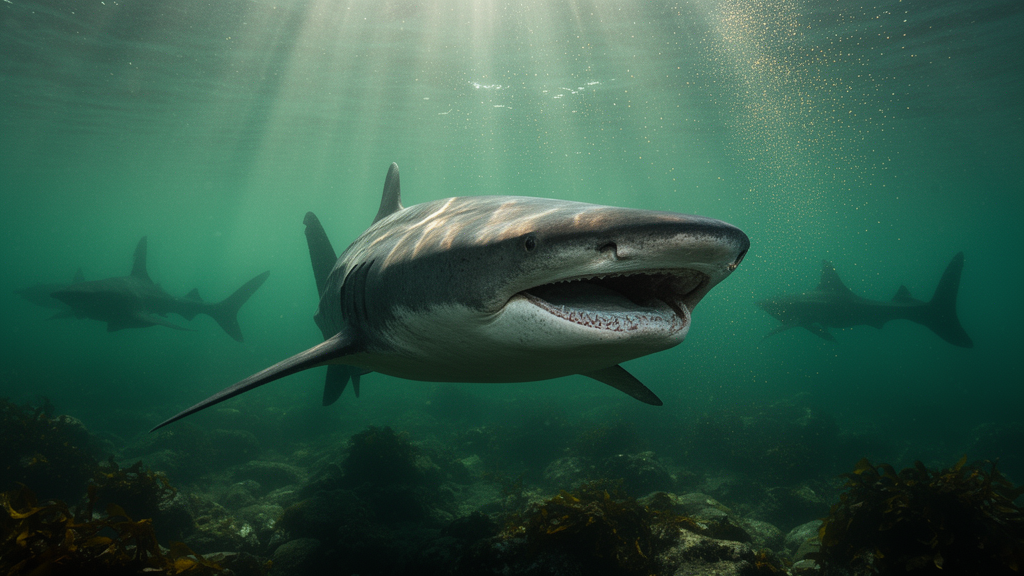
Off Ireland’s northwestern coast, the second-largest fish in the ocean gathers in groups that can swell from a pair of shadows to hundreds of gaping giants. Why basking sharks (Cetorhinus maximus) assemble like this has puzzled marine scientists for decades, because the endangered species is otherwise largely solitary, following highly individualized migration routes. Now, the first individual-based model (IBM) of basking shark aggregation behavior has simulated 36 years of shark movements around the Inishowen Peninsula in County Donegal — and the verdict is clear: neither food nor company alone can explain the gatherings. It takes both.
The new study, published in the journal Individual-based Ecology, tested four competing behavioral rules against one of the longest-running citizen science datasets in shark research. Between 1982 and 2018, the Irish Basking Shark Group and the Irish Whale and Dolphin Group documented 2,136 sightings across Ireland, of which 969 — 45 percent — involved two or more sharks. Around Inishowen alone, 458 sightings were reported, again with 45 percent of them aggregations. The area includes Malin Head and Lough Swilly, identified by the IUCN as an Important Shark and Ray Area, and is famous for breaching sharks, a behavior hypothesized to be linked to courtship.
Individual-based models work from the bottom up. Instead of assuming an average shark moving through an average sea, an IBM populates a spatially explicit environment with simulated individuals that each sense, decide, and move on their own — and whose interactions with their surroundings generate population-level patterns. This approach had never been applied to basking sharks before, despite the species being uniquely suited to it: largely solitary yet prone to poorly understood aggregations ranging from two individuals to groups of up to 1,000, with proposed explanations including feeding, courtship, or both.
Earlier modeling efforts successfully identified long-range migration trends but failed to reproduce shark behavior at finer spatial scales. A particular stumbling block has been the standard practice of using chlorophyll a — a satellite-measured proxy for phytoplankton — as a stand-in for zooplankton, the tiny copepods that basking sharks filter from the water. That proxy has produced inconsistent results when compared with sightings in Ireland and the United States. The new model sidesteps the problem by simulating zooplankton directly, drawing on decades of data from the Continuous Plankton Recorder Survey and distributing the prey across a patchy seascape of 1-kilometer-square cells.
The model, built in NetLogo, simulated daily movements from April through October each year from 1982 to 2018, with 200 sharks entering the 10,545-square-kilometer model area on randomly assigned migration dates. Each simulated day, every shark faced a decision: whether its current patch held enough zooplankton to support the sharks already there, and whether to seek food, other sharks, both, or — in the control case — nothing at all. Sharks could sense zooplankton and conspecifics within a configurable distance, doubled when locating other sharks, and retained memories of high-zooplankton patches to mimic the intermittent site fidelity documented by tagging studies. Sharks that failed to eat for a set number of days left the model, diving deeper or migrating away, only to return later in the season.
Getting the parameters right took roughly 2,000 exploratory model runs. The team calibrated settings for how far sharks can sense, how fast they swim, how much zooplankton a patch must contain, and what fraction of patches hold prey at all, then validated the best configurations against the real sightings data using mean error, mean absolute error, and root mean square error. The final confirmatory runs used 50 trials of the full 200-shark model for each of the two best parameter sets.
The results were striking. The combined food-and-social submodel produced the lowest errors of any submodel, with normalized error values between 0.0 and 0.18, and its time series of monthly aggregation numbers qualitatively matched the episodic, irregular rises and falls seen in the Irish sightings record. The food-only submodel, by contrast, generated rhythmic seasonal cycling that did not fit the data, and produced far more aggregations than were ever documented — up to nearly 75,000 over the model period. Most telling, the social-only and random-movement submodels rarely produced aggregations larger than two or three individuals under any parameter combination. Social attraction in isolation, the model shows, is simply insufficient to generate the large groups observed in the wild.
A robustness analysis drove the point home. When the researchers removed individual behavioral mechanisms one at a time, stripping out food-seeking or the sharks’ assessment of whether a patch could support its occupants sharply reduced aggregation size, while removing migration inflated aggregation numbers to unrealistic levels. Removing the behavior of seeking other sharks increased the number of aggregations but weakened the fit to the data. The pattern suggests a division of labor: food availability drives how many aggregations form, while social attraction shapes how large they become. In a patchy environment where only a minority of cells contain prey, sharks may effectively use other sharks as living signposts to food — a phenomenon known as local enhancement, documented in other shark species and consistent with the theory that breaching serves as long-range signaling between basking sharks.
The implications reach beyond shark sociology. Surface aggregations coincide with seasonal boat traffic, putting sharks at risk of collisions, and in 2022 Ireland listed basking sharks under Section 23 of its Wildlife Act, forbidding disturbance of their feeding and reproductive habits. Effective conservation requires knowing where and when sharks are likely to gather, yet directly observing these elusive animals is difficult and tagging is prohibitively expensive. An IBM offers a flexible framework that can incorporate improved environmental and behavioral data as they become available — and, with better zooplankton data, could eventually predict large aggregations or provide high-low risk estimates for boaters and fishers.
The model has limits. The lack of localized zooplankton measurements makes it hard to judge how realistic the simulated surface environment is, and the memory mechanism is constrained by the random daily redistribution of prey. Publicly reported sightings, meanwhile, miss sharks and lack true absences, and the model captures only surfacing individuals. But as a proof of concept, the work demonstrates that individual-based modeling can reproduce long-term trends in basking shark behavior even with limited environmental data. As climate change shifts zooplankton communities northward and alters the patchiness of the prey seascape, understanding how individual sharks make movement decisions may prove essential to building climate-resilient conservation strategies for one of the ocean’s most iconic giants.
Subject of Research: First individual-based model of basking shark aggregation behavior in Ireland shows food and social drivers combined
Article Title: An individual-based model of basking sharks in Ireland
Article References: Gray, C., Rothman, D. S., Peters-Burton, E., Smith, C., Parsons, E., & Garretson, A. (2026). An individual-based model of basking sharks in Ireland. Individual-based Ecology, 2, Article e176474. https://doi.org/10.3897/ibe.2.176474
Image Credits: AI Generated
DOI: 10.3897/ibe.2.176474
Keywords: basking sharks, individual-based model, Ireland, zooplankton, aggregation behavior, Inishowen Peninsula, NetLogo, citizen science sightings, conservation, shark social behavior, individual-based, model
News Source: Drew Townsend. (October 15, 2026). Simulated sharks reveal why basking giants gather off Ireland. Scienmag.