


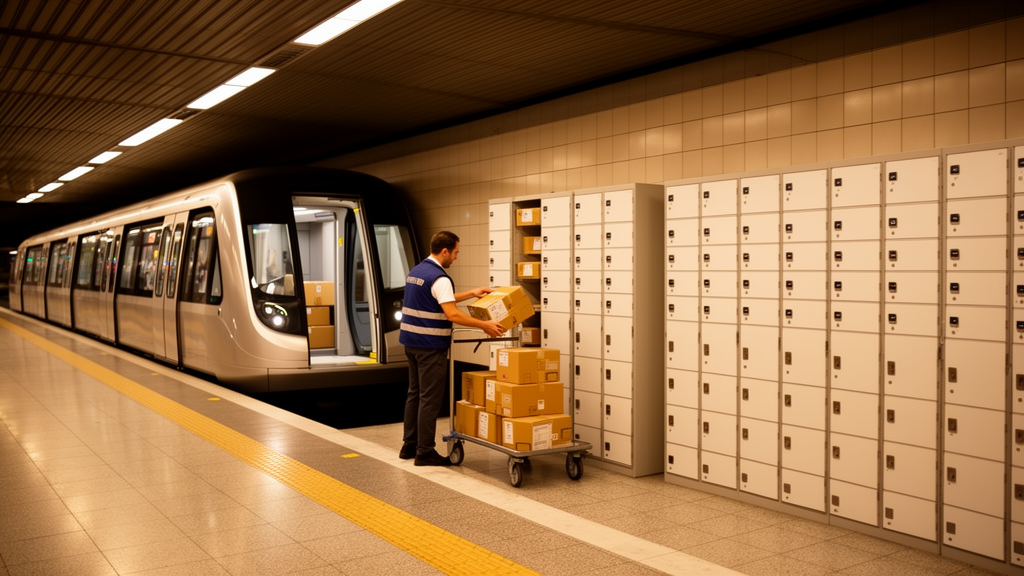
A discrete-event simulation of a proposed parcel delivery chain that would move freight through the Madrid metro system has produced some of the most detailed operational estimates yet for so-called freight on transit. The study, published in European Transport Research Review, models the full journey of a parcel from two DHL warehouses on the outskirts of the Spanish capital, through Metro de Madrid depots and trains, to lockers at 94 stations where customers would collect their orders. Because the proposed metro-freight service was never actually running during the study, the results are planning scenarios rather than observations of a live system, but they show how end-to-end simulation can expose bottlenecks that isolated analyses of warehouses, trains or lockers would miss.
The researchers, from a team including Zisis Maleas, Georgia Ayfantopoulou, Sofoklis Dais, Katerina Batzou and Dimitris Logothetis, built their model in AnyLogic 8.9.4 using operational information and planning inputs supplied within the DHL and Metro de Madrid case study. Representatives of both operators reviewed the modeled process, the main inputs and assumptions, and the intended use of the outputs. In the simulated configuration, parcels arrive at two DHL warehouses in Illescas and Ontigola, roughly 42 and 58 kilometers by road from central Madrid respectively. There they are sorted, loaded into roller cages dedicated to a single destination station, and dispatched once per day by van or truck to one of six metro depots. Freight trains run once daily before stations open to passengers, carrying the cages to destination stations where staff transfer parcels into lockers.
A central feature of the model is that critical operational objects, including individual parcels, roller cages, vehicles and lockers, are represented individually and follow rule-based logic wherever routing, loading, capacity and availability decisions demand it. Each parcel carries a unique destination identifier linking it to a specific station locker, and together with its assigned warehouse, depot and metro line this defines its complete routing chain. For stations served by more than one metro line, the line choice is made at the warehouse stage so the parcel follows a predetermined route without later rerouting. Parcel arrivals are generated by 94 destination-specific source blocks configured in rate-schedule mode, with a daily schedule read from the model database for each monthly demand scenario. The authors stress that these settings parameterize planning scenarios; they are not distributions fitted to observed arrivals in an operating metro-freight service.
Road travel times from the warehouses to the depots are sampled from discrete uniform distributions with depot-specific minimum and maximum bounds, ranging for example from 22 to 35 minutes for Depot 3 and 40 to 65 minutes for Depot 2. The same bounds apply to vans and trucks departing either warehouse. The authors flag these explicitly as scenario assumptions for road-time variability, not empirically calibrated travel-time distributions. At the depots, the model reproduces a cross-docking logic: cages are unloaded from road vehicles and transferred directly to metro wagons with minimal intermediate storage. Trains stop at each assigned station, unload cages and continue their routes without delay, and the model assumes staff availability at every station to move parcels from cages into lockers.
The downstream stage turns out to be where the system feels the pinch. Each station is assumed to have one parcel locker with a fixed capacity of 80 parcels, and parcels remain in lockers until customers collect them within a defined time window. If locker space is unavailable, or if a parcel lingers too long upstream, it is recorded as unmet by the metro-enabled chain and redirected to an alternative delivery option such as home delivery. Customer pickup behavior was modeled through two policy levers, since no utility-choice data were available: a tight policy in which customers collect parcels within 24 hours, and a loose policy allowing 48 hours. The comparison is conditional on these fixed capacity and dwell-time assumptions and is not presented as a general threshold or locker-utilization analysis.
The experimental design combined three monthly demand scenarios, labeled M-1, M-2 and M-3, with the two pickup policies, yielding six experimental setups. Monthly demand in the scenarios ranges between roughly 89,000 and 152,000 parcels, based on estimates provided by DHL and Metro de Madrid and treated as exogenous inputs. Each setup covered 30 daily demand inputs and was repeated 30 times with different random seeds, with reported indicators being mean values across the repetitions. Across all experiments, demand satisfaction ranged from 85.9 percent to 99.6 percent, making this the clearest indicator of downstream system stress as the gap between total demand and completed deliveries widened under more congested settings.
The pickup-policy contrast produced the most striking pattern. Tight-policy experiments showed higher satisfaction than their loose-policy counterparts in every monthly scenario, with Experiment 1 reporting 8.0 percentage points higher satisfaction than Experiment 2. Under the modeled rules, faster parcel collection releases locker capacity sooner and leaves more room for subsequent arrivals. The authors are careful about causality here: the directional pattern is consistent with locker availability being an important downstream constraint in the fixed 80-parcel-capacity configuration, but the aggregate comparison does not isolate the pickup-policy effect from stochastic demand variability. Because replication-level outputs and matched-run records were unavailable in the accessible project materials, between-run uncertainty and paired policy effects cannot be verified from the retained aggregates, and the reported contrasts remain descriptive.
The resource side of the ledger looks far more stable. Average vehicle loading ranged from 192 to 246 parcels per vehicle route, and required vehicle counts changed only modestly across the six experiments. The authors emphasize that the required-fleet figure should be read as the fleet requirement produced by their loading heuristic, which packs cages into vans and trucks to maximize loading per trip while preventing delays from insufficient vehicle space, not as a mathematically optimized minimum. The divergence between the two indicator families carries a practical message: comparable fleet provision does not guarantee comparable service performance when downstream storage conditions differ, so planners need to examine vehicle provision and customer pickup policies together rather than treating each stage of the chain independently.
The study’s limitations frame how far these numbers can be generalized. Demand was supplied by the operators as processed planning input rather than reconstructed from raw parcel-delivery records, and since the proposed service was not operating, no independent observations were available to calibrate or validate the modeled outputs against reality. The analysis focuses on aggregate operational indicators within one predefined case-study configuration covering metro lines 1, 2, 3, 4, 5, 6 and 10, with one active train route per line. Broader environmental, comparative, sensitivity and optimization assessments are left as extensions. The authors also note that assuming staff at every station to receive parcels and load lockers is a reasonable first abstraction that may prove labor-intensive relative to the gains achieved.
Those limitations shape an unusually concrete research agenda. The authors propose comparing direct van replenishment of station lockers against metro-based line-haul combined with time-limited courier allocation at stations, where personnel handle parcels within a concentrated 30 to 60 minute window, potentially raising total shift throughput while cutting additional van routes and depot returns. Future work could also test alternative assignment rules balancing workforce, loading effort and depot congestion, deploy user choice models to predict locker retention times and assess whether tighter pickup windows are behaviorally acceptable, and couple the simulation with mixed-integer optimization for facility location and locker sizing. A matched road-only baseline assessment, requiring consistent route, load, service-time, vehicle, cost and emissions data, would finally allow the vehicle-kilometer and environmental case for metro freight to be tested on common ground rather than assumed.
Subject of Research: Discrete-event simulation of a prospective metro-based last-mile parcel delivery system integrating DHL warehouses, Metro de Madrid trains and station lockers
Article Title: Rail-enabled last mile: simulating parcel flows via urban metro networks
Article References: Maleas, Z., Ayfantopoulou, G., Dais, S., Batzou, K., & Logothetis, D. (2026). Rail-enabled last mile: simulating parcel flows via urban metro networks. European Transport Research Review, 18(1), Article 86. https://doi.org/10.1186/s12544-026-00848-8
Image Credits: AI Generated
DOI: 10.1186/s12544-026-00848-8
Keywords: last-mile delivery, freight on transit, discrete-event simulation, Metro de Madrid, parcel lockers, urban logistics, DHL, fleet requirements, demand satisfaction, pickup policy, AnyLogic, Madrid
News Source: Denise Maddox. (October 29, 2026). Simulated Metro Freight Moves Parcels From Warehouse to Station Locker in Madrid. Scienmag.



