• HOME
  • NEWS
  • EXPLORE
    • CAREER
      • Companies
      • Jobs
    • EVENTS
    • iGEM
      • News
      • Team
    • PHOTOS
    • VIDEO
    • WIKI
  • BLOG
  • COMMUNITY
    • FACEBOOK
    • INSTAGRAM
    • TWITTER
Wednesday, June 24, 2026
BIOENGINEER.ORG
No Result
View All Result
  • Login
  • HOME
  • NEWS
  • EXPLORE
    • CAREER
      • Companies
      • Jobs
        • Lecturer
        • PhD Studentship
        • Postdoc
        • Research Assistant
    • EVENTS
    • iGEM
      • News
      • Team
    • PHOTOS
    • VIDEO
    • WIKI
  • BLOG
  • COMMUNITY
    • FACEBOOK
    • INSTAGRAM
    • TWITTER
  • HOME
  • NEWS
  • EXPLORE
    • CAREER
      • Companies
      • Jobs
        • Lecturer
        • PhD Studentship
        • Postdoc
        • Research Assistant
    • EVENTS
    • iGEM
      • News
      • Team
    • PHOTOS
    • VIDEO
    • WIKI
  • BLOG
  • COMMUNITY
    • FACEBOOK
    • INSTAGRAM
    • TWITTER
No Result
View All Result
Bioengineer.org
No Result
View All Result
Home NEWS Science News Chemistry

Simplified method for calibrating optical tweezers

Bioengineer by Bioengineer
July 16, 2021
in Chemistry
Reading Time: 2 mins read
0
IMAGE
Share on FacebookShare on TwitterShare on LinkedinShare on RedditShare on Telegram

Broadband measurement of viscoelasticity with reduced measurement time
IMAGE

Credit: Pascal Runde

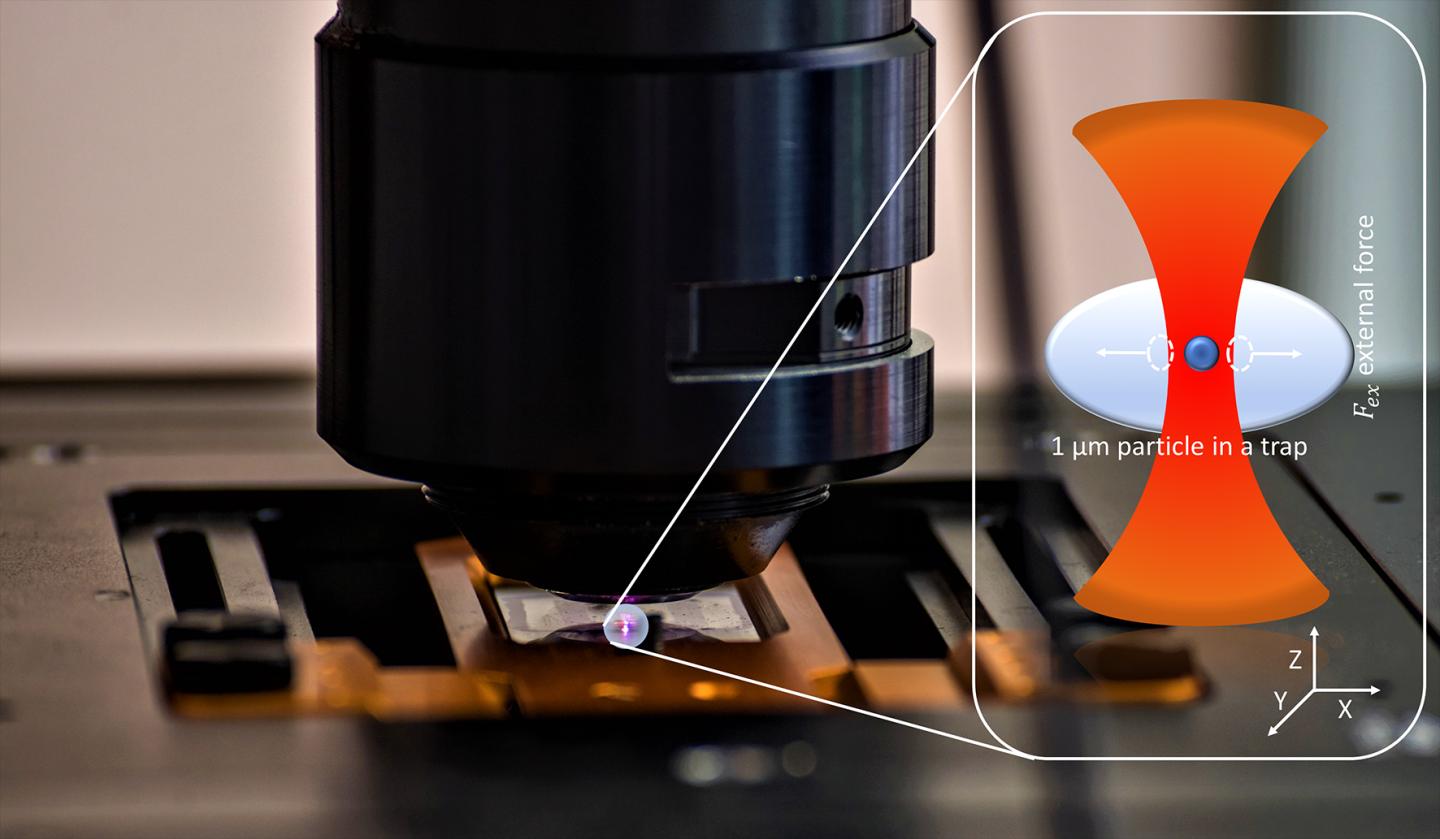
Measurements of biomechanical properties inside living cells require minimally invasive methods. Optical tweezers are particularly attractive as a tool. It uses the momentum of light to trap and manipulate micro- or nanoscale particles. A team of researchers led by Prof. Dr. Cornelia Denz from the University of Münster (Germany) has now developed a simplified method to perform the necessary calibration of the optical tweezers in the system under investigation. Scientists from the University of Pavia in Italy were also involved. The results of the study have been published in the journal Scientific Reports.

The calibration ensures that measurements of different samples and with different devices are comparable. One of the most promising techniques for calibrating optical tweezers in a viscoelastic medium is the so-called active-passive calibration. This involves determining the deformability of the sample under investigation and the force of the optical tweezers. The research team has now further improved this method so that the measurement time is reduced to just a few seconds. The optimized method thus offers the possibility of characterizing dynamic processes of living cells. These cannot be studied with longer measurements because the cells reorganize themselves during the measurement and change their properties. In addition, the shortening of the measurement time also helps to reduce the risk of damage to the biological samples due to light-induced heating.

In simplified terms, the underlying procedure to perform the calibration works as follows: The micro- or nanometer-sized particles are embedded in a viscoelastic sample held on the stage of a microscope. Rapid and precise nanometer-scale displacements of the specimen stage cause the optically trapped particle to oscillate. By measuring the refracted laser light, changes in the sample’s position can be recorded, and in this way, conclusions can be drawn about its properties, such as stiffness. This is usually done sequentially at different oscillation frequencies. The team led by Cornelia Denz and Randhir Kumar, a doctoral student in the Münster research group, now performed the measurement at several frequencies simultaneously for a wide frequency range. This multi-frequency method leads to a shortened measurement time of a few seconds. The scientists used solutions of methyl cellulose in water at different concentrations as samples. These have a similar viscoelasticity to living cells.

Background: Biomechanical properties such as stiffness, viscosity and viscoelasticity of living cells and tissues play a crucial role in many vital cellular functions such as cell division, cell migration, cell differentiation and tissue patterning. These properties of living cells could also serve as indicators of disease progression. For example, the onset and development of cancer is typically accompanied by changes in cell stiffness, viscosity, and viscoelasticity.

###

Media Contact
Prof. Cornelia Denz
[email protected]

Original Source

https://www.uni-muenster.de/news/view.php?cmdid=11912

Related Journal Article

http://dx.doi.org/10.1038/s41598-021-93130-x

Tags: Biomechanics/BiophysicsChemistry/Physics/Materials SciencesOptics
Share13Tweet8Share2ShareShareShare2

Related Posts

Harnessing Machine Learning to Solve Complex Inverse Problems in Semiconductor Analysis — Chemistry

Harnessing Machine Learning to Solve Complex Inverse Problems in Semiconductor Analysis

June 24, 2026
HKU Tea Hosts Super Angel and Going Global Innovation Forum in Gianhai to Propel Cross-Border Tech Collaboration and Global Expansion — Chemistry

HKU Tea Hosts Super Angel and Going Global Innovation Forum in Gianhai to Propel Cross-Border Tech Collaboration and Global Expansion

June 24, 2026

Light-Based Sensors Identify Minute Levels of Traumatic Brain Injury Biomarkers

June 24, 2026

Plasmonic Catalysis Activated by NIR-II with Tip-Localized Enhancement: A Novel Approach to Eradicate Hypoxic Biofilms on Orthopedic Implants

June 24, 2026
Please login to join discussion

POPULAR NEWS

  • Saying Goodbye to PGY-6: Pediatric Fellowship Realities

    103 shares
    Share 41 Tweet 26
  • Multi-Hospital Study Reveals Long Covid Burden Is Twice as High as Current Estimates

    92 shares
    Share 36 Tweet 23
  • Detection of EDCs in Breast Milk and Infant Urine Up to Six Months Highlights Early Exposure Risks

    77 shares
    Share 31 Tweet 19
  • New Drug Candidate Developed at McMaster Shows Potential for Treating Brain Cancer

    58 shares
    Share 23 Tweet 15

About

We bring you the latest biotechnology news from best research centers and universities around the world. Check our website.

Follow us

Recent News

Immune Cell–Fibroblast Interaction: A Potential Trigger for Autoimmune Diseases

How Zebrafish Could Hold the Key to Developing Treatments for CADASIL

New Technology Uncovers How the Heart Produces Cells with Regenerative Potential

Subscribe to Blog via Email

Enter your email address to subscribe to this blog and receive notifications of new posts by email.

Join 82 other subscribers
  • Contact Us

Bioengineer.org © Copyright 2023 All Rights Reserved.

Welcome Back!

Login to your account below

Forgotten Password?

Retrieve your password

Please enter your username or email address to reset your password.

Log In
No Result
View All Result
  • Homepages
    • Home Page 1
    • Home Page 2
  • News
  • National
  • Business
  • Health
  • Lifestyle
  • Science

Bioengineer.org © Copyright 2023 All Rights Reserved.