

• HOME
  • NEWS
  • EXPLORE
    • CAREER
      • Companies
      • Jobs
    • EVENTS
    • iGEM
      • News
      • Team
    • PHOTOS
    • VIDEO
    • WIKI
  • BLOG
  • COMMUNITY
    • FACEBOOK
    • INSTAGRAM
    • TWITTER
Saturday, May 30, 2026
BIOENGINEER.ORG
No Result
View All Result
  • Login
  • HOME
  • NEWS
  • EXPLORE
    • CAREER
      • Companies
      • Jobs
        • Lecturer
        • PhD Studentship
        • Postdoc
        • Research Assistant
    • EVENTS
    • iGEM
      • News
      • Team
    • PHOTOS
    • VIDEO
    • WIKI
  • BLOG
  • COMMUNITY
    • FACEBOOK
    • INSTAGRAM
    • TWITTER
  • HOME
  • NEWS
  • EXPLORE
    • CAREER
      • Companies
      • Jobs
        • Lecturer
        • PhD Studentship
        • Postdoc
        • Research Assistant
    • EVENTS
    • iGEM
      • News
      • Team
    • PHOTOS
    • VIDEO
    • WIKI
  • BLOG
  • COMMUNITY
    • FACEBOOK
    • INSTAGRAM
    • TWITTER
No Result
View All Result
Bioengineer.org
No Result
View All Result
Home NEWS Science News Biology

Simpler and safer method for handling a useful but foul-smelling gas in chemical synthesis

Bioengineer by Bioengineer
September 20, 2018
in Biology
Reading Time: 2 mins read
0
Share on FacebookShare on TwitterShare on LinkedinShare on RedditShare on Telegram
IMAGE

Credit: Troels Skrydstrup

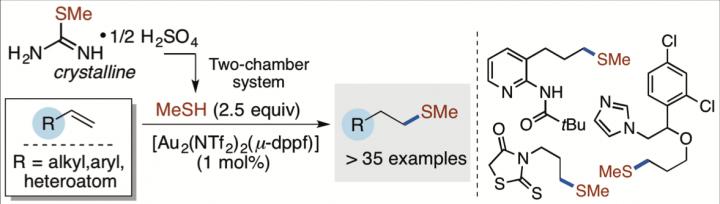
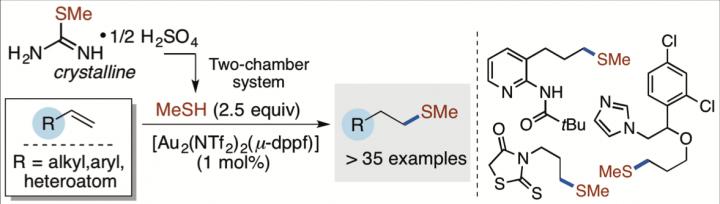
The chemical element sulfur is an important constituent in many pharmaceuticals and, consequently, it is desirable to be able to introduce sulfur-containing fragments efficiently in a broad range of chemical compounds. The Skrydstrup team provides an effective and safe way for introducing a small sulfur building block, which is generally difficult to work with, being a gas and with an extremely repulsive odor. Especially interesting in this work is that a gold-based catalyst is exploited for these specific reactions involving carbon-carbon double bonds.

The research group focused on the use of the smallest carbon-containing thiol, namely methanethiol (MeSH). However, not only is MeSH the main compound responsible for bad breath and the smell of flatus, it is also highly flammable and therefore unsafe to work with in the laboratory. In the present study, researchers from iNANO and the Department of Chemistry, Aarhus University, report on how they successfully exploit their own invention, the two-chamber system, in order to avoid handling pressure cylinders with MeSH, and having to add the gas directly to the chemical reactions. The authors also demonstrate that a crystalline organic compound can be used to liberate an exact amount of MeSH upon activation in the two-chamber system.

In this work, the direct use of MeSH has been circumvented and a protocol for the delivery and use of a stoichiometric amount of gaseous MeSH has been developed without the need of pressure cylinders. The Skrydstrup group has demonstrated by the ex-situ generation of MeSH from a simple crystalline precursor in the two-chamber reactor that a gold(I)-mediated hydrothiolation of terminal alkenes is possible to provide the corresponding methyl sulfide in high yields. The reaction promoted by a gold(I) complex is also interesting as these complexes appear to operate as radical initiators from the mechanistic investigation undertaken.

###

The research has been carried out by scientists from Interdisciplinary Nanoscience Centre (iNANO) and Department of Chemistry at Aarhus University (AU) in collaboration with Haldor Topsøe A/S. Professor Troels Skrydstrup has been in charge of the research team behind the study.

The work was generously supported by BIOVALUE SPIR (Strategic Platform for Innovation and Research), the Danish National Research Foundation, Innovation Fund Denmark, Haldor Topsøe and Aarhus University.

The scientific article has been published in the international journal Angewandte Chemie Int. Ed.:

"Ex Situ Formation of Methanethiol: Application in the Gold(I)?Promoted anti?Markovnikov Hydrothiolation of Olefins"
Steffan K. Kristensen, Simon L. R. Laursen, Esben Taarning and Troels Skrydstrup

https://doi.org/10.1002/anie.201809051

For further information, contact

Professor Troels Skrydstrup
Interdisciplinary Nanoscience Center
Department of Chemistry
Aarhus University
Denmark
Email: [email protected]
Phone: 45-87-15-59-68

Media Contact

Troels Skrydstrup
[email protected]
45-87-15-59-68
@aarhusuni

http://www.au.dk

Original Source

http://inano.au.dk/about/news-events/news/show/artikel/simpler-and-safer-method-for-handling-a-useful-but-foul-smelling-gas-in-chemical-synthesis/ http://dx.doi.org/10.1002/anie.201809051


Share12Tweet8Share2ShareShareShare2

Related Posts

Ohio Wall Lizards Overcame Genetic Bottleneck Through Reproduction, Study Finds — Biology

Ohio Wall Lizards Overcame Genetic Bottleneck Through Reproduction, Study Finds

May 29, 2026
Double Agent Unveils Unexpected Revelations — Biology

Double Agent Unveils Unexpected Revelations

May 29, 2026

University of Toronto Scientists Work to Enhance Access to Advanced Research and Biomanufacturing Tools in Resource-Limited Areas

May 29, 2026

CLPTM1L Alters Lipid Rafts to Drive Glioblastoma Progression

May 29, 2026
Please login to join discussion

POPULAR NEWS

  • ESMO 2025: mRNA COVID Vaccines Enhance Efficacy of Cancer Immunotherapy

    319 shares
    Share 128 Tweet 80
  • Multi-Hospital Study Reveals Long Covid Burden Is Twice as High as Current Estimates

    79 shares
    Share 31 Tweet 20
  • Common Food Preservatives Associated with Elevated Blood Pressure and Increased Heart Disease Risk

    56 shares
    Share 22 Tweet 14
  • New Study Reveals Plants Can Detect the Sound of Rain

    736 shares
    Share 294 Tweet 184

About

We bring you the latest biotechnology news from best research centers and universities around the world. Check our website.

Follow us

Recent News

Revolutionizing Chip Design: Sequential Silicon Stacking to Push Moore’s Law Further

Immunotherapy Addition Demonstrates Sustained Survival Benefits in Long-Term Follow-Up of NRG Oncology Trial for Advanced or Recurrent Endometrial Cancer

Early Neonatal Transfers After Moderate, Late Preterm Births

Subscribe to Blog via Email

Enter your email address to subscribe to this blog and receive notifications of new posts by email.

Join 82 other subscribers
  • Contact Us

Bioengineer.org © Copyright 2023 All Rights Reserved.

Welcome Back!

Login to your account below

Forgotten Password?

Retrieve your password

Please enter your username or email address to reset your password.

Log In
No Result
View All Result
  • Homepages
    • Home Page 1
    • Home Page 2
  • News
  • National
  • Business
  • Health
  • Lifestyle
  • Science

Bioengineer.org © Copyright 2023 All Rights Reserved.
