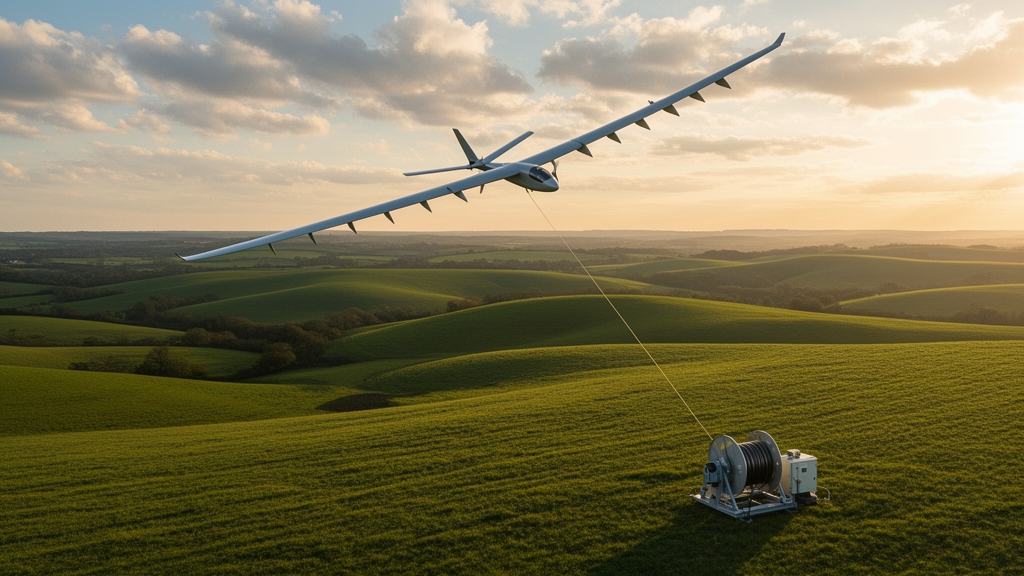
Airborne wind energy has long promised a radical alternative to the towering steel of conventional wind farms: instead of building ever-larger turbines, a tethered aircraft or kite climbs into the stronger, steadier winds found hundreds of meters above the ground and harvests their energy by pulling on a tether connected to a winch. Now a team of researchers from the United Arab Emirates University and the Norwegian company Kitemill has used detailed computer simulations to show that two surprisingly modest operational changes—automatically adjusting the wing’s flaps with flight speed and raising the lowest point of the flight path—could dramatically increase the electricity such systems produce. According to their new preprint in Wind Energy Science, flap scheduling alone lifted average traction power by roughly 47 percent, and combined with a higher minimum operating height the gain reached about 71 percent.
The study focused on a specific class of airborne wind energy systems known as ground-generation, or ground-gen, configurations. In these systems, a rigid-wing aircraft flies repeated crosswind loops while tethered to a drum on the ground. As the aircraft pulls the tether out during the so-called traction phase, the spinning drum drives a generator and produces electricity; the wing is then reeled back in to begin the next pumping cycle. Because the aircraft flies fast across the wind rather than sitting statically in it, the apparent wind at the wing can far exceed the ambient wind speed, which is precisely what makes the approach attractive. But the performance of such a system depends on a tangle of interlocking choices: how the wing’s aerodynamic surfaces are deployed, what shape and altitude the flight path takes, and how the winch behaves.
To untangle those choices, the team built on a validated nonlinear simulator of the Kitemill KM1, a rigid-wing ground-gen prototype with a wingspan of about 7.5 meters. The simulator couples a model of the kite’s flight dynamics with a tether model and a winch model, allowing the researchers to reproduce full pumping cycles under realistic wind conditions. Crucially, they used an altitude-dependent wind field driven by a time-varying ground-reference wind, meaning the aircraft experienced winds that changed both with height and over time, rather than the idealized steady winds common in earlier studies. With the control algorithms held constant and hardware limits respected, they then ran a one-factor-at-a-time campaign, varying a single operating parameter at a time to isolate its effect on the average reel-out mechanical power.
The baseline configuration, with fixed flap settings and the system’s standard flight geometry, produced an average reel-out power of 7.56 kilowatts. That figure became the yardstick against which every modification was measured. The first and most striking finding concerned the wing’s flaps. Rather than holding the trailing-edge flaps at a fixed deflection, the researchers introduced a simple schedule in which the flap angle varied automatically with flight speed within a conservative range of 0 to 10 degrees. This single change raised the average reel-out power to 11.10 kilowatts—an increase of about 47 percent—while the aircraft continued to fly stable, repeated crosswind loops in all evaluated simulations.
The physics behind that gain is rooted in the changing demands of circular flight. As a tethered wing sweeps through a loop, its airspeed, angle of attack, and the load on the tether vary continuously around each circuit. A fixed flap setting that suits one part of the loop may be poorly matched to another. By scheduling flap deflection with speed, the wing can maintain a more favorable lift-to-drag balance throughout the cycle, converting more of the available aerodynamic force into tether tension and hence into winch torque. Importantly, the researchers kept the schedule within conservative deflection limits, suggesting that meaningful power gains do not require aggressive or risky aerodynamic actuation.
The second lever was altitude. The team examined the minimum production height—the lowest altitude at which the aircraft performs its power-generating loops. Raising that floor improved the average reel-out power further, from 11.10 to 12.96 kilowatts, bringing the total improvement over the baseline to roughly 71 percent. The reason is straightforward: wind speed generally increases with altitude, and because the power available to a crosswind-flying wing scales strongly with the local wind, flying higher loops means stronger apparent winds and greater tether forces. The result offers a practical design guideline—set the flight path as high as safety and airspace constraints allow—without demanding any new hardware.
Not every parameter mattered equally. When the researchers compared lateral path geometries, testing circular loops against elliptical ones, the shape of the path had only a minor influence on average traction power. The size of the loop, however, was a different story: the circular loop radius showed a clear effect on performance. In other words, it is not whether the aircraft traces a circle or an ellipse that counts, but how much sky each loop covers and where in the wind profile it sits. Meanwhile, tuning the elevation angle of the helix axis—the tilt of the overall flight volume—did not yield additional power beyond what the minimum-height optimization had already achieved within the considered operating envelope.
The authors argue that these findings fill a genuine knowledge gap. For rigid-wing ground-gen systems, the combined influence of aerodynamic actuation, flight-path geometry, and operating height had been inadequately understood, particularly under constant control settings and realistic hardware constraints. By quantifying each factor’s contribution in a validated simulator, the study gives designers a ranked list of where to look first: flap scheduling and flight altitude offer the largest returns, while path shape is largely a secondary concern. Because the improvements come from operational tuning rather than new materials or mechanisms, they could in principle be implemented through software updates and mission planning on existing platforms.
The work is not without caveats, some of which emerged during the open peer discussion that accompanies Copernicus preprints. A referee noted that the method of averaging reel-out power excludes periods when the winch temporarily consumes power, which may inflate the reported figures, and questioned why the simulated aircraft struggled to remain airborne at larger flap deflections when earlier parameter sweeps of the same airframe suggested it should handle them. The referee also observed that the sequential, one-factor-at-a-time approach cannot guarantee that the reported 71 percent gain corresponds to the true global optimum, which would require a full multi-dimensional sweep or a formal optimization search, and asked for more detail on the exact flap scheduling law and winch speeds. These critiques underscore that the results, while promising, are a sensitivity study rather than a final design recipe.
Even with those qualifications, the study’s central message is compelling: airborne wind energy systems may be leaving significant performance on the table simply because of how they fly, not how they are built. A modest, speed-scheduled flap adjustment and a higher flight floor together delivered a simulated 71 percent power increase on a real prototype’s digital twin, all while preserving flight stability. As the field matures from experimental prototypes toward commercial deployments, such simulation-driven refinements could prove decisive in closing the gap between airborne wind’s theoretical promise and its delivered kilowatt-hours—and they suggest that the cheapest upgrades to this emerging technology may be written in code rather than cast in carbon fiber.
Subject of Research: Flap scheduling and operating height optimization for ground-generation airborne wind energy systems
Article Title: Simulation-Based Assessment of Flap Scheduling and Operating Height for Ground‑Gen Airborne Wind Energy Systems
Article References: Paul, P., Khurshid, Y., Oland, E., Kamra, M. M., & Dief, T. N. (2026). Simulation-Based Assessment of Flap Scheduling and Operating Height for Ground‑Gen Airborne Wind Energy Systems. https://doi.org/10.5194/wes-2026-148
Image Credits: AI Generated
DOI: 10.5194/wes-2026-148
Keywords: airborne wind energy, ground-generation, flap scheduling, flight path optimization, kite power, tethered flight, wind energy, reel-out power, Kitemill KM1, simulation, operating altitude, crosswind flight
News Source: Denise Maddox. (October 9, 2026). Simple Wing Flap Tweaks Could Boost Airborne Wind Power by 71 Percent. Scienmag.