


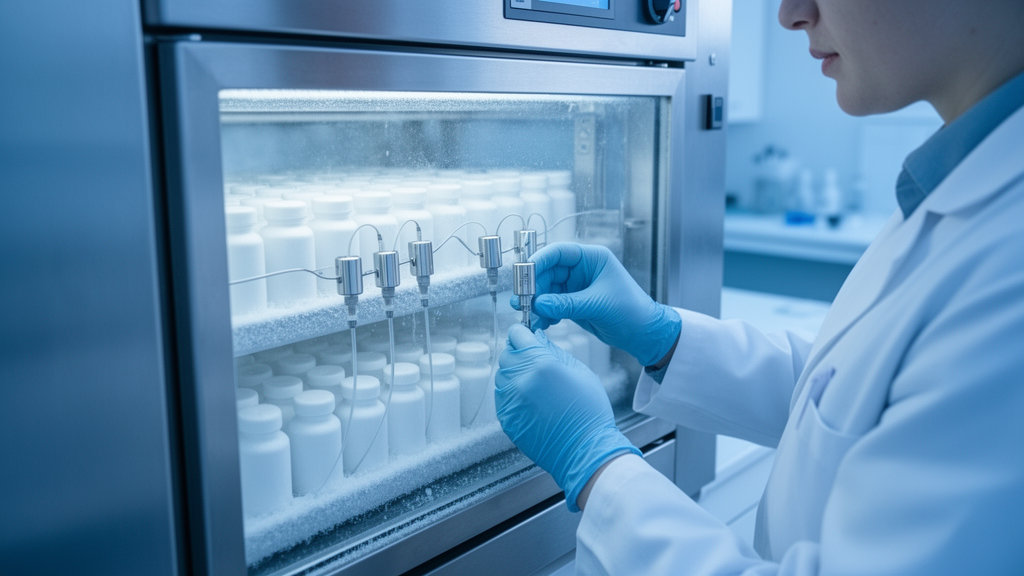
Freeze-drying, or lyophilization, is one of the most delicate operations in biopharmaceutical manufacturing: a drug solution is frozen, and then most of its water is removed by sublimation under vacuum, leaving a stable cake that can be reconstituted later. The critical stage, primary drying, is essentially a controlled heat-and-vapor flow problem, yet the industry has long lacked an inexpensive way to watch that flow in real time inside commercial equipment. A new open-access study published in AAPS Open argues that the answer has been sitting in the machines all along, in the form of ordinary temperature and pressure sensors that most industrial lyophilizers already carry.
The research, led by Efimia Metsi-Guckel with co-authors including Jean René Authelin, Lionel Gerbeau, Evgenyi Shalaev and Ehab Moussa, builds on methodologies introduced in the literature in 2024 and demonstrates them across multiple pharmaceutical companies. The two approaches, called the ΔT and ΔP methods, quantify the mass flow of sublimated water vapor per vial, which the authors propose as the key parameter for characterizing a lyophilization process and for transferring it between machines and sites. Both methods rely only on data that are usually recorded in supervisory control and data acquisition systems and data historians, so implementation generally requires no physical investment, just a few simple calculations that can be automated in commonly used software.
The ΔT method is calorimetric. Sublimation is endothermic, so as ice leaves the vials it consumes heat from the silicone oil circulating through the shelves, producing a slight temperature drop between the oil inlet and outlet of each shelf. That temperature difference, corrected for the heating ramp effect and for a baseline offset, is proportional to the sublimation flow. The ΔP method, by contrast, exploits the pressure difference that develops between the drying chamber and the condenser as vapor streams toward the colder condenser surfaces. Measured with capacitance manometers, this difference, combined with the average chamber-condenser pressure, follows a power-law relationship with mass flow, with an exponent α constrained between 0.5 for turbulent flow and 1 for laminar flow.
Calibrating these equations is the practical crux, and the paper lays out how to do it with data that companies already possess. In a laboratory-scale lyophilizer, historical heat transfer coefficient experiments, in which lyophilization was interrupted after six hours and each vial weighed before and after, provided everything needed. By plotting the integral of the calculated flow against the measured sublimated ice mass for trial values of α, the team found the exponent with striking precision: α = 0.5810 plus or minus 0.0005, with the constant β determined from the slope of that linear relationship. No dedicated experiment was necessary; a minimum of three runs at three different chamber pressures suffices, and more runs improve accuracy.
At commercial scale, roughly 30 square meter lyophilizers, historical batch data served the same purpose when sublimation flow rates and, ideally, multiple pressure conditions were available. Where both ΔT and ΔP signals existed, matching one against the other calibrated the pressure-based method directly. One example across five large-scale lyophilizers used conservative freeze-drying conditions with mass flows at or below 0.2 kilograms per hour per square meter, where ΔP values fell to 3 microbar or less, pushing the method close to its detection limit. Even so, the five machines showed similar behavior, with α = 0.5 and β = 0.4.
The payoff for process transfer is conceptual as much as technical. Traditionally, two lyophilizers are considered equivalent if product temperature profiles match, but that requires product temperature sensors, which are often prohibited in good manufacturing practice because of contamination concerns, even when steam-sterilizable. The authors argue that matching the average sublimation flow per vial at a given cycle time is a sounder criterion: if the flow per vial is consistent between two machines, then both the cake resistance to vapor flow and the pressure at the sublimation front are equal, which in turn implies the product temperature must be the same. In one demonstration, lab-scale flow rates measured by ΔP agreed closely with tunable diode laser absorption spectroscopy signals and with engineering runs of the same product at five commercial lyophilizers, whose signals also aligned with one another, with slightly reduced commercial rates attributable to lower heat transfer coefficients.
That scale-dependent heat transfer difference is well understood. Commercial units typically show heat transfer coefficients 5 to 10 percent lower than lab units, mainly because edge vials warmed by radiation from chamber walls make up a much smaller fraction of a large batch; in a lab lyophilizer they can represent about 20 percent of the total. Using the ΔP-derived flow rates, the team calculated the heat transfer coefficient Kv and the cake resistance Rp for lab and commercial scales, finding values that aligned closely with lab-scale TDLAS results, with a slight Kv reduction and slight Rp increase at commercial scale. For the product studied, these shifts did not produce a significant product temperature difference during moisture and temperature mapping, so the process transferred without modification. Batch-average Kv and Rp comparisons across the five large-scale lyophilizers showed excellent agreement.
The methods also expose equipment behavior that would otherwise be invisible. When outlet temperatures are logged for each shelf individually, the ΔT method computes a sublimation rate per shelf. In one industrial example with 14 of 15 shelves loaded, about 140,000 vials in total, the 14 loaded shelves produced nearly identical signals while the empty shelf stood out plainly, offering a direct read on shelf-to-shelf heat transfer homogeneity. The authors note the approach can also help determine the end of primary drying, though with caveats: when vapor flow falls below roughly 5 to 10 percent of its steady-state value, the ΔT and ΔP signals become too weak to pinpoint the endpoint reliably, whereas the Pirani pressure signal declines earlier and more steeply, and in their lab example the ΔP estimate of about 18 hours corresponded to the Pirani convergence midpoint.
Limitations are stated candidly. Temperature and pressure differences can be smaller than 0.5 degrees Celsius or a few microbar, and sensors are rarely calibrated at that precision, so baseline correction for sensor offsets is essential, and offsets can drift after maintenance or steam sterilization. Sensitivity matters more than nominal accuracy here, since offsets cancel out in baseline subtraction; a sensitivity of 0.01 degrees Celsius is highly beneficial, and data should be recorded to at least two decimal places. Across lyophilizers ranging from 0.3 to 35 square meters supplied by three vendors, a mass flow of 0.2 kilograms per hour per square meter yielded an average ΔT signal of about 0.2 degrees Celsius with a signal-to-noise ratio near 7, above the limit of detection of 3 but below the quantification limit of 10. At higher specific flows, quantification becomes safe. Currently the baseline can only be established at the end of primary drying, so real-time monitoring awaits further development, and α and β values must be revised for new formulations and process conditions.
Even with those constraints, the economics are compelling. Tunable diode laser absorption spectroscopy is expensive and demands specific pipe configurations between chamber and condenser, gravimetric studies are time-consuming and labor-intensive, and wireless product temperature sensors raise sterility concerns. The ΔT and ΔP methods need no new hardware, work on older equipment that can be retrofitted with simple calculations, and act as redundant, orthogonal checks on each other, with the ΔP signal typically less noisy. The authors suggest them as a best practice for future technology transfers and process monitoring, supporting product quality, efficiency and consistency in biopharmaceutical manufacturing, and as a contribution to the emerging digital twin for lyophilization, provided that real-time baseline prediction can be achieved through further development.
Subject of Research: New ΔT and ΔP methods for monitoring sublimation flow during pharmaceutical freeze-drying using standard lyophilizer sensors
Article Title: A new standard for lyophilizer characterization, comparability and efficient technology transfers
Article References: Metsi-Guckel, E., Authelin, J. R., Gerbeau, L., Mousli, S. E., Rellis, B., Roscioli, N., Russo, G., Shalaev, E., & Moussa, E. (2026). A new standard for lyophilizer characterization, comparability and efficient technology transfers. AAPS Open, 12(1), Article 53. https://doi.org/10.1186/s41120-026-00153-7
Image Credits: AI Generated
DOI: 10.1186/s41120-026-00153-7
Keywords: lyophilization, freeze-drying, sublimation mass flow, ΔT method, ΔP method, technology transfer, process analytical technology, pharmaceutical manufacturing, heat transfer coefficient, cake resistance, TDLAS, digital twin
News Source: Ophelia Keating. (October 30, 2026). Simple Temperature and Pressure Sensors Could Become the New Standard for Freeze-Drying Monitoring. Scienmag.



