


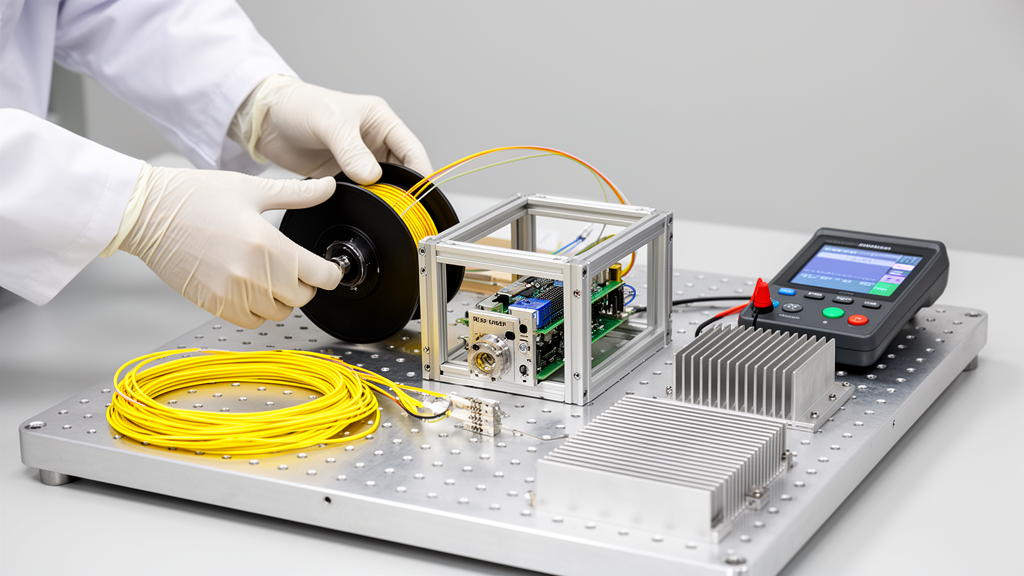
Physicists have built a ytterbium-doped fiber amplifier (YDFA) that produces a continuous output of more than 10 watts of 1064 nm laser light, using a deliberately simple construction designed to be repaired quickly on site. The device, described in a research article published on 4 April 2024 in EPJ Techniques and Instrumentation, was developed by Naoya Ozawa, Keisuke Nakamura and Yasuhiro Sakemi with a specific application in mind: high-power laser experiments carried out inside accelerator facilities, where radiation can quietly degrade optical components and where losing a single experimental run can cost months of preparation.
The central idea is not a record-breaking output power or an exotic new gain medium. Instead, the team pursued what they describe as a modest performance target with a system configured to be as simple as possible. Commercial high-power laser sources, when deployed near a beamline, typically have to be shipped back to the manufacturer for repair, an inefficient and costly process when experimental beam time is limited and scheduled months in advance. By assembling the amplifier themselves from readily available components, the researchers can stock spare parts beforehand and rapidly replace damaged elements, and they can customize the configuration whenever the need arises.
The motivation comes from a genuine dilemma in accelerator-based laser experiments. Optoelectric components, including semiconductor lasers, are suspected to be vulnerable to radiation damage. To protect them, commercial laser sources are often placed far from the beamline in a separate room, with the light delivered either through free space or through optical fiber. But free-space transport can be a safety problem when an experimental hall is shared among multiple users, or unpractical given the hall’s layout, making optical fibers the only viable option. Long optical fibers, however, cannot support the high powers needed for optical dipole traps because of stimulated Brillouin scattering (SBS), so high-power laser sources, including optical amplifiers, must be placed close to the beamline after all. The team’s answer to this dilemma was to build their own YDFA rather than buy a commercial product.
The specific application driving the design is the optical trapping of short-lived isotopes. The researchers plan to trap francium-210 atoms in an optical lattice, a system expected to serve as a probe for searches of fundamental symmetry violation. Because francium has no stable isotope, it must be produced by nuclear reactions at the RIKEN Nishina Center accelerator facility. In a related study at Tohoku University, the typical neutron flux near the beamline during francium production was estimated at the order of 10^6 per square centimeter per second, assuming neutrons monochromatic at 1 MeV energy. According to a past study on neutron radiation effects on Yb-doped fibers, output power degrades by around 10 percent after a total fluence of 10^14 per square centimeter of 1 MeV-equivalent monochromatic neutrons. Assuming the total dose determines the degree of attenuation, the team expects their YDFA to decay in output power by about 1 percent in roughly four months. Since gamma rays and radiation from other users’ experiments could add further effects, the ability to repair degraded components quickly, with minimal loss of time and cost, is crucial.
The performance requirements were set by the physics of the planned trap. To trap francium atoms while suppressing the photon scattering rate so that the trap lifetime does not fall below the desired interaction time of about 5 seconds, the team aimed for a 1064 nm trap of 2 watts per axis focused to a 1/e^2 radius of 60 micrometers. This corresponds to a trap potential depth of approximately 0.2 mK and a photon scattering rate of 0.2 Hz. Estimating that roughly half the produced power could be lost passing through optical components between the amplifier and the vacuum chamber, the required power was set at a minimum of about 4 watts. Because the amplification stage uses a large-mode-area fiber whose output may contain contributions from higher-order transverse modes, and because the beam is recoupled into a single-mode fiber for transport to the vacuum chamber, the team adopted a practical beam-quality criterion: at least 50 percent coupling efficiency of the amplifier output into a single-mode fiber.
The physical construction reflects the simplicity-first philosophy. Continuous-wave, linearly polarized 1064 nm seed light comes from a Coherent Mephisto 500NE laser with up to 500 mW of power, coupled into a single-mode polarization-maintaining fiber and passed through a fiber isolator. Pump light at 976 nm is produced by a Coherent DILAS laser diode with up to 65 W of power and launched directly into a multimode fiber; based on their simulations, the team found a pump power of 20 W sufficient for the planned use. The two beams are coupled into the core and inner cladding of a passive double-cladded fiber at a combiner, which is directly spliced to an ytterbium-doped active fiber, itself connected to a pigtail fiber collimator. The fiber tip and collimator are anti-reflection coated with a nominal return loss of 60 dB, and the nominal output beam has a 1/e^2 diameter of 2.5 mm with a full divergence angle of 0.6 mrad. All connections were made by fusion splicing with a Fujikura FSM-100+ splicer, with splice points protected by sleeves except at the passive and active fibers, where the high refractive index causes light to leak; these points were instead recoated with a Fujikura FSR-05 recoater where possible. The components from the in-line isolator to the second splice point of the active fiber are housed in a custom-made aluminum box for protection against accidental breaking and dust.
A key design parameter, the length of the ytterbium-doped fiber, was optimized through numerical simulation. The team formulated population rate equations and power propagation equations based on a published model, introducing the ytterbium doping density per volume as a fiber-specific parameter set to 1.1 x 10^26 per cubic meter based on manufacturer information, a value they found greatly affects the result. They also introduced three dimensionless parameters accounting for the effective coupling efficiencies of the seed and pump beams into the active fiber and for the fraction of amplified light reflected at the output end. The equations were integrated with the Euler method using C++ code with the ROOT library, with a fiber length step of 2 mm and a time step of 0.3 ms, re-tuned whenever the calculation diverged. The simulation showed that the pump is absorbed and the seed enhanced as both propagate along the fiber; at approximately 5 meters the pump is almost completely absorbed and the seed enhancement saturates. Forward and backward amplified spontaneous emission (ASE) were calculated but contribute negligibly at the chosen wavelengths. The fiber length was set to 4.7 meters, maximizing amplification gain while minimizing the risk of SBS, which becomes non-negligible when the fiber is too long. With a pump of approximately 13 W, the simulation predicted the signal would be amplified to more than 10 W, with a signal gain of 22 dB, a signal-to-noise ratio of 57 dB, and a calculated noise figure of 5.9 dB assuming a noise-free seed.
Experimental characterization confirmed the design. With the seed power fixed at 0.2 W, the output power was measured for various pump powers using a power meter, and the results showed the amplifier capable of producing over 10 W, consistent with the simulation. The measured trend reasonably matched the numerical curve, which the team says indicates their relatively simple model adequately represents the device and that SBS contributes nothing significant at this power level. The coupling efficiency of the seed light was determined experimentally to be about 0.326, while the pump coupling was found to be around 80 percent despite being spliced directly to the active fiber; the team suspects slight differences in core diameter and numerical aperture, as well as the quality of the fusion splicing and recoating, as origins of this loss.
Spectral and mode measurements completed the picture. The output spectrum, sampled by picking off roughly 3 percent of the beam with a glass plate and feeding an optical spectrum analyzer, showed that ASE has a negligibly small contribution to the output beam, as the simulation predicted. A large peak around 970 nm, differing from the 976 nm pump wavelength, was confirmed to originate from the pump laser source itself and does not appear to contribute significantly to the amplification or to gain loss of the 1064 nm seed. The spatial mode was not explicitly measured because of the high power, but the team confirmed that approximately 50 percent of the beam can be coupled into a single-mode polarization-maintaining fiber when transmitted through an optical isolator, meeting their self-imposed beam-quality criterion.
The conclusion, the authors write, is a YDFA capable of producing a continuous-wave 1064 nm laser of over 10 W, sufficient to form an optical lattice trap with a depth equivalent to more than 0.2 mK. Because the device is self-constructed with fiber splicing techniques, rapid maintenance and flexible customization become possible, offering an example of a high-power laser source suited to harsh environments such as radiation-controlled areas. The team notes that studies on improving radiation hardness for optoelectronic devices used in high-energy colliders are also under way elsewhere, and that their strategy allows installed components to be easily replaced with devices less vulnerable to radiation. As laser cooling and trapping techniques remain powerful tools for precision measurements, including the electron electric dipole moment search using francium atoms, the authors expect their work to benefit such schemes. The data supporting the findings are available from the corresponding author upon reasonable request.
Subject of Research: A simple, repairable ytterbium-doped fiber amplifier for high-power laser use in radiation environments
Article Title: Conception, modelling, and characterization of a fiber amplifier with a simple and easy-to-repair configuration intended for the use in harsh environments
Article References: Ozawa, N., Nakamura, K., & Sakemi, Y. (2024). Conception, modelling, and characterization of a fiber amplifier with a simple and easy-to-repair configuration intended for the use in harsh environments. EPJ Techniques and Instrumentation, 11(1), Article 3. https://doi.org/10.1140/epjti/s40485-024-00111-1
Image Credits: AI Generated
DOI: 10.1140/epjti/s40485-024-00111-1
Keywords: fiber amplifier, ytterbium-doped fiber, laser physics, radiation hardness, accelerator facilities, optical trapping, francium, optical lattice, stimulated Brillouin scattering, fusion splicing, numerical simulation, 1064 nm laser
News Source: Denise Maddox. (October 29, 2026). Simple, Repairable Yb-Doped Fiber Amplifier Delivers Over 10 Watts for Harsh Radiation Environments. Scienmag.



