• HOME
  • NEWS
  • EXPLORE
    • CAREER
      • Companies
      • Jobs
    • EVENTS
    • iGEM
      • News
      • Team
    • PHOTOS
    • VIDEO
    • WIKI
  • BLOG
  • COMMUNITY
    • FACEBOOK
    • INSTAGRAM
    • TWITTER
Monday, June 29, 2026
BIOENGINEER.ORG
No Result
View All Result
  • Login
  • HOME
  • NEWS
  • EXPLORE
    • CAREER
      • Companies
      • Jobs
        • Lecturer
        • PhD Studentship
        • Postdoc
        • Research Assistant
    • EVENTS
    • iGEM
      • News
      • Team
    • PHOTOS
    • VIDEO
    • WIKI
  • BLOG
  • COMMUNITY
    • FACEBOOK
    • INSTAGRAM
    • TWITTER
  • HOME
  • NEWS
  • EXPLORE
    • CAREER
      • Companies
      • Jobs
        • Lecturer
        • PhD Studentship
        • Postdoc
        • Research Assistant
    • EVENTS
    • iGEM
      • News
      • Team
    • PHOTOS
    • VIDEO
    • WIKI
  • BLOG
  • COMMUNITY
    • FACEBOOK
    • INSTAGRAM
    • TWITTER
No Result
View All Result
Bioengineer.org
No Result
View All Result
Home NEWS Science News Chemistry

Simple is best? Simple and universal design for fuel cell electrolyte

Bioengineer by Bioengineer
June 18, 2020
in Chemistry
Reading Time: 2 mins read
0
IMAGE
Share on FacebookShare on TwitterShare on LinkedinShare on RedditShare on Telegram

IMAGE

Credit: JAIST

Researchers at Japan Advanced Institute of Science and Technology (JAIST) and Dalian Institute of Chemical Physics, Chinese Academy of Sciences have successfully established a universal synthetic design using porous organic polymers (POPs) for fuel cell electrolyte, according to an Editor’s choice hot article published in the journal Materials Chemistry Frontiers.

Development of new materials for cost-effective technologies is urgent and necessary to bring about an environmentally sustainable society. Polymer electrolyte fuel cells have high expectations for a clean energy system that can support environmental protection. They must be able to split a molecule of hydrogen into positively charged protons and negatively charged electrons. For this purpose, polymeric materials with high proton conductivity are needed. Electrons do not pass through the material, only protons pass through, so we can be extracted as electricity.

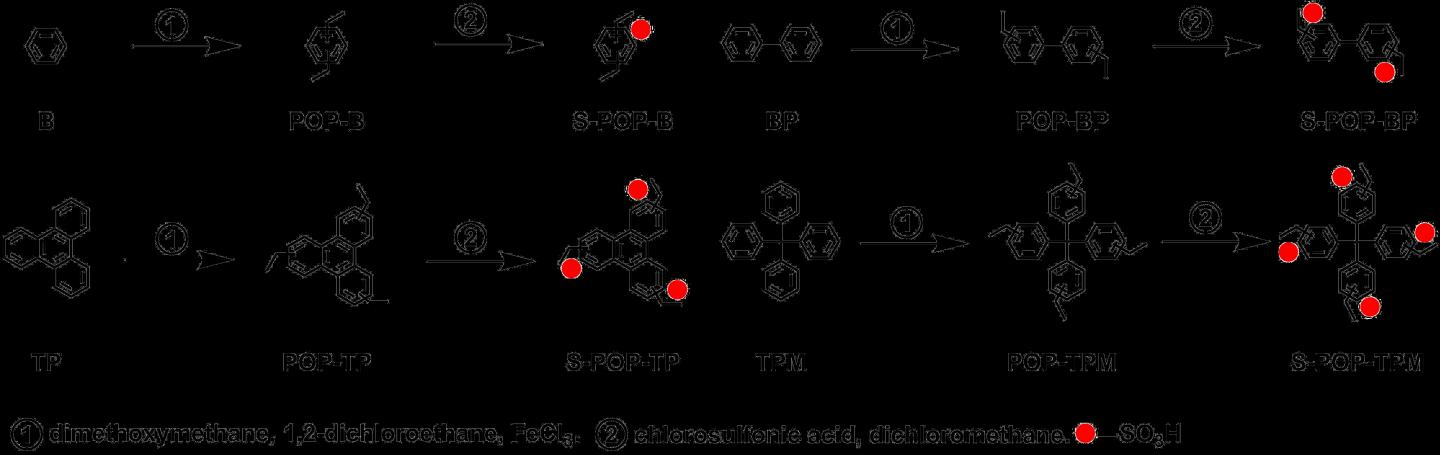
Research has shown simple, universal, and cost-effective synthetic strategy for gaining highly proton-conductive POPs as shown in Scheme 1. They show excellent proton conductivity of 10-2 to 10-1 S cm-1.

In the research so far, there were problems that the synthetic method using POPs was complicated and the skeleton was limited. In order to establish the synthetic strategy universal for practical applications, we were able to try various skeletons as POPs and established the synthetic method applicable to almost all aromatic-based materials, says materials scientist Yuki Nagao of JAIST, who has been researching proton-conducting materials for many years.

They divided the synthetic steps into two steps. First, a porous organic polymer was synthesized. Second, a post-sulfonation strategy was adopted which then introduced sulfonic acid groups through the pores. The catalyst used during synthesis causes deterioration of the material during fuel cell operation, but it could also be removed by using the pores. A remarkable conductivity of S-POP-TPM (Scheme 1) was recorded on 2.7 × 10⁻² and 1.0 × 10⁻¹ S cm-1 under 25 and 80 °C at 95% RH, respectively.

“Results of this study indicate that the structure of sulfonated POPs offers a simple and universal means for evolving structural design for highly proton-conductive materials.,” explains Zhongping Li, who is the first author of this work. A step forward towards a hydrogen society.

###

Media Contact
Yuki Nagao
[email protected]

Related Journal Article

http://dx.doi.org/10.1039/D0QM00276C

Tags: Chemistry/Physics/Materials SciencesEnergy/Fuel (non-petroleum)Polymer Chemistry
Share12Tweet8Share2ShareShareShare2

Related Posts

AI and Physics Collaborate to Design Advanced Hydrogen Storage Materials

June 25, 2026

International Team Including Dresden Scientists Develops Novel Designer Proteins for Advanced Study of Living Tissue

June 25, 2026

New Study Uncovers Key Factors Driving Water Chemistry in Nanoscale Environments

June 25, 2026

Plasma Technology Extends Catalyst Lifespan in Hydrogen Production

June 24, 2026
Please login to join discussion

POPULAR NEWS

  • Saying Goodbye to PGY-6: Pediatric Fellowship Realities

    103 shares
    Share 41 Tweet 26
  • Multi-Hospital Study Reveals Long Covid Burden Is Twice as High as Current Estimates

    92 shares
    Share 36 Tweet 23
  • Detection of EDCs in Breast Milk and Infant Urine Up to Six Months Highlights Early Exposure Risks

    77 shares
    Share 31 Tweet 19
  • New Drug Candidate Developed at McMaster Shows Potential for Treating Brain Cancer

    58 shares
    Share 23 Tweet 15

About

We bring you the latest biotechnology news from best research centers and universities around the world. Check our website.

Follow us

Recent News

Tracking Lanthanide-Labeled Microplastics in Plants

POSTECH Researchers Slash Cost of Reconstituted Cell-Free Systems by 95%

AI and Physics Collaborate to Design Advanced Hydrogen Storage Materials

Subscribe to Blog via Email

Success! An email was just sent to confirm your subscription. Please find the email now and click 'Confirm' to start subscribing.

Join 82 other subscribers
  • Contact Us

Bioengineer.org © Copyright 2023 All Rights Reserved.

Welcome Back!

Login to your account below

Forgotten Password?

Retrieve your password

Please enter your username or email address to reset your password.

Log In
No Result
View All Result
  • Homepages
    • Home Page 1
    • Home Page 2
  • News
  • National
  • Business
  • Health
  • Lifestyle
  • Science

Bioengineer.org © Copyright 2023 All Rights Reserved.