• HOME
  • NEWS
  • EXPLORE
    • CAREER
      • Companies
      • Jobs
    • EVENTS
    • iGEM
      • News
      • Team
    • PHOTOS
    • VIDEO
    • WIKI
  • BLOG
  • COMMUNITY
    • FACEBOOK
    • INSTAGRAM
    • TWITTER
Saturday, July 11, 2026
BIOENGINEER.ORG
No Result
View All Result
  • Login
  • HOME
  • NEWS
  • EXPLORE
    • CAREER
      • Companies
      • Jobs
        • Lecturer
        • PhD Studentship
        • Postdoc
        • Research Assistant
    • EVENTS
    • iGEM
      • News
      • Team
    • PHOTOS
    • VIDEO
    • WIKI
  • BLOG
  • COMMUNITY
    • FACEBOOK
    • INSTAGRAM
    • TWITTER
  • HOME
  • NEWS
  • EXPLORE
    • CAREER
      • Companies
      • Jobs
        • Lecturer
        • PhD Studentship
        • Postdoc
        • Research Assistant
    • EVENTS
    • iGEM
      • News
      • Team
    • PHOTOS
    • VIDEO
    • WIKI
  • BLOG
  • COMMUNITY
    • FACEBOOK
    • INSTAGRAM
    • TWITTER
No Result
View All Result
Bioengineer.org
No Result
View All Result
Home NEWS Science News Chemistry

Silicon with a two-dimensional structure

Bioengineer by Bioengineer
July 22, 2021
in Chemistry
Reading Time: 3 mins read
0
IMAGE
Share on FacebookShare on TwitterShare on LinkedinShare on RedditShare on Telegram

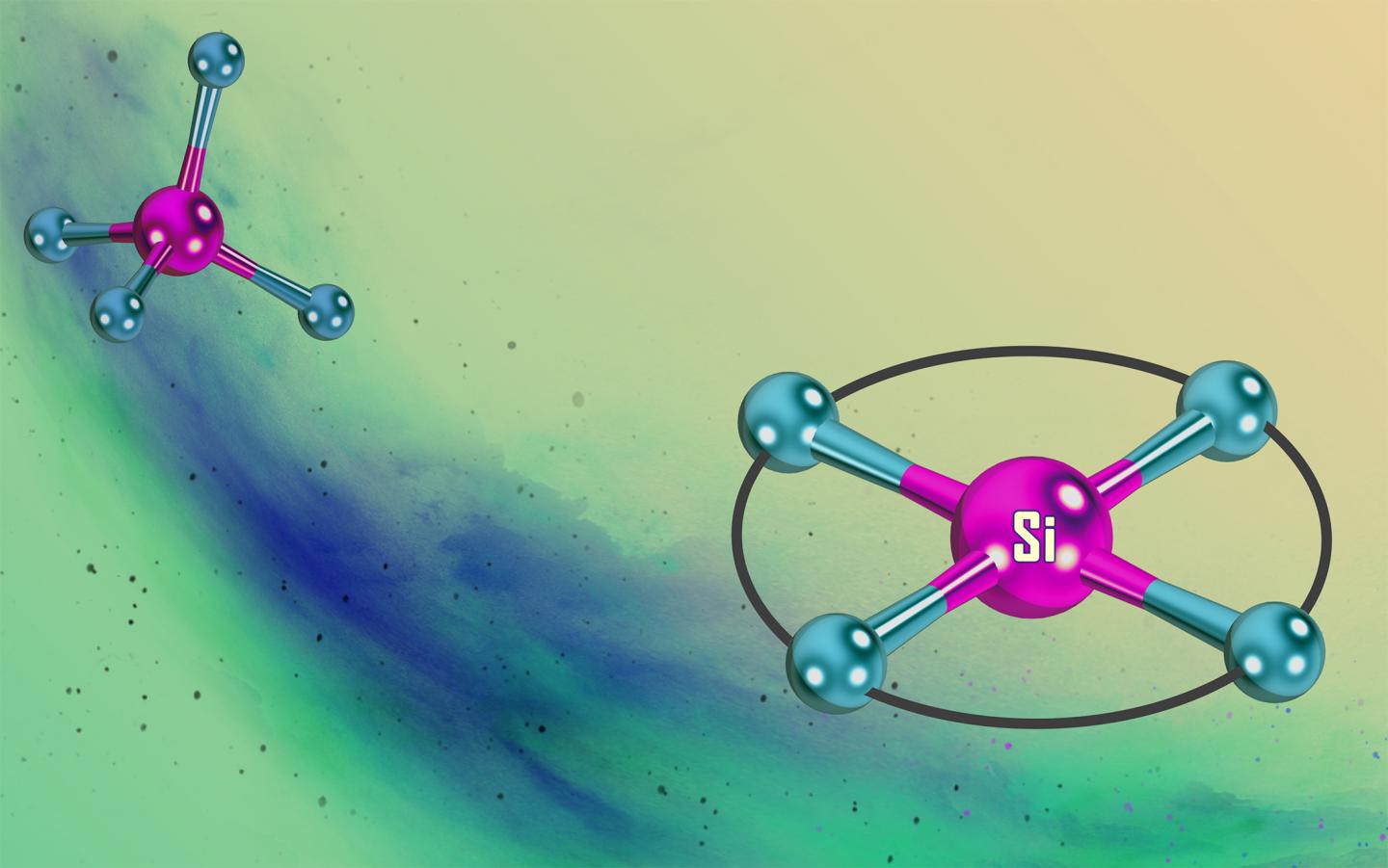
Heidelberg chemists succeed in producing synthesis and complete characterisation for the first time
IMAGE

Credit: Illustration: Ebner/Greb (Heidelberg)

Silicon, a semi-metal, bonds in its natural form with four other elements and its three-dimensional structure takes the form of a tetrahedron. For a long time, it seemed impossible to achieve the synthesis and characterisation of a two-dimensional equivalent – geometrically speaking, a square. Now scientists from the field of Inorganic Chemistry at Heidelberg University have succeeded in producing a crystalline complex with such a configuration. PD Dr Lutz Greb from the Institute of Inorganic Chemistry underlines that it has surprising physical and chemical properties and, in the field of molecular chemistry, will open up new approaches to using the second most abundant element in the Earth’s crust for catalysis and materials research.

As a classical semi-metal, silicon possesses properties of both metals and non-metals, and belongs to the carbon group on the periodic table. Like carbon, silicon bonds with four elements. Its three-dimensional structure then corresponds to a tetrahedron, a body with four sides. Due to the high stability of a tetrahedron, other structures are not known in natural silicon with four bonds – silicon(IV) for short. Considered purely geometrically, the two-dimensional equivalent to a tetrahedron is a square. These configurations are already known for carbon but, according to Dr Greb, a square-planar structure has not yet been produced in the field of silicon(IV) chemistry, even after over 40 years of intensive effort.

Dr Greb’s working group has succeeded for the first time in synthesising and completely characterising a square-planar silicon(IV) species. It was possible to show this with the aid of X-ray crystallography. The scientists grew a monocrystal which they irradiated with a finely focused beam of X-rays. The diffraction of the X-rays when encountering the atoms of the monocrystal led to an unmistakable pattern from which it is possible to calculate the position of the atom nuclei. This measurement enabled the researchers to show that they were dealing with molecules with square-planar silicon(IV). Further studies with spectroscopic methods supported this configuration. It displays physical and chemical properties that the researchers did not expect, e.g. colour in a naturally colourless class of substances.

“Synthesising this configuration from the components we chose is comparatively simple once you have understood the key conditions,” explains Dr Fabian Ebner, who is meanwhile a postdoctoral researcher at the Institute of Inorganic Chemistry. It surprised the scientists, however, that the square-planar silicon(IV) molecule constitutes a stable, isolable compound at all. “Due to the high reactivity, there are many conceivable ways of decomposition. Still, we have always believed that it is possible to isolate this compound,” Dr Greb emphasises.

Lutz Greb received a Starting Grant from the European Research Council (ERC) for his research in the area of structurally constrained main-group elements. The Foundation of German Business supported Fabian Ebner’s work. The research results were published in the journal Chem.

###

Media Contact
Lutz Greb
[email protected]

Original Source

https://www.uni-heidelberg.de/en/newsroom/silicon-with-a-two-dimensional-structure

Related Journal Article

http://dx.doi.org/10.1016/j.chempr.2021.05.002

Tags: Chemistry/Physics/Materials Sciences
Share13Tweet8Share2ShareShareShare2

Related Posts

Blue Light and Chemistry Simplify Complex Drug Production Steps

Blue Light and Chemistry Simplify Complex Drug Production Steps

July 10, 2026
New Discovery Promises Brighter, More Energy-Efficient Digital Displays

New Discovery Promises Brighter, More Energy-Efficient Digital Displays

July 10, 2026

New Crystalline 3D Frameworks Linked by Spiroborates Developed

July 10, 2026

IBEC Joins Major European Grant on Living Matter Physics

July 10, 2026
Please login to join discussion

POPULAR NEWS

  • Detection of EDCs in Breast Milk and Infant Urine Up to Six Months Highlights Early Exposure Risks

    77 shares
    Share 31 Tweet 19
  • New Drug Candidate Developed at McMaster Shows Potential for Treating Brain Cancer

    58 shares
    Share 23 Tweet 15
  • KTU Researchers Explore Ultrasound’s Role in Enhancing Blood Flow Beyond Diagnostics

    53 shares
    Share 21 Tweet 13
  • 高齢者の骨粗鬆症治療の持続性比較

    51 shares
    Share 20 Tweet 13

About

We bring you the latest biotechnology news from best research centers and universities around the world. Check our website.

Follow us

Recent News

Transient Simulation Advances in Bioresorbable Flexible Electronic Circuits

Evaluating Geriatric Assessment and Interventions for Prostate Cancer Patients on ADT

Single-Cell Multi-Omics Reveals Cancer-Associated Fibroblast Programs in Breast Cancer

Subscribe to Blog via Email

Enter your email address to subscribe to this blog and receive notifications of new posts by email.

Join 85 other subscribers
  • Contact Us

Bioengineer.org © Copyright 2023 All Rights Reserved.

Welcome Back!

Login to your account below

Forgotten Password?

Retrieve your password

Please enter your username or email address to reset your password.

Log In
No Result
View All Result
  • Homepages
    • Home Page 1
    • Home Page 2
  • News
  • National
  • Business
  • Health
  • Lifestyle
  • Science

Bioengineer.org © Copyright 2023 All Rights Reserved.