A cellular signalling cascade balances information transmission against energy consumption
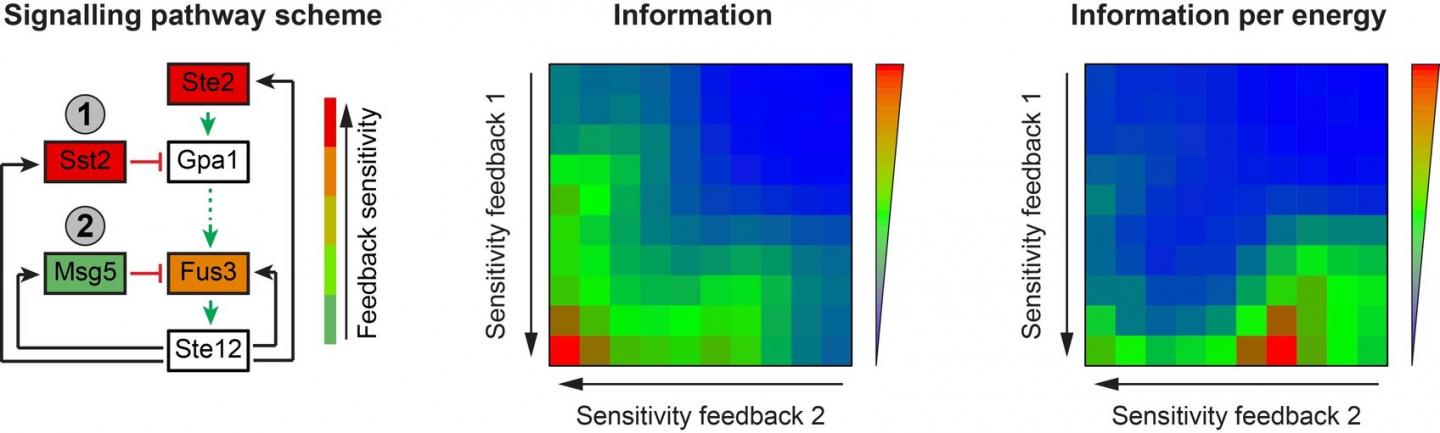
Credit: Max Planck Institute for Terrestrial Microbiology/Sourjik
Cellular signal transmission is not only optimized for precision – it also includes a cost cap. The relationship between information and energy, a concept well established in physics and engineering, is likely to fundamentally shape cellular signalling networks. One of the questions addressed by researchers at the Max Planck Institute for Terrestrial Microbiology, headed by biophysicist Victor Sourjik, is: What enables reliable transmission of signals in the “noisy” cellular environment? The research team is studying signal transmission in baker’s yeast (Saccharomyces cerevisiae), combining information theoretical approaches with quantitative experiments.
Precise signaling is crucial for the fitness of every living organism: whether during development or while communicating with a possible mating partner, only accurate transmission of received signals enables cells to trigger appropriate responses. In biological systems, random fluctuations of signals always lead to background noise, which can impede cell communication. Organisms must therefore have developed strategies to improve the accuracy of signal transmission in the presence of such interference. However, little is yet known about how noise suppression is achieved in cellular networks.
The pheromone signalling pathway of baker’s yeast belongs to a class of MAPK (mitogen-activated protein kinase) signalling pathways, which in eukaryotes commonly play a key role in the transmission and translation of extracellular stimuli into intracellular responses such as cell differentiation, proliferation or stress responses.
That the pheromone signalling pathway of yeast contains negative feedback regulations could be seen as clear indication of selection for increased accuracy. Surprisingly, however, both theoretical and experimental analyses of the signalling pathway showed that its accuracy could be easily further improved by increasing the sensitivity of one of the negative feedbacks. So why this discrepancy between the potentially more efficient hypothetical and the natural design? In other words, why didn’t yeast naturally optimize the system this way?
Costs versus benefits
The answer seems to lie in the cellular economics. The discrepancy disappears when the energy investment in the operation of the signalling pathway is also considered. “We were able to show that the core of the MAPK signalling pathway, the phosphorylation cycle, has measurable fitness costs. When these are taken into account, and the accuracy of the signal transduction is weighed against the energetic costs of the signalling pathway operation, the naturally observed design appears optimal,” explains Alexander Anders, first author of the current publication.
“Here we observe a relation between information and energy, analogous to what is well established in physics and engineering sciences.” says Victor Sourjik. “In biology, little attention has been paid to this interplay so far. Our work suggests that cost-benefit trade-off in information transfer must have been important in the evolution of cellular signalling systems. This helps us to better understand the evolutionary optimization of cellular signalling networks.” How biology has solved this fundamental dilemma of information costs in other cases remains to be elucidated.
###
Original Publication
Anders, A., Ghosh, B., Glatter, T. et al. Design of a MAPK signalling cascade balances energetic cost versus accuracy of information transmission.
Nat Commun 11, 3494 (2020)
Media Contact
Dr. Virginia Geisel
[email protected]
Original Source
https:/
Related Journal Article
http://dx.