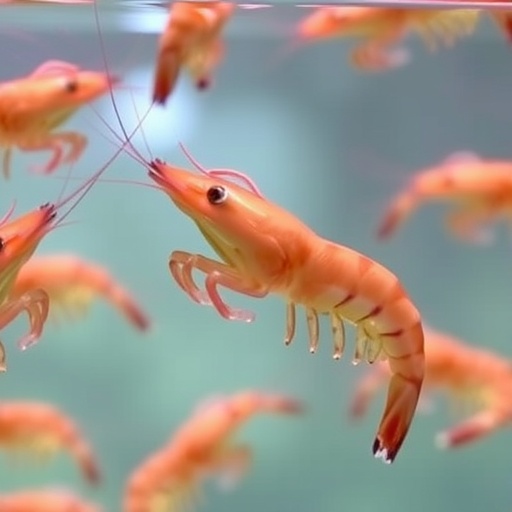
Researchers at Okayama University of Science have achieved a breakthrough in space aquaculture by successfully observing the feeding behavior of juvenile shrimp under simulated microgravity conditions. This advance could pave the way for sustainable food production systems on the Moon and Mars, essential for long-term human space exploration.
The hallmark of this study lies in the development of a novel high-speed clinostat—a device that simulates microgravity by rapidly rotating specimens around two perpendicular axes. Unlike traditional clinostats rotating at about 20 rpm, which allow aquatic animals to regain normal posture and thus negate microgravity effects, this new design spins swiftly enough to prevent shrimp from righting themselves. This innovation enabled unprecedented long-duration observation of shrimp feeding behaviors in a microgravity analog environment.
Transporting fully grown fish to extraterrestrial colonies is impractical, so juvenile fish, larvae, or eggs must be cultured in space. However, uncertainties regarding their ability to thrive and feed properly without Earth’s gravity have posed significant challenges. The research group, comprising life science experts and aquaculture specialists, sought to address these questions by creating conditions mimicking space’s microgravity on Earth.
Previous microgravity simulation methods—such as parabolic flights, drop towers, and magnetic levitation—proved unsuitable for extended experiments or failed in practical application with live aquatic animals. The high-speed clinostat overcame these issues, allowing realistic and sustained microgravity simulation for freely moving aquatic species.
After rigorous testing and refinement, the team successfully recorded live footage of juvenile shrimp feeding under simulated microgravity. Subsequent genetic analyses, including Gene Ontology assessments, revealed molecular changes potentially induced by microgravity exposure. To strengthen their findings, the team expanded experiments to include Artemia, small crustaceans that grow rapidly and tolerate group culturing. Artemia feeding on microalgae—Tetraselmis—was confirmed to continue unabated even under these conditions.
All experiments utilized “Third Water,” a proprietary aquatic medium developed by the university, optimized to support aquatic life in space-like environments. This innovative approach aims to sustain closed-loop aquaculture systems suitable for space habitats.
Looking ahead, the team is engineering an aquaculture tank sized for potential installation on the International Space Station. Their goal is a fully closed recirculating system that can maintain aquatic life for over 100 days without water exchange. Remote-controlled automatic feeders and AI-powered organism recognition systems are also in development to automate and enhance aquaculture operations in space.
These breakthroughs represent critical steps toward realizing the vision of space-based aquaculture, promising to enhance future astronauts’ nutrition and well-being on long-duration planetary missions. As humanity eyes extended stays beyond Earth, innovations like these will be indispensable to sustainable life support.
Article Title: In Situ Observation of Shrimp Feeding Process Under Microgravity Environment
News Publication Date: June 2026
Web References: http://dx.doi.org/10.1007/s12217-026-10262-3
Image Credits: Okayama University of Science
Keywords: Space aquaculture, microgravity simulation, clinostat, juvenile shrimp, Artemia, closed-loop aquaculture, space food production
Tags: advanced microgravity research methodschallenges of extraterrestrial aquaculturehigh-speed clinostat technologyimplications for human space explorationjuvenile shrimp feeding behaviorlong-duration microgravity experimentsmicrogravity effects on aquatic animalsmicrogravity simulationsimulated microgravity environmentSpace aquaculturespace farming for Moon and Marssustainable food production in space