


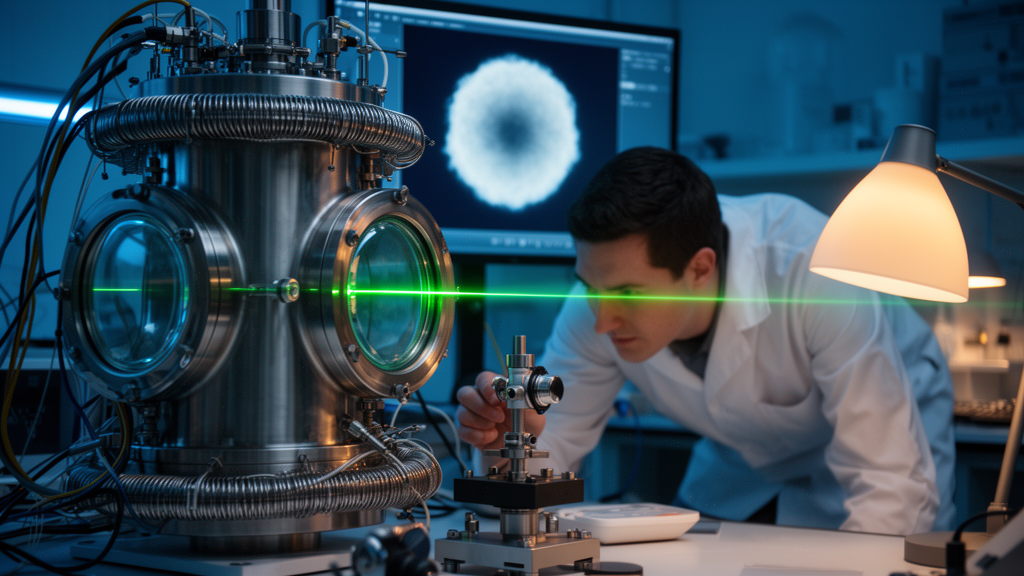
Physicists who trap clouds of electrons in Penning-Malmberg traps have long relied on a simple trick to take their temperature: lower one of the confining barriers, let the hottest particles boil off, and read the temperature out of the pattern of escapes. But the coldest plasmas, the ones needed for antihydrogen trapping, have been slipping below the resolution of that standard diagnostic. A new analysis now shows that the limit is not an experimental failing but a fundamental one, imposed by the discrete, random nature of the escaping particles themselves, and it quantifies exactly where that floor lies.
Their central result: shot noise caps the measurable temperature at roughly 3 K for a plasma 1 cm long, and reaching 10 percent accuracy requires about 100 particle counts. The bound scales inversely with plasma length, so longer plasmas can be probed at lower temperatures.
The diagnostic they analyzed is the workhorse of the field. One of the electrodes confining the plasma along the magnetic field axis is slowly ramped down, and particles whose axial kinetic energy plus electrostatic self-potential exceeds the barrier voltage escape and are counted by a detector, typically a microchannel plate paired with a silicon photomultiplier that resolves individual escape times. Assuming the particles follow a Boltzmann distribution, the escape rate falls off exponentially with the barrier voltage, and the slope of that exponential on a logarithmic plot yields the temperature.
The catch is that the exponential behavior does not last. As the most energetic particles leave, they drain from the radial center of the plasma, where the self-potential is highest, and the changing charge distribution flattens the barrier seen by the remaining particles. The escape rate then saturates and bends away from the straight line. For typical parameters, the clean exponential regime corresponds to the escape of only about 5 percent of a Debye cylinder, the column of plasma with a radius equal to the Debye length running the length of the trap. For plasmas colder than about 5 K, that region contains fewer than 50 particles, which makes the fit intrinsically noisy. Deciding where the linear regime begins and ends is also ambiguous, and the cutoffs are often chosen by hand, introducing human error.
The researchers' answer was to stop throwing data away. Building on a continuum model developed by Beck in 1990, which solves a set of coupled Poisson-Boltzmann-like equations to produce the full escape curve through the linear, bend-over and saturated regimes, they constructed a maximum likelihood estimator that works on single-count data. The method assumes the electron escapes follow an inhomogeneous Poisson process whose expected counts in each voltage bin come from Beck’s model, then minimizes the negative log likelihood over the plasma parameters using a Nelder-Mead algorithm. Because the model captures the bend-over regime, the fit can use roughly a quarter of a Debye cylinder of escapes, about five times more data than the conventional straight-line fitter exploits.
To test the algorithm, the researchers generated synthetic escape data with a Monte Carlo simulation consistent with Beck’s model before the continuum limit. Particles were initialized with random radial positions and Maxwellian velocities, and the highest-energy particle was repeatedly removed with its escape voltage recorded, recalculating the self-potential after each escape. A slight negative bias appears at the lowest temperatures, but at the 3 K-cm point its magnitude, around 2 percent, is dwarfed by the statistical error.
The simulations also showed the fitter is robust. Varying the plasma density and radius over a range of values produced no significant differences in the error curves, because those parameters mostly shift where escapes begin rather than change the shape of the escape curve. The team also examined how much data to include: fitting only the linear regime reached 10 percent error only at about 13 K-cm, while using a full Debye cylinder pushed the threshold down to about 1.5 K-cm, though the improvement per additional particle beyond the linear regime diminishes as the escape rate saturates. Bin width mattered little; a histogram bin size twenty times the minimum escape-voltage spacing introduced only a 1.1 percent deviation in the root mean square compared with a much finer binning.
External noise, such as false counts from cosmic rays or detector oversensitivity, was modeled as a homogeneous Poisson process added to the signal. The researchers augmented the likelihood function with a term for this noise and found that the total estimator error agreed well with the quadrature sum of the intrinsic shot-noise error and the external contribution. With an advanced microchannel plate and silicon photomultiplier system, this external noise can be made essentially negligible, though other effects, including persistent high-energy tail particles from imperfect thermalization and variability in detector response, are not captured by the additive noise model and remain for future study.
The practical implications reach into experiments that matter. Low-temperature nonneutral plasmas are the starting point for antihydrogen formation, where antiprotons and positrons must be merged cold enough to bind, and realizing such temperatures has demanded experimental resourcefulness against electrode noise and radiation propagating down the vacuum chamber. As techniques have improved and plasmas have been cooled to near the temperature of the electrodes, the ability to measure those temperatures robustly, and to quantify the uncertainty of the measurement, has become critical. The new algorithm converges in at most about 10 seconds on a 2015 laptop for 500 data counts, fast enough, the authors argue, for a live experimental pipeline, and documented code is publicly available.
The authors are careful about the limits of their analysis. The model assumes the plasma stays azimuthally symmetric, that the plasma length is constant in time, and that effects such as the change in the longitudinal potential and plasma length as more particles escape, along with variations of the barrier voltage with radius, are not included; these may cause systematic biases that need further exploration. Diocotron instabilities, which become more likely as more particles are extracted and can cause chaotic escapes not captured by the model, are handled conservatively by restricting the fit to the first quarter of a Debye cylinder. Even so, the temperatures resolvable by the new algorithm are significantly smaller than those achieved in current experiments, meaning the diagnostic is ready for the coldest plasmas experimentalists can produce, and the 3 K floor for a centimeter-scale plasma now stands as a quantified benchmark for how low the standard measurement can go.
Subject of Research: A maximum likelihood temperature diagnostic for nonneutral plasmas in Penning-Malmberg traps and its shot-noise-imposed lower temperature limit
Article Title: Shot-noise-induced lower temperature limit of the nonneutral plasma parallel temperature diagnostic
Article References: Zhong, A., Fajans, J., & Wurtele, J. S. (2024). Shot-noise-induced lower temperature limit of the nonneutral plasma parallel temperature diagnostic. EPJ Techniques and Instrumentation, 11(1), Article 6. https://doi.org/10.1140/epjti/s40485-024-00112-0
Image Credits: AI Generated
DOI: 10.1140/epjti/s40485-024-00112-0
Keywords: nonneutral plasma, Penning-Malmberg trap, temperature diagnostic, shot noise, maximum likelihood estimation, antihydrogen, Monte Carlo simulation, Debye cylinder, diocotron instability, silicon photomultiplier, evaporative cooling, statistical uncertainty
News Source: Denise Maddox. (October 29, 2026). Shot Noise Sets a Three-Kelvin Floor for Measuring Ultracold Plasma Temperatures. Scienmag.



